Uniswap Takes Over Decentralized Trading of Tokenized Real-World Assets
Key Takeaways
- •Uniswap has carried more than 50% of all decentralized exchange RWA spot trading volume since the end of August and recently announced its share reached 60%.
- •The rStocks integration by RealityFi brought over 1,700 tokenized assets covering 95% of major US equities, backed by FINRA-registered custodians and issued under El Salvador's jurisdiction, though not directly tradable by US persons.
- •UNI climbed from the $3.24 range a month ago to $6.28 as of September 16, reaching a local peak of $7.29 on September 7 for net growth of 10.9% in 2026.
- •Approximately 1,400 wallets hold most of UNI's supply, a concentration that makes the token's fee-driven recovery vulnerable to whale selling pressure.
- •Uniswap holds $3.59 billion in total value locked, generates $14.9 million in monthly revenues, and has produced more than $182 million in fees, while its Robinhood Chain V3 deployment alone surpassed $743 million in volume.
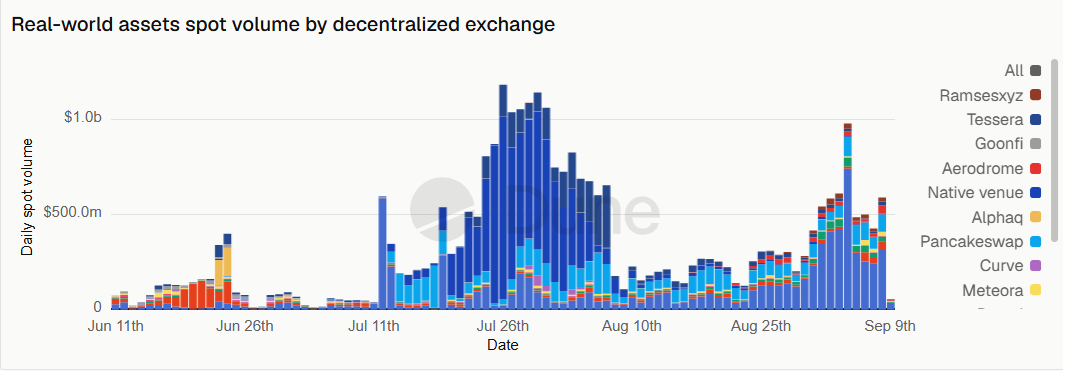
Uniswap has become the dominant venue for decentralized spot trading of tokenized real-world assets (RWAs) — traditional financial instruments such as stocks represented as tokens on public blockchains — a position it established at the end of August and has retained through September. The exchange now carries more than 50% of all RWA trading volume on decentralized exchanges (DEXs), according to Dune data.
As Cryptopolitan previously reported, RWAs are expanding their footprint across decentralized markets, with both spot trading and perpetual futures migrating toward permissionless venues. While Hyperliquid's HIP-3 framework serves as the primary venue for RWA-based perpetual futures, Uniswap has captured the spot side of the market, emerging as the leading venue for RWA swaps at the end of August. The DEX recently announced that its share had reached 60% of DEX-based RWA volume.
During peak activity, Uniswap handled more than $743 million in RWA volume as of September 4, with daily volumes later easing to around $300 million.
Beyond operating as a simple DEX, Uniswap is building toward an open financial system. Uniswap V4 and third-party deployments allow the creation of specialized markets, and Unichain is gaining influence as a trading venue in its own right.
RWA trading accelerated following the launch of a new wave of reflection tokens — meme-style assets that pass a share of trading fees back to holders — often linked to tokenized stocks, a trend that lifted volumes across existing tokenization platforms. Uniswap benefited from its connections to Robinhood Chain and its presence within the Robinhood ecosystem. The DEX also taps volume on Solana, Ethereum, Base, and other major networks, cementing its role as a staple of decentralized RWA activity, and it may be positioned to capture a shift of RWA trading away from Binance.
Uniswap introduces rTokens by RealityFi
To date, Uniswap has listed tokenized stocks from Ondo Finance and XStocks. The exchange recently added rStocks by RealityFi, a new format of tokenized assets. RealityFi has already extended its tokenized assets to the Arbitrum chain, the Morph Network ecosystem, and Bitget Wallet, a gateway to retail adoption that could also lift Uniswap usage.
The rStocks integration brings more than 1,700 new assets covering 95% of major US equities, which rank among the most in-demand assets for trading, perpetual swaps, and reflection meme tokens. The tokenized stocks are backed by FINRA-registered custodians and launched under the jurisdiction of El Salvador. They are not directly available for trading by US persons, but they remain accessible through the permissionless DEX.
UNI rises on new wave of RWA trading
UNI, Uniswap's native token, has rallied alongside the surge in RWA trading, climbing from the $3.24 range a month ago to $6.28 as of September 16, according to CoinGecko. The token reached a local peak of $7.29 on September 7, for net growth of 10.9% in 2026.
One caveat for UNI is that around 1,400 wallets hold most of the supply, according to an analysis shared on X, a concentration that breaks down the narrative of widespread retail adoption. A recovery driven by trading activity and fees could prove vulnerable to whale selling pressure.
Uniswap's resurgence ranks among biggest comebacks in the crypto space, following years of underperformance and sluggish trading. The financial infrastructure compensated for the loss of token trading by shifting to new networks and narratives.
As of September 16, the Uniswap V3 deployment on Robinhood Chain carried over $743 million in trading volume, with roughly $640 million on Ethereum V3, while Robinhood V4 grew to $278 million. Daily Uniswap volumes have expanded over the past 30 days and are approaching their highest level of the year to date, according to DeFi Llama.
Uniswap already holds $3.59 billion in total value locked (TVL), produces $14.9 million in monthly revenues, and has generated more than $182 million in fees.

