UNI Price Holds Quarterly Breakout as Tokenized-Stock DEX Volume Reaches $20.9B
Key Takeaways
- •UNI rallied from $2.35 to a quarterly high of $10.85 during the third quarter, breaking out of a descending triangle pattern that had contained the token since 2021.
- •The token traded near $9.61 on September 26, with immediate support at $9.33 and short-term resistance at $9.93 ahead of the $12.30 chart hurdle.
- •Token Terminal recorded $20.9 billion in tokenized-stock trading volume across decentralized exchanges over 30 days, with Uniswap v4 handling 40.7% and v3 another 19.4% for a combined 60.1% share.
- •Uniswap v4's share of a selected Ethereum DEX group including Curve rose to 50% from 31 in August 2025, while Uniswap v2's share dropped from 5% to below 1%.
- •The September 30 Personal Consumption Expenditures inflation report could influence volatility around UNI's established chart levels, and a break below $9.33 would expose support at $8.37.
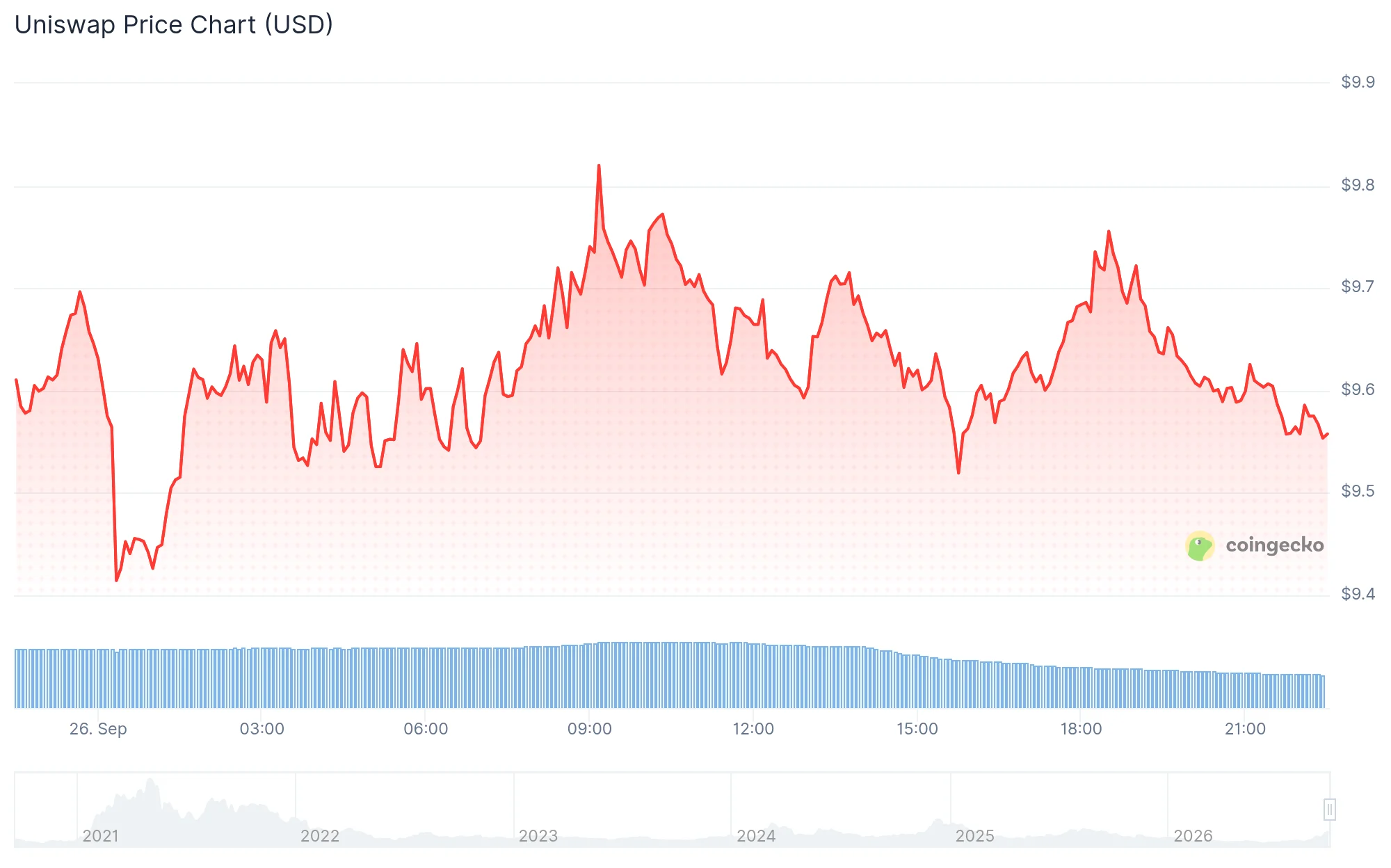
UNI traded near $9.61 on September 26, consolidating after a third-quarter advance that reshaped the token's chart structure. Market data showed a modest pullback from the quarter's highs, with buyers defending the $9.33 support area as sellers slowed the token's momentum. The session leaves the token below its quarterly swing high of $10.85 but well above where the quarter began.
The price action coincided with fresh usage data: Token Terminal reported $20.9 billion in tokenized-stock trading volume across decentralized exchanges over the past 30 days, with Uniswap v4 and v3 processing a combined 60.1% share of that market. Those figures add a protocol-usage dimension to the technical picture surrounding the token's next move.
UNI Holds Its Breakout Below the $12.30 Hurdle
The quarter's rally carried UNI from $2.35 to $10.85, breaking out of a descending triangle pattern that had contained the token since its 2021 peak. Sellers eventually slowed the advance, but the clearance remains technically significant: it separates the current range from the prolonged decline that followed the former $45 high and materially changes a structure that had restricted the token since that era.
Before larger targets come into view, UNI must first hold its nearer levels. Market data places immediate support at $9.33 and short-term resistance near $9.93. A move through $9.93 would reopen the path toward the recent swing high, while failure to defend $9.33 would leave $8.37 exposed.
On the daily chart, $12.30 stands as the next major hurdle above that short-term range. Buyers would need a sustained move above the area to strengthen the breakout structure. If $12.30 flips into support, the subsequent chart levels sit at $15.10 and $17.50.
Momentum cooled after the sharp rise, reducing the strength of immediate continuation signals. UNI therefore sits between a confirmed quarterly breakout and unresolved short-term resistance, and the next directional move depends on whether buyers protect $9.33 and regain $9.93.
A scheduled macro event may also shape conditions around these levels in the sessions ahead. The September 30 Personal Consumption Expenditures (PCE) inflation report is on the calendar for crypto markets, and changing rate expectations could influence volatility around UNI's established chart levels.
Tokenized Stock Trading Strengthens Uniswap Activity
Protocol usage offers a separate measure from the token's technical setup. Tokenized stocks are blockchain representations of traditional equities, a format that moves share trading onto decentralized venues where volume is recorded directly on-chain. UNI, in turn, serves as the governance token of the Uniswap protocol, making activity across its versions a usage gauge for the platform behind the token. According to Token Terminal, tokenized stocks produced $20.9 billion in decentralized exchange volume during the latest 30-day period. Uniswap v4 accounted for 40.7% of that trading, making it the largest venue version in the dataset, while Uniswap v3 contributed another 19.4%.
Together, the two versions processed 60.1% of tokenized-stock DEX volume during the window. The figures show that trading in tokenized equities spans two generations of Uniswap infrastructure — successive iterations of its automated market maker design — rather than concentrating in a single isolated deployment.
A separate Ethereum market-share comparison also shows growth for Uniswap v4. Its share across Uniswap v2, v3, v4, and Curve reached 50%, up from 31% in August 2025. V4 has held the leading monthly position from March 2026 through the latest reading.
Uniswap v2 moved in the opposite direction. Its share fell from 5% to below 1% over the same period, indicating that trading activity migrated toward the newer pool architecture as v4 gained adoption.
The two percentages measure different markets, and distinguishing them matters. The 40.7% figure covers tokenized-stock DEX volume specifically, while the 50% reading covers a selected group of Ethereum decentralized exchanges that includes Uniswap v2, v3, v4, and Curve. Keeping those datasets separate avoids overstating Uniswap v4's share across all decentralized trading.
Rising protocol activity does not set a fixed value for UNI, but it gives traders another operating metric beside chart momentum. The token still needs to clear $9.93 before the market can test the broader $12.30 threshold. If sellers force a break below $9.33, the short-term setup would weaken despite Uniswap's volume share, and the next support at $8.37 would return to focus, followed by the wider breakout zones near $8.25 and $6.35. Defending $9.33, by contrast, would preserve the immediate trading range and keep $9.93 positioned as the level to reclaim on any recovery attempt.
Source: Blockonomi

