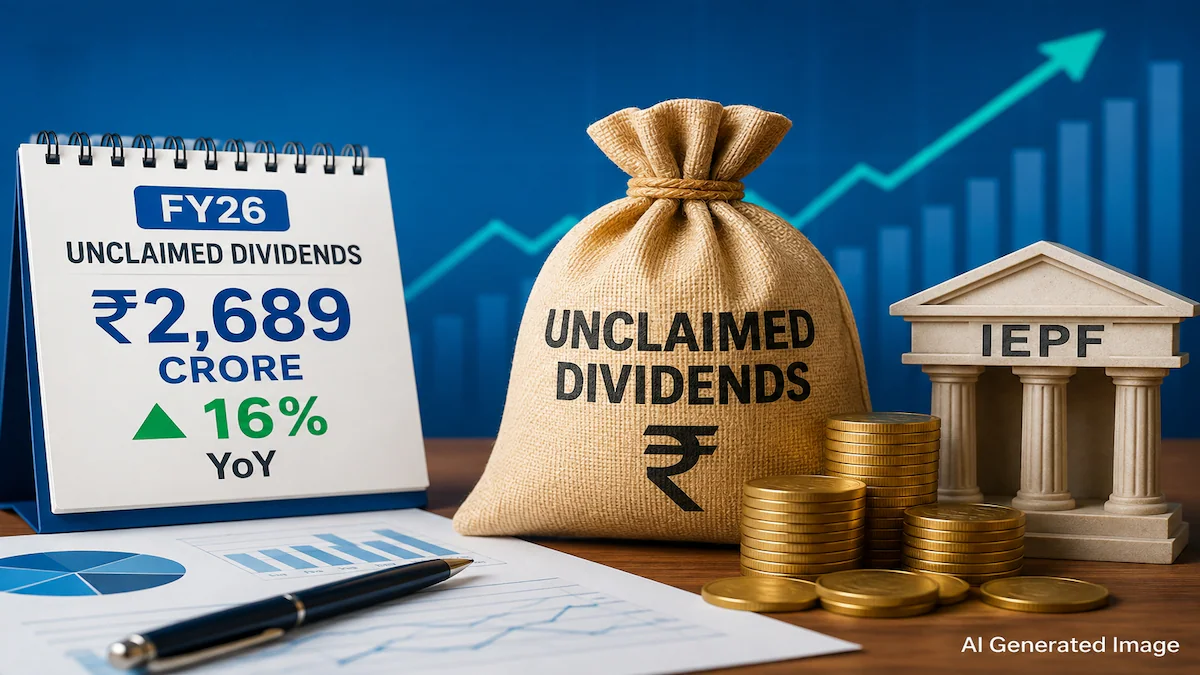
Unclaimed Dividends with Listed Companies Rise 16% to ₹2,689 Crore in FY26: SEBI
Key Takeaways
- •SEBI reported that unclaimed dividends with listed companies in India increased 16% to ₹2,689 crore in FY26.
- •The amount has risen steadily over the past two years, while mutual fund redemption levels stayed broadly unchanged.
- •Unclaimed dividends that remain unpaid for seven consecutive years are transferred to the Investor Education and Protection Fund under Indian corporate law.
- •Investors can recover eligible amounts by filing a claim through the IEPF portal with the required documentation.
- •Possible causes of unclaimed dividends include outdated contact details, investors not tracking declared payouts, and heirs being unaware of inherited holdings.
Unclaimed Dividends with Listed Companies Rise 16% to ₹2,689 Crore in FY26: SEBI
Unclaimed dividends held by listed companies in India increased 16% to ₹2,689 crore in FY26, according to data released by the Securities and Exchange Board of India (SEBI). The figure highlights a growing pool of shareholder payouts that remain unpaid despite robust dividend distributions by listed firms during the period. The accumulation comes at a time when India's retail investor base has expanded rapidly, with demat accounts more than doubling over recent years, bringing many first-generation investors into the equity ecosystem.
SEBI's data indicates that unclaimed dividends have been on a steady upward trajectory over the past two years. During the same timeframe, mutual fund redemption amounts have remained largely unchanged, suggesting that the accumulation of unclaimed dividends is not correlated with broader trends in investor redemptions from fund products.
Under Indian corporate law, dividends that remain unclaimed by shareholders for a period of seven consecutive years are transferred to the Investor Education and Protection Fund (IEPF), a framework administered by the Ministry of Corporate Affairs. The IEPF was established to promote investor awareness and protect the interests of investors, and it serves as a repository for unclaimed amounts including dividends, matured deposits, debentures, and application money. The ₹2,689 crore figure represents the corporate dividend category specifically; the total value across all unclaimed categories held by the IEPF is substantially larger.
Investors who are owed eligible amounts can recover their funds from the IEPF by completing the prescribed claim process. This typically involves submitting a claim through the IEPF portal along with the necessary documentation to verify entitlement. Once the claim is processed and approved, the amount is transferred to the investor's registered bank account.
Unclaimed dividends can arise for a variety of reasons, including outdated contact information on file with companies or their registrars, shareholders being unaware of declared dividends, or heirs not being informed about holdings after the original investor's death. The growing scale of the problem underscores a practical gap as millions of new accounts are opened each year: many investors may not update contact details or activate dividend mandates after purchasing shares. Companies are required to publish details of unclaimed dividends on their websites and in annual reports, and the IEPF Authority maintains a searchable database that allows investors to check whether any unclaimed amounts are held in their name.
SEBI, India's principal securities market regulator, continues to monitor the issue as part of its broader mandate to safeguard investor interests and improve the efficiency of capital market processes.

