FCA Crypto Registration Rate Climbs to 56%, Though Underlying Data Tells a More Complex Story
Key Takeaways
- •As of August 1, 2026, 67% of concluded FCA crypto registration cases resulted in withdrawal, compared to a 17% successful registration rate.
- •Application withdrawals represent a distinct procedural outcome where firms exit voluntarily, rather than an indication of formal regulatory refusal.
- •Crypto firms can apply for formal authorization under the Financial Services and Markets Act starting September 30, 2026, with the application window projected to close on February 28, 2027.
- •Current registrations under the Money Laundering Regulations will not carry over to the new framework, requiring all qualifying firms to undergo the authorization process again.
- •The new regulatory regime will introduce expanded assessment criteria, including Consumer Duty obligations and operational resilience requirements.
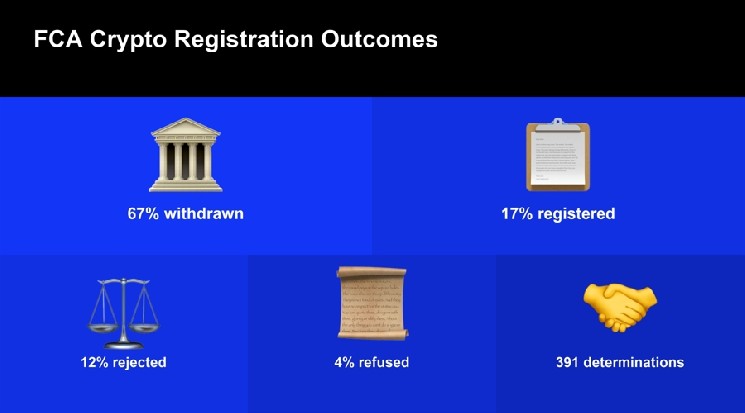
According to a report by FM Intelligence, 263 out of 391 crypto registration cases concluded by the Financial Conduct Authority (FCA) ended in withdrawal as of August 1, 2026. Withdrawals accounted for 67% of all determinations, whereas only 17% resulted in successful registration and 4% in formal refusal.
While the headline figures appear severe, they do not signify that the regulator formally rejected two-thirds of all applicants, as withdrawal operates as a distinct procedural outcome. Per FCA guidance, firms may choose to withdraw their applications if they require additional time to rectify shortcomings, are unable to demonstrate compliance with required standards, or anticipate a likely refusal. The formal refusal rate exclusively represents the final stage of the registration pipeline; a case may exit the process prior to a final ruling, including instances where the FCA has already identified substantive concerns. To avoid conflating these outcomes, the comprehensive FM Intelligence report distinguishes between withdrawals, rejections, and formal refusals rather than aggregating them into a unified failure metric.
Recent Registration Trends Show Improvement
Examining the most recent 12-month period reveals a different trend. Successful registrations constituted 13 out of 23 total determinations, or 56%, with withdrawals decreasing to 35% of decisions. In contrast, over the entire timeframe beginning January 2020, registrations represented a mere 68 out of 391 decisions, equivalent to 17%.
However, this recent improvement does not necessarily indicate a relaxation of FCA standards. The latest figures represent decisions processed within a specific timeframe, rather than a directly matched cohort of applications submitted during that same window. Furthermore, application cases can overlap across different reporting periods, and companies possess the option to reapply following a previous withdrawal or rejection.
The relatively small sample size of 23 recent determinations also limits broader conclusions. It remains unclear whether the statistical shift is attributable to higher-quality applications, a changing demographic of applicant firms, proactive regulatory engagement, or standard case-processing timelines. Although the FCA's public data tables enumerate final outcomes, they do not map individual decisions to their original submission dates or flag repetitive applicants.
Transition to a New Regulatory Framework
The release of this historical performance data closely precedes a fundamental shift in the UK's regulatory landscape for digital assets. Starting September 30, 2026, cryptocurrency firms will be permitted to apply for formal authorization under the Financial Services and Markets Act. The application window for this regime is projected to close on February 28, 2027.
The move to FSMA authorization follows the UK government's stated ambition, articulated under then-Chancellor Rishi Sunak in April 2022, to position the UK as a global hub for cryptoasset technology within a robust regulatory framework. It also parallels the EU's Markets in Crypto-Assets (MiCA) regulation, which has applied to crypto-asset service providers across EU member states since December 30, 2024, reflecting a broader international transition from AML-focused oversight toward comprehensive prudential and conduct regulation of digital asset firms.
Crucially, current registrations obtained under the Money Laundering Regulations will not transition automatically to the new framework. The updated assessment criteria will expand significantly beyond standard anti-money laundering protocols to encompass corporate governance, operational resilience, prudential requirements, and Consumer Duty obligations. The Consumer Duty, which has applied to in-scope financial products and services since July 31, 2023, requires firms to deliver good outcomes for retail customers — an obligation that would extend to authorized cryptoasset providers for the first time under the new regime.
As previously reported by FinanceMagnates.com, firms that delay their applications might encounter operational restrictions, including limitations on securing new UK-based business while their authorization remains pending.
Consequently, relying on the historical 17% registration success rate offers little predictive value for the impending 2027 regulatory regime. The upcoming framework will introduce an entirely different applicant demographic, a revised legal threshold, and specific transitional measures. Even digital asset firms that successfully navigated the existing gateway will be required to undergo the authorization process once again.
Nevertheless, the historical data remains useful for illustrating the precise stages at which applications have historically exited the process and demonstrating why formal refusal numbers alone fail to capture the full extent of applicant attrition. The full FM Intelligence report provides further analysis of outcome definitions, recent statistical shifts, and the existing segments of the UK cryptocurrency market that remain uncaptured by standard registration metrics.

