UK's Largest Banks Complete First Interbank Tokenised Deposit Transfers
Key Takeaways
- •Seven UK banks are participating in the Great British Tokenised Deposit project, supported by Quant, EY and Linklaters.
- •Programmable deposits can hold and automatically release funds when predefined conditions are satisfied, potentially reducing fraud in online commerce.
- •Tokenised deposits remain liabilities of issuing banks, while stablecoins are liabilities of private issuers backed by reserve assets.
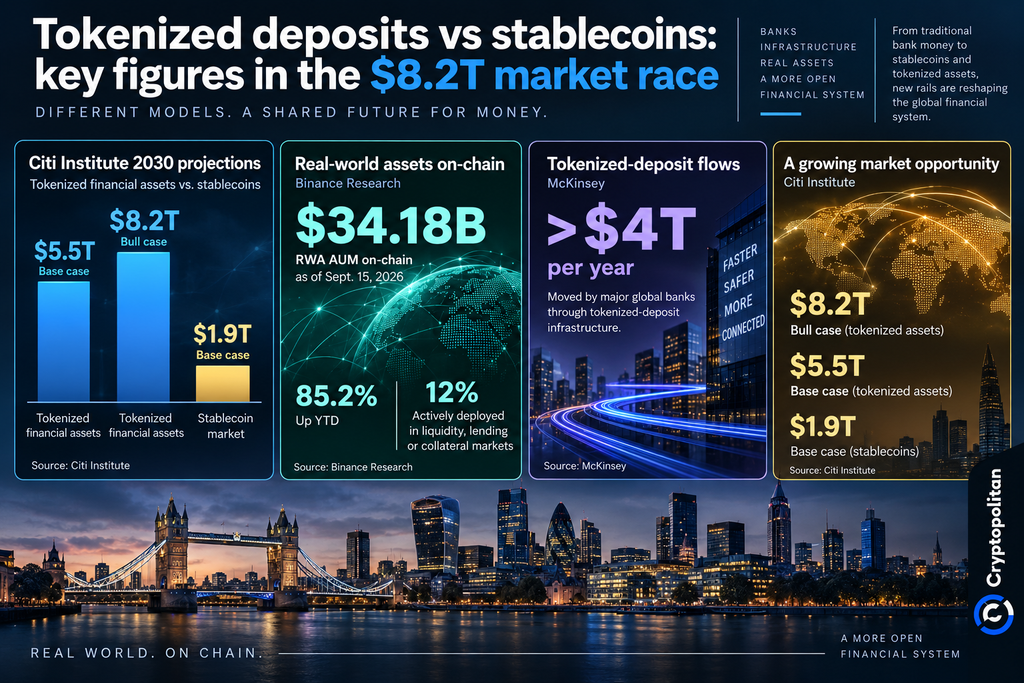
- •The Citi Institute forecasts tokenised financial assets could reach $5.5 trillion by 2030 in its base case and $8.2 trillion in its bull case.
- •UK Finance is scheduled to provide the project’s next public update through an October 6 webinar.
Britain's largest banks have completed their first interbank transfers of tokenised deposits, moving blockchain-based commercial bank money past the experimentation stage and closer to becoming a viable settlement method for tokenised assets. The development positions tokenised deposits to compete with, or operate alongside, stablecoins, according to a Reuters report published on September 23.
The transactions were carried out under the Great British Tokenised Deposit project run by UK Finance, the trade association for the British banking sector, as part of a pilot spanning marketplace payments, remortgaging and the settlement of digital assets.
Two mortgage trades and a marketplace payment
Lloyds Banking Group, NatWest and Barclays executed two remortgage transactions, while a trio of banks including HSBC carried out a customer-to-customer payment designed to mimic an online marketplace purchase. In that experiment, programmable deposits held the buyer's money and released it only once the goods had been delivered. Although no tangible goods actually changed hands, the exercise showed how tokenised bank money could help reduce fraud, while allowing payments to move between banks rather than remaining locked inside separate, unconnected banking systems.
That programmability — funds held and released automatically once pre-set conditions are met — is the property the test highlighted as a route to lower fraud in online commerce.
Seven institutions are taking part in the pilot: Barclays, HSBC, Lloyds, Monzo, NatWest, Nationwide and Santander, with support from distributed-ledger technology firm Quant, professional services group EY and law firm Linklaters.
Jana Mackintosh, UK Finance's managing director of payments and innovation, said the project is already drawing interest from beyond Britain's borders.
"In the last 12 months, other jurisdictions have been speaking to us in earnest about what we've done," Mackintosh told Reuters.
Why bank liabilities, not stablecoins
The distinction between tokenised deposits and stablecoins is not purely technical; it goes to the question of what the money itself actually is. According to the IMF, tokenised deposits are bank liabilities that are transferred over a blockchain or another form of distributed-ledger technology. Changing the technology affects how the deposit moves, but not what it is. In other words, a tokenised deposit remains a claim on the bank that issued it, while a stablecoin is a claim on its private issuer and the reserves behind it.
Stablecoins are separate liabilities, issued by private companies and backed by reserve assets. Reuters reports that the Bank of England would rather see banks issuing tokenised deposits than relying on privately issued stablecoins. The BIS, the Basel-based Bank for International Settlements, has made a comparable argument, contending that tokenised deposits fit more naturally with the existing two-tier monetary system.
Bank of England Governor Andrew Bailey has presented tokenisation as a way of modernising the existing forms of money rather than replacing them outright.
"We are now working with the banks to design and implement the introduction of so-called tokenised money," Bailey said in a Bank of England speech.
That does not mean stablecoins are now irrelevant. Deputy Governor Sarah Breeden has articulated the idea of a "multi-money" system in which conventional deposits, tokenised deposits and regulated systemic stablecoins could coexist and be easily converted at par value.
Canada and the US are building the same rails
The same shift is taking shape well beyond the UK. In June, major US banks threw their weight behind an on-chain money network run by The Clearing House, designed to connect tokenised commercial bank money with the payment rails already used across the financial system, including the RTP instant-payment system and the CHIPS interbank clearing system.
"This initiative brings together the innovation of digital finance with the trust, scale, and settlement certainty of established bank payment infrastructure," said Mark Monaco of Bank of America.
Canada appears to be heading in the same direction. Its Big Six banks are working together to build a Canadian-dollar tokenised-deposit rail, and the regulatory picture around the initiative became clearer on September 10, when the Office of the Superintendent of Financial Institutions (OSFI) announced: "The underlying technology of a financial product or service does not determine its legal nature."
Cryptopolitan has also reported that SWIFT has 17 banks across six continents lined up for tokenised cross-border payment trials.
The prize: a settlement question worth trillions
The market these banks want to settle could become enormous. The Citi Institute projects tokenised financial assets reaching $5.5 trillion by 2030 in its base case and $8.2 trillion in its bull case, compared with a $1.9 trillion base case for stablecoins. Binance Research puts the value of real-world assets under management on-chain at $34.18 billion as of September 15, up 85.2% year to date — although only about 12% of tracked tokenised capital is actively deployed in liquidity, lending or collateral markets.
Banks, meanwhile, already have scale. McKinsey estimates that major global banks move more than $4 trillion a year through tokenised-deposit infrastructure. UK participants are also preparing three digital bonds for the first quarter of 2027, which could trade and settle using tokenised deposits.
For crypto, the question is no longer whether banks will use blockchain. It is whether bank money captures settlement volume that might otherwise flow to stablecoins — or instead becomes the trusted cash leg that helps tokenised securities and real-world assets scale.
The project's next public milestone comes on October 6, when UK Finance hosts a webinar on the initiative.

