TxFlow Review: Community-Owned Layer 1 and Fully On-Chain CLOB Perp DEX Detail Season 1 Points Program
Key Takeaways
- •TxFlow's Season 1 points campaign allocates 1,402,000 points weekly, with 82% (1,250,000 points) reserved for the trader pool, a 10% referral cap of 152,000 points, and an 8% Growth Reserve.
- •The scoring algorithm prioritizes Open Interest duration and trading consistency across multiple days while applying a wash-trading penalty and a logarithmic dampening curve on outsized whale volume.
- •TxFlow launched with no venture capital allocations, private token sales, or insider pre-mines, and its DAG-based Layer 1 with the TxCore engine is described as delivering sub-second finality and more than 250,000 transactions per second.
- •The project has no active token on any blockchain, and the report warns that tokens claiming to be $TXFLOW on decentralized exchanges are counterfeit scams, with points strictly non-transferable and tied to on-chain wallets.
- •Self-custody wallet users can fund accounts via gas-free EIP-712 deposits of native USDC from Arbitrum, with TxFlow sponsoring gas through an audited bridge contract and funds arriving in roughly 60 seconds.
TxFlow (txflow.com / app.txflow.com) is a high-performance Layer 1 blockchain and decentralized perpetual exchange (Perp DEX) engineered to address the liquidity fragmentation and latency bottlenecks that plague modern decentralized finance. In a review published on October 21, 2026, the TinyFish Protocol Research Lab deconstructed the network's architecture — the TxFlow L1 blockchain with DAG consensus and the TxCore execution engine — along with the mechanics of its Season 1 points campaign, which carries a weekly distribution pool of 1,402,000 points.
Built around proprietary TIP Liquidity Standards (TxFlow Improvement Proposals), TxFlow unifies spot markets, perpetual futures, outcome prediction markets, and vaults into a shared, composable settlement layer without requiring cross-chain bridges between internal modules. The project communicates through the X account @TxFlow_L1.
What Sets TxFlow Apart
100% community ownership, zero VC allocations. According to the review, TxFlow launched with no venture capital allocations, private token sales, or insider pre-mines. The entire genesis allocation is described as verifiable on-chain and owned by community participants and active traders.
DAG-based parallel execution. TxFlow L1 features a multi-threaded state machine with directed acyclic graph (DAG) consensus, achieving sub-second block finality and more than 250,000 transactions per second (TPS).
Fully on-chain CLOB execution. Unlike hybrid DEXs that match orders off-chain and settle asynchronously, TxFlow's Central Limit Order Book (CLOB), powered by TxCore, processes order submissions, cancellations, matching, margin calculations, and liquidations entirely on-chain with USDC collateral.
Points Program Season 1. Commencing October 12, 2026, Season 1 distributes 1,250,000 points weekly to active traders across weekly Monday-to-Monday epochs. Points are credited every Tuesday based on holistic trading quality, specifically prioritizing Open Interest (holding positions over time) and multi-day consistency over short-lived wash trading.
Gas-free EIP-712 onboarding. Self-custody wallet users can bridge native USDC from Arbitrum without holding ETH. TxFlow sponsors and broadcasts the on-chain gas fee via audited smart contracts (0xcDE3F99bCB4c91e19124e41730489EAeFEc24565).
Architecture: TxFlow L1, TxCore, and Shared TIP Liquidity
In traditional DeFi, each decentralized application — perpetuals, spot AMMs, prediction markets — operates within an isolated liquidity silo, and bridging assets between them introduces latency, oracle risks, and smart contract attack surfaces. The review argues that TxFlow eliminates this structural friction through a unified multi-application state machine built on three technological foundations:
- TxCore Matching Engine: a zero-overhead deterministic order book running directly on Layer 1 validator nodes, matching limit and market orders with microsecond execution latency.
- TIP Liquidity Standards: standardizedability protocols ensuring that capital deposited into TxFlow can simultaneously back perpetual margin, provide automated vault yield, or service prediction market orders without capital fragmentation.
- Open Interest Valuation: the points allocation algorithm mathematically penalizes rapid "flash trading" — opening and immediately closing positions to generate synthetic volume. Positions held open over hours and days receive a significant weighting multiplier, incentivizing genuine market liquidity.
Points Program Season 1: Pool, Scoring, and Epoch Mechanics
The points program operates under a pool-based system in which participants earn a proportional share of a fixed weekly allocation rather than a fixed reward per trade. The report describes the design as prioritizing sustainability and organic adoption over mercenary capital extraction.
Weekly Pool Allocation
The overall Season 1 distribution pool totals 1,402,000 points per week. Of this, 1,250,000 points are designated for the trader pool — described in the documentation as an 82% allocation — with a 10% referral cap of 152,000 points per week and an 8% Growth Reserve. Each epoch runs on a strict seven-day schedule from Monday 00:00 UTC to Monday 23:59 UTC. Every Tuesday, the algorithm compiles all eligible trading records, calculates quality scores across the platform, and distributes the fixed weekly trader pool proportionally among verified accounts.
Multi-Factor Scoring
The exact formula weights are dynamic to prevent algorithmic gaming, but the documentation identifies a trader quality score derived from five foundational variables — Open Interest duration, trading consistency in days, volume split between maker and taker flow, fees paid, and TVL balance — minus a wash-trading penalty:
- Open Interest duration: the primary differentiator. A $10,000 position held open for 48 hours earns substantially more points than a $100,000 position opened and closed in 30 seconds.
- Trading consistency: accounts active across 4 to 7 distinct days within an epoch receive escalating multiplier bonuses compared with single-day traders.
- Volume balance: both maker orders (providing order book liquidity) and taker orders (market execution) contribute to volume, with maker fills receiving favorable weighting.
- Fees paid: total transaction fees contributed to the network reinforce score weighting.
- TVL contribution: maintaining active collateral balances on the exchange bolsters an account's reliability tier.
- Anti-Sybil spam deduction: automated anomaly detection flags self-crossing orders, cyclic trading loops, and unnatural volume spikes, deducting points or zeroing out the epoch reward.
Because the weekly trader pool is capped at 1,250,000 points, rewards reflect how a trader's activity compares with other platform users during that exact seven-day window. The algorithm incorporates a logarithmic dampening curve on massive whale volume, which the report says ensures smaller and mid-sized accounts that trade genuinely and consistently capture a meaningful share of the distribution.
Season 0 Early Supporters
Traders who participated before the October 12 launch of Season 1 are classified under Season 0. As confirmed by official team communications cited in the report, Season 0 rewards will be finalized and distributed before October 27, 2026.
Inside the Live Product: The Review's Walkthrough
The review's screenshots were gathered, per the author, during authenticated testing of TxFlow production endpoints with a connected live self-custody wallet (0x51D2...046b), and are presented in a five-block format covering what is shown, the rationale, architectural context, execution steps, and key metrics.
Access Code and Onboarding Gate (app.txflow.com)
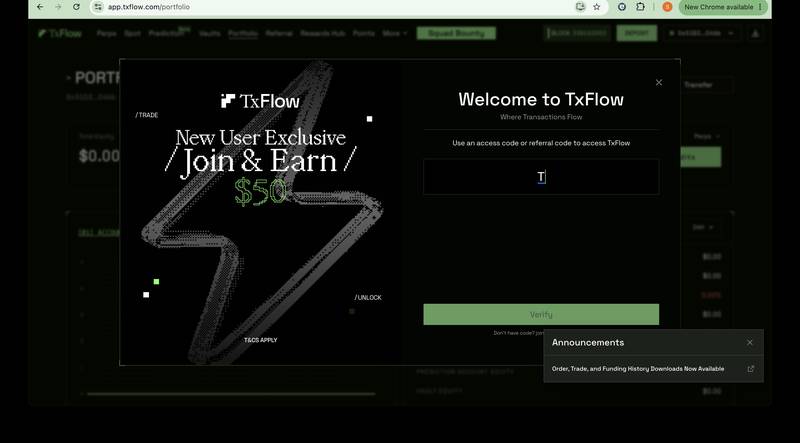
The entry screen displays a "Welcome to TxFlow, Where Transactions Flow" modal with a "New User Exclusive / Join \u0026 Earn $50" headline, an access code field with a "Verify" button, and a link to the official Discord server for whitelist code retrieval. Season 1 is currently in an access-gated rollout intended to protect on-chain performance and filter out automated Sybil scripts. Entering a valid access code — such as the community codes TXTENKO or TXEXITPUMP — or joining via an official Discord code unlocks the trading interface and activates eligibility for the $50 New User Exclusive fee rebate bonus.
Access codes function as an initial barrier against bulk-generated bot wallets; by tying wallet initialization to verified referral or community codes, the protocol aims to prevent automated bot swarms from exhausting transaction queues and diluting the weekly 1,250,000-point pool reserved for genuine traders. The report advises sourcing codes exclusively from the official bio link (discord.gg/txflow) or verified community creators. New users navigate to the app, paste the code, click "Verify," and confirm the wallet connection signature.
New User Exclusive Campaign
The walkthrough proceeds through a referral link (app.txflow.com/r/TXTENKO), with the parameter ?referral_code=TXTENKO visible in the browser navigation state. The campaign queues a 5% fee discount across perpetual contracts on the first $25 million in volume plus the $50 welcome incentive, both activated upon wallet signature. Clicking "Join" binds the referral code to the address permanently; referral associations are locked upon registration and cannot be modified retroactively.
On fee credit economics, the report explains that 1 fee credit equals $1.00 of trading fee reimbursement. Credits are consumed automatically as the user trades perpetual contracts — no manual claiming is required — and the equivalent USDC amount is credited back to the margin account.
Fully On-Chain CLOB Perpetual Trading Terminal (app.txflow.com/trade/BTC-USDC)
The flagship BTC-USDC terminal showed the connected wallet (0x51D2...046b) alongside live Layer 1 telemetry at Block Height 338139466, 24-hour trading volume of $68,110,722.73, Open Interest of $14,864,934.33, a Mark Price of $83,209.4, an Oracle Price of $83,240.8, and a 1-hour funding rate of 0.0012%. The interface featured a live TradingView candlestick chart, a real-time on-chain order book with a 0.1 USDC spread (0.0001%), and an order entry console configured for 10x cross margin.
Perpetual trading is the sole qualifying activity for earning Season 1 points; spot trading and prediction markets do not earn points in Season 1. Executing orders demonstrates active participation, while holding open positions builds the Open Interest metric that dominates the weekly scoring algorithm. Because every limit order, market fill, cancellation, and margin recalculation is processed directly on the Layer 1 blockchain — rather than by a centralized off-chain matching engine — the report points to the visible order book depth down to a 0.0001% spread as evidence of genuine liquidity backed by decentralized market makers.
Execution steps described in the review: select the target market, choose a margin mode (cross margin is recommended for portfolio efficiency), set leverage — with a conservative 2x-5x described as optimal to minimize liquidation risk while farming points — choose a limit order (maker trades receive preferential scoring and lower fees) or a market order, review the liquidation price, and keep the position open over multiple days to accumulate Open Interest credits.
Points Dashboard and Epoch Countdown (app.txflow.com/points)
The points dashboard for the connected wallet confirmed that Epoch 1 was live, with a countdown timer displaying 04 days 13 hrs 29 min 36 sec remaining until the weekly snapshot. The statistics grid showed Last Epoch Points (0), All Time Points (0), Last Epoch Rank (-), All Time Rank (-), alongside an official notification that points are credited every Tuesday following the conclusion of each weekly epoch. The report characterizes the dashboard as the monitoring hub for confirming that trading activity registers within the active epoch and for tracking standing relative to the global leaderboard.
Official X Channel and Security Advisory (x.com/TxFlow_L1)
The verified X profile @TxFlow_L1 displays the brand motto "WHERE TRANSACTIONS FLOW." The bio reads: "Where Transactions Flow. Join our Discord to get your access code: discord.gg/txflow | app.txflow.com | Joined March 2026." At the time of the review, the account showed 1,317 posts, 325 following, 15.9K followers, and 25 verified affiliates. Pinned at the top is the formal launch announcement "Today's the day. Points Season 1 is live," published October 12.
The report urges users to verify official channels because fraudulent social accounts and phishing links are prevalent during major DeFi points campaigns; the authentic account is the source for genuine contract addresses, official Discord links, and epoch distribution announcements.
Crucial security advisory from the report: TxFlow has no active token trading on any blockchain at this stage. Any tokens claiming to be $TXFLOW on Uniswap, Raydium, or PancakeSwap are unassociated counterfeit scams. Points are strictly non-transferable and tied to the on-chain wallet, and users should never purchase "points allocations" from OTC brokers. Recommended actions include following the authentic account at https://x.com/TxFlow_L1, enabling notifications for epoch settlement and Season 0 distribution updates, and using only the bio link (discord.gg/txflow) for access code assistance.
Points Program Documentation (docs.txflow.com/points)
The official documentation page, "How Points Work," outlines a governance framework updated October 12 following community feedback. Key takeaways: points represent a proportional share of a weekly pool rather than a fixed reward per trade; the trader pool receives an 82% allocation; referrals are capped at 10% (152,000 points per week); an 8% Growth Reserve is set aside; and explicit anti-farming enforcement policies apply. Understanding these mechanics, the report argues, allows traders to optimize capital deployment, since Open Interest and trade quality outweigh raw volume.
Gas-Free Deposit Architecture (docs.txflow.com/getting-started/gas-free-deposit)
The gas-free deposit guide lists eligibility requirements: a self-custody wallet (MetaMask, OKX Wallet), native USDC on Arbitrum (0xaf88d065e77c8cC2239327C5EDb3A432268e5831), a minimum deposit of 5 USDC, and an Arbitrum ETH balance of exactly 0. The documentation explains the security parameters of the bridge contract (0xcDE3F99bCB4c91e19124e41730489EAeFEc24565), off-chain EIP-712 authorization, and automated 60-minute signature expiration.
The report frames the feature as removing onboarding friction: instead of needing both ETH for gas and USDC for trading, users can fund accounts with pure USDC. Security notes state that the signature authorizes only the exact deposit amount and cannot be altered or redirected to third-party addresses, and that the USDC.e bridged token is not supported.
The deposit sequence: ensure the Arbitrum wallet holds native USDC (minimum 5 USDC) and 0.00 ETH; open the deposit console and input the desired amount; verify that the spender contract in the wallet signature request matches 0xcDE3F99bCB4c91e19124e41730489EAeFEc24565; sign the gasless EIP-712 message, after which TxFlow's relayer broadcasts the transaction and pays the gas; funds arrive in the TxFlow margin account within approximately 60 seconds.
Layer 1 Ecosystem and Vision (txflow.com)
The official homepage carries the hero message: "Where Transactions Flow, One transparent, verifiable on-chain financial foundation connecting markets, liquidity and applications on a high-performance Layer 1." Visual tabs showcase integrated modules including Spot, Perpetuals, Prediction Markets, and developer infrastructure.
The review emphasizes that TxFlow is not merely a decentralized exchange built on someone else's chain but an independent Layer 1 blockchain, and that early Perp DEX users are simultaneously stress-testing the network and establishing reputation across the underlying Layer 1 — positioning, in the report's framing, for foundational network rewards. Stated architectural differentiators include community ownership (no VC pre-allocations or team token locks), 250,000 TPS parallelized state execution designed to prevent congestion during extreme volatility, and composability without bridges, with all applications sharing liquidity pools natively at the Layer 1 level.
The Report's Five-Step Season 1 Playbook
The TinyFish team lays out a five-step execution sequence for Season 1. The steps below summarize the report's published methodology and are not recommendations by this publication.
Step 1 — Secure an access code and complete registration. Visit the official app; if prompted, input a code such as TXTENKO or TXEXITPUMP and click "Verify." Connect an EVM-compatible self-custody wallet (MetaMask, Rabby, OKX Wallet) and authorize the login signature to link the address.
Step 2 — Fund margin via gas-free deposit. Acquire native USDC on Arbitrum One (0xaf88d065e77c8cC2239327C5EDb3A432268e5831), at least 5 USDC, and open the deposit console. If the Arbitrum ETH balance is 0.00, use the gas-free deposit option after verifying the bridge contract address (0xcDE3F99bCB4c91e19124e41730489EAeFEc24565) and signing the gasless EIP-712 message. Users holding ETH on Arbitrum can execute a standard deposit transaction.
Step 3 — Execute strategic perpetual positions. Navigate to the perps terminal, choose a liquid pair such as BTC-USDC or ETH-USDC, and select conservative leverage between 2x and 5x. Place limit (maker) orders near the mid-price to minimize fee drag and capture maker scoring bonuses, then keep positions open to accumulate Open Interest hours rather than exiting immediately.
Step 4 — Consider a delta-neutral hedging structure. To farm Open Interest points without directional market risk, the report describes opening a long perpetual position on TxFlow (for example, a 0.1 BTC long at 2x leverage) while simultaneously opening an equivalent short on another venue — such as Hyperliquid, Binance, or Bybit — or holding spot Bitcoin. Maintaining the delta-neutral hedge for 3 to 5 days during an epoch accumulates continuous Open Interest credits while funding costs offset.
Step 5 — Maintain weekly consistency. Avoid executing all volume in a single session. Distribute trades across at least 4 to 5 separate days of the weekly epoch (Monday to Monday UTC), and check the points dashboard every Tuesday to review credited points and adjust for the next epoch.
Sources and Key Links
This article is based on "TxFlow (@TxFlow_L1): In-Depth Review \u0026 Season 1 Points Farming Playbook," verified and published by the TinyFish Protocol Intelligence Lab via NFTENEX on 21, 2026: https://nftenex.com/txflow-in-depth-review-and-season-1-points-farming-playbook
Official resources referenced in the report: txflow.com, app.txflow.com, the points dashboard at app.txflow.com/points, the documentation at docs.txflow.com/points, and the official X account @TxFlow_L1.

