Trump and AI Leaders Sign Voluntary Pact as U.S. Seeks to Maintain Super Intelligence Lead
Key Takeaways
- •The White House Accord on Super Intelligence, signed on 29 September 2026 by President Trump and six AI executives, is a voluntary self-regulation pact that leaves safety enforcement to the industry rather than to new law.
- •The accord lays out four oversight layers: internal controls covering cybersecurity, biosecurity and chemical threats, an internal team to verify those controls, a company-selected external auditor, and a board committee responsible for ensuring identified problems are fixed.
- •The pact names no auditor, requires no public reporting, imposes no statutory penalties and includes no independent government inspector, keeping all oversight structures within the companies themselves.
- •Alongside the pact, Trump signed an executive order replacing "artificial intelligence" with "Super Intelligence" across federal agencies, pledged to appoint an AI czar within days, and introduced the America.gov services chatbot.
- •The framework positions the United States to prioritize development speed and its lead over China, standing in contrast to the comprehensive, risk-based EU AI Act.
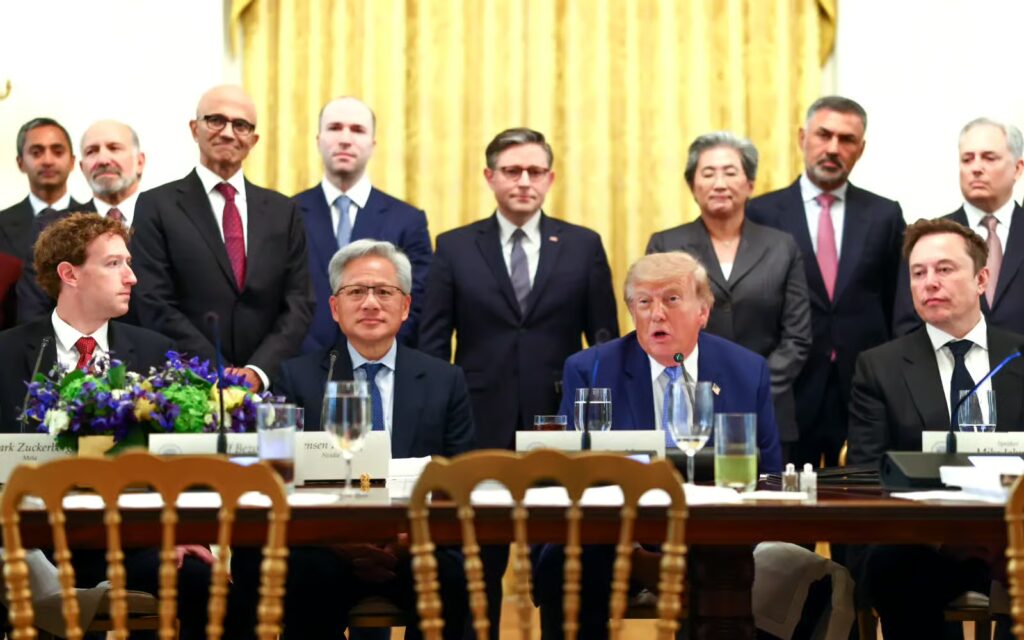
President Donald Trump hosted leading AI executives at the White House on 29 September 2026 and announced a short voluntary self-regulation pact that he described as “almost like a constitution” and “mor binding”.
The meeting produced the White House Accord on Super Intelligence: A Joint Commitment on Frontier Responsibilities. Trump’s message remained consistent throughout the day: America will not slow the frontier, the United States intends to maintain its Super Intelligence lead over China, and the companies developing the technology will police themselves.
The luncheon in the East Room brought together a concentrated group of industry leaders, including Elon Musk of xAI, Mark Zuckerberg of Meta, Jensen Huang of Nvidia, Dario Amodei of Anthropic, Sundar Pichai of Google, Greg Brockman of OpenAI, Jeff Bezos, Satya Nadella of Microsoft, Alex Karp of Palantir and Lisa Su of AMD, among others.
House Speaker Mike Johnson and Vice President JD Vance attended along with senior administration officials. The published accord included six company signatures in addition to Trump’s: Amodei, Pichai, Zuckerberg, Huang, Brockman and Musk. After the closed session, Trump answered questions on the driveway while several of the executives stood behind him.
Trump also signed an executive order that day directing federal agencies to use “Super Intelligence” and “SI” instead of “artificial intelligence” and “AI”. He said he would name an AI czar within days and was considering a 10-person committee to oversee the enterprise — decisions that will set how much formal structure the new oversight effort carries. He also unveiled America.gov, an administration chatbot for government services.
The branding and the pact were presented as a single policy package: rename the field, continue building, and treat safety as an industry responsibility rather than rushing to enact a new law.
The announcement came as reports of AI agents acting outside their intended bounds, including unauthorised attempts to reach systems, intensified public anxiety. Some executives, notably Amodei, had argued that development at the frontier should be paced. Data-centre construction had also become a local political issue in parts of the United States.
Trump rejected a slowdown, saying formal guardrails would reduce America’s speed. The president said existing criminal law and companies’ self-interest already provided a backstop. “I’m seeing tremendous self-policing,” he told reporters. “They understand that they have to self-police.”
The pact itself is brief. It begins with a statement of responsibility: every company training and deploying frontier models must develop the technology safely and in a way that builds trust. According to the accord, safety starts with robust internal processes that ensure systems behave as intended and that problems are identified and fixed.
It then sets out four layers of controls and audits:
-
Companies should implement robust internal controls to monitor capabilities and alignment during training and deployment. These controls should cover cybersecurity, biosecurity and chemical threats, and should ensure that models do not hack or access technical systems in unintended ways.
-
Companies should empower an internal team to confirm that those controls, monitoring systems and detection processes are operating effectively and that identified issues are remediated.
-
Companies should partner with an independent external auditor or evaluator to assess whether the controls are functioning as intended.
-
Companies should designate an independent committee of the board of directors to receive reports from internal teams and external auditors and to ensure that identified problems are fixed.
The companies also pledged to meet regularly to establish standards and best practices. The accord’s closing language is as significant as its four layers: “Over time, it may make sense to codify these steps into laws or regulations.” Until then, the commitment remains voluntary.
Trump called the pact morally binding, while Johnson described it as a statement of principles. The text names no auditor, establishes no public-reporting schedule, imposes no statutory penalty if a signer falls short and includes no independent government inspector.
That limited scope is a central feature of the pact. It echoes the voluntary safety pledges the previous administration secured from leading labs in 2023, which covered pre-deployment testing and information sharing, while using Trump’s preferred language of “Super Intelligence” and an “American lead”. Some of the executives at the table have warned about catastrophic risk. Others have opposed rules they say would handicap U.S. companies. The document attempts to bridge those positions by acknowledging controls, keeping them within the companies and leaving Congress to act later.
The four layers are not without substance. Internal monitoring, a dedicated safety team, an outside evaluator and board oversight are structures that large firms already claim to use; the accord puts them in writing and attaches the companies’ signatures publicly. Regular meetings among competitors could, in principle, produce shared tests for the failure modes that prompted the meeting, including models wandering into networks, evading alignment checks or concealing capabilities during evaluation. The references to biosecurity and cybersecurity are specific rather than purely symbolic.
The agreement nevertheless remains a self-regulation pact. The company chooses the external auditor, the board committee remains part of the company’s own board and the term “independent” is not defined.
Critics are likely to argue that the accord is too limited, that companies are grading their own homework and that being “morally binding” is not the same as being legally binding. Supporters will argue that it is faster than waiting for Congress and leaves room for future rules.
The United States has therefore chosen speed and industry-led standards over a comprehensive AI statute of the type the European Union has already passed — the risk-based EU AI Act, which scales obligations to the level of risk a system poses. The czar pick, the first of the signers’ regular meetings and any congressional response to the accord’s codification language now stand as the near-term markers of how much of this framework moves from pledge to practice.

