Trade Expert Says Trump’s Conflict With Canada Has a Personal Dimension
Key Takeaways
- •The Trump administration imposed a 20% tariff on Canadian goods in February 2025, citing fentanyl trafficking that trade expert Ed Gress says seizure data does not support.
- •Canada and China are the only countries to have mounted meaningful retaliation against the administration's tariffs during the past year and a half.
- •Measures imposed in July and Canada's August response cover about $20 billion in trade, roughly 5% of US-Canada commerce, though threatened auto tariffs could substantially expand the damage.
- •Tariff costs are borne by US businesses and ultimately consumers and workers rather than foreign countries, and the rate of job creation has declined over the past year and a half.
- •Courts have so far ruled against the administration's use of old trade laws to impose tariffs, and Congress reclaiming tariff authority represents one potential off-ramp.
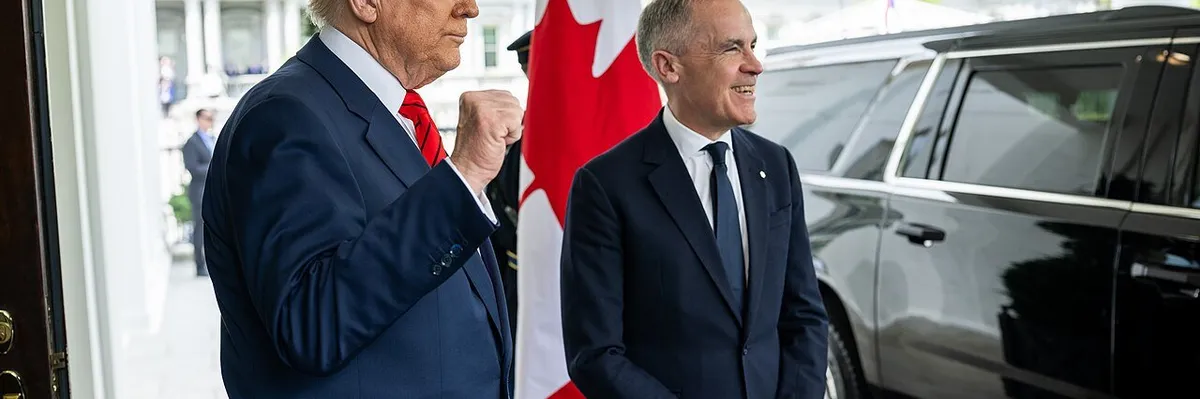
President Donald Trump’s trade wars are producing real economic consequences, not merely serving as a theoretical policy exercise. Their effects include long-term harm to the US economy, whether the tariffs target longtime allies such as Canada or countries with which the United States has had periodic tensions, including China and nations in the Middle East.
Canada has received particular attention because Americans are unaccustomed to an antagonistic relationship with their northern neighbor. Speaking to AlterNet in August, former President Bill Clinton’s top economic adviser, Dr. Robert J. Shapiro, said that “just this week, Trump announced 50 percent tariffs on our largest trading partner, Canada, which will further increase inflation.” In September, Dr. Richard D. Wolff, professor emeritus of economics at the University of Massachusetts Amherst, discussed how Canadian Prime Minister Mark Carney had gained an advantage over Trump, saying that “our government is busy strong-arming people around the world in every way that it can, militarily, economically, politically, and discovering time after time to their amazement, if you take them seriously, that the folks are going to resist. And that's what's going to happen.”
To examine the dispute and its wider implications, AlterNet spoke with Dr. Ed Gresser, a trade expert at the Progressive Policy Institute and the author of Freedom From Want: American Liberalism and the Global Economy. Gresser connected the trade conflict with Canada to the Trump administration’s disputes with China and countries in the Middle East. The interview has been lightly edited for length, clarity and context. The original interview is available from AlterNet.
ROZSA: What specifically triggered this trade dispute with Canada, and how does it differ historically from previous US-Canada bilateral trade friction?
GRESSER: In terms of what specifically triggered it, it appears to have started during the transition period, when Trump personally began threatening Canada and Mexico with relatively high tariffs, contrary to the United States-Mexico-Canada Agreement that the first Trump administration had negotiated. The reason was not clear then, and I do not think it is clear now.
At the beginning of February 2025, the administration claimed that Canada was not doing enough to stop fentanyl trafficking along the US-Canadian border and announced what I believe was a 20% tariff on Canadian goods. That claim was not true. There is very little fentanyl trafficking along the northern border. Based on seizure data, there may well be more fentanyl moving north than south.
Then, I believe in March, the administration significantly expanded the existing so-called national security tariffs on steel and aluminum. For the first time, those tariffs were applied to Canadian and Mexican steel and aluminum. Canada is the main source of aluminum for the United States, and it has a substantial aluminum industry.
The Canadian government retaliated with its own tariffs. That appears to be a major factor motivating both the Trump administration and Trump personally. During its year and a half of trying to impose tariffs on everyone, the administration has faced meaningful retaliation from only China and Canada. China has more or less wrestled the administration to a draw.
Canada is smaller and more dependent on the United States. The administration may believe it needs to respond forcefully to prevent other countries from adopting Canada’s approach and retaliating when they are targeted. Officials may be alarmed by that possibility and want to make an example of Canada.
Trump also appears to have genuine personal animosity toward Canada, for reasons I do not understand. That hostility goes beyond tariffs. He repeatedly belittles Canada and calls it the “51st state.” There seems to be something personal involved, although I have no insight into what it is. It is weird. [Laughs.]
ROZSA: I think much of what Trump does can accurately be described with the adjective “weird.”
GRESSER: Yes. Canada seems to be particularly weird.
ROZSA: I agree. Say what you will about Trump’s animosity toward China, but China has behaved aggressively toward the United States, at least economically. That animosity is not entirely unjustified. Am I correct that the same cannot accurately be said of Canada?
GRESSER: Yes, I would say that is correct. The US-Canada trade relationship is very large. There are long-standing irritants within it. Many generations of trade negotiators have been frustrated with Canadian dairy policy, and some have objected to cultural-exception issues. But these are specific disputes within a very large relationship that is generally beneficial to both sides.
Most relationships have particular points of friction. One country may object to a deeply established policy of the other, while the other country has its own complaints. The United States often imposes tariffs on Canadian lumber based on a concern about subsidization of Canadian logging. That concern is not irrational, but it is also not unassailable.
There are issues that the US government has tried and failed to resolve with Canada, and the Trump administration is using them as a rationale for its policies. But in a trade relationship worth about $1 trillion, those issues are relatively small. The harm caused to the US economy by the aluminum tariff alone is much greater than the harm associated with those other disputes. That is in addition to the Trump administration’s apparent effort to end a friendly relationship with the United States’ permanent neighbor.
ROZSA: I want to refer to your book, Freedom From Want: American Liberalism and the Global Economy. I recommend it to readers who want to understand trade policy. On page 95, you wrote: “The agreement which brought China into the World Trade Organization, conducted by President Bill Clinton's second US trade representative, Charlene Barshefsky, in 1999 and implemented in 2001, was the last genuinely big change in the global trading system.” Looking back a quarter-century later, is that still true?
GRESSER: No, I would not say that is true at all. There have been a number of developments, but the Trump administration’s attempt to return the United States to a high-tariff, isolationist policy is itself a very significant change.
ROZSA: Has Trump’s conduct permanently disrupted the prospect of bilateral and amicable trade relations between the United States and China?
GRESSER: “Permanent” is a long time. Chinese history covers roughly 3,000 years, and there have been many ups and downs during that period.
In the relationships the United States has with Canada, Mexico, the European Union and other major trading partners, as well as with developing and low-income countries, the main source of current stress is the Trump administration’s policy. Reversing the administration’s actions or replacing them with something better would help ease those problems.
China is different because there are substantial complaints about Chinese behavior. Many countries view China as mercantilist, directing large amounts of money into industries in which it is already powerful and squeezing out competitors.
Eight years ago, the first Trump administration published what it called a Section 301 report on Chinese government intellectual-property extraction and forced technology transfer. One can debate whether the response was appropriate, but the diagnosis identified real problems. Underlying those issues was a broader policy China introduced in 2015 called Made in China 2025, which established market-share targets, both within China and globally, for a range of industries.
Many Americans in government, business, labor and academia viewed that policy as threatening and did not believe the US government should simply accept it. Thus, the US-China relationship includes many legitimate complaints about Chinese policy and conduct. Those concerns are not unique to Americans; other countries share them as well.
ROZSA: In the chapter of your book on the Middle East, page 197, you wrote: “The Muslim world needs no aid program on the scale of the Marshall Plan” — which was implemented by President Harry Truman to reconstruct Europe after World War II — “Instead, it needs a Western policy suited to a region with lots of cash, but little industry, few jobs, and too much oil. Though some help for Pakistan's schools and Egypt's roads and ports would be welcome, the region's real need is to attract investment, create jobs, and restore a sense of hope to the public. And for this, trade is far more effective than aid.”
Does what you describe as President Trump’s invasion of Iran and his broader belligerent posture toward the Middle East advance or undermine those goals?
GRESSER: I would say it undermines them. I do not think the administration has ever explained what it is trying to achieve with this war. The region already had endemic, high tensions, and those tensions are now considerably worse.
The Iranian government appears to have been emboldened and may feel, with some justification, that it has stood up to Trump. The administration seems to be continuing its course in the hope that something will change, rather than explaining what it intends to achieve and how it plans to achieve it. In that respect, I would say the administration of President George W. Bush at least tried to explain its objectives and the means it would use. That effort did not go well.
The current situation is significantly worse in one respect: There is no US public support for it, and there is no congressional authorization. No one knows where it will end.
ROZSA: Which industries or sectors on either side of the US-Canada border are absorbing the greatest damage?
GRESSER: In the United States and Canada, the Canadian industries most heavily targeted by the Trump administration’s tariffs are probably metals and, potentially, automobiles. Both are large parts of Canada’s industrial economy.
Aluminum and automotive manufacturing are particularly integrated with US industry. Measures that make Canadian aluminum harder and more expensive to purchase immediately harm US aircraft manufacturers, appliance makers and automakers. The same applies to tariffs on auto parts.
If the dispute escalates, the US auto industry — at least its Michigan- and Midwest-based segments — would be highly vulnerable. Canada is the largest foreign buyer of American-made cars. Production lines are deeply integrated across Ontario and Michigan, so tariffs could multiply the damage. The US dairy industry would also be hit significantly by Canadian tariffs.
Aviation is another example. In recent weeks, I was watching Trump’s statement that he might try to prevent Bombardier aircraft from being sold in the United States. Bombardier is a Canadian manufacturer of small aircraft, including corporate jets. The administration may not have known that many Bombardier components are made in the United States, including in Kansas and Texas. Those US operations would suffer if such a ban were imposed.
So far, the anger and stress surrounding the dispute appear much greater than the actual coverage of the tariffs. The measures imposed by the Trump administration in July and Canada’s response in August involved approximately $20 billion in trade between the two countries, or about 5% of US-Canada trade. The tariffs affect particular industries, but they probably do not yet cause systemic damage to either economy.
However, escalation remains possible. Trump has threatened tariffs on Canadian automobiles, which would be a much larger measure. The extent of the economic damage therefore remains unresolved and depends on whether the dispute de-escalates or continues to worsen.
The damage to the sense of common destiny, trust and confidence within North America is probably already substantial and will not be easy to repair.
ROZSA: Who actually pays the cost of these tariffs — Canada, countries in the Middle East and China, or companies, consumers and workers? How does the process work in practice?
GRESSER: Economists are effectively observing an experiment and will learn from how it operates. Economic models generally suggest that consumers ultimately bear the cost of tariffs.
In most cases, a business initially pays. If a car suddenly carries a 20% tariff, for example, the dealership importing it pays Customs and Border Protection. If the tariff is 15%, as the Trump administration has imposed in some cases, the dealership pays that 15% and incorporates it into the cost of the vehicle. The dealership must still earn enough profit to pay employees and keep operating, so the cost eventually reaches consumers.
That is the standard theory. In practice, companies have alternatives. They must pay the tariff, and the simplest response is to add it to the price charged to customers. Large companies, however, may be able to reduce costs elsewhere. They might hire fewer people, for example. That is one development seen during the past year and a half: The rate of job creation has declined.
Companies are concerned about how customers will respond to higher prices, so they may initially try to avoid passing on the full cost by reducing spending elsewhere. Large retailers can also distribute the cost unevenly. They may determine which products customers are most willing to accept at higher prices and which products they are least willing to pay more for. Prices can then rise more for the first category and less for the second.
What does not happen is foreigners paying the tariffs. The cost is imposed on the US economy in one way or another. If you had asked me a year and a half ago, I would probably have expected a greater impact on prices and would not have predicted the labor-market impact.
ROZSA: Is there a realistic off-ramp from Trump’s trade wars with Canada and China and his policies in the Middle East, or does the trajectory point toward escalation?
GRESSER: There are several possible off-ramps. One is through the courts. Courts have so far ruled against the administration on these issues.
The administration’s method is not constitutionally appropriate. The Constitution gives Congress the power to “lay and collect Taxes, Duties, Imposts and Excises” and to regulate commerce with foreign nations. Earlier presidents who wanted higher tariffs, including Herbert Hoover, William McKinley and Benjamin Harrison, asked Congress to pass tariff legislation. Congress either approved or rejected those bills. That is the constitutional process for raising tariffs.
The Trump administration has instead attempted to locate old, largely disused trade laws dating from 1930 to 1974 and use them in various ways to impose broad tariff increases. When those actions have been challenged, courts have so far said that the administration cannot use those laws in that manner. The authority belongs to Congress, and laws intended for a particular purpose cannot be repurposed for another one.
A second off-ramp would be for Congress to reclaim its authority by passing legislation stating that presidents may no longer set tariff rates by decree. A third possibility is that Republicans perform poorly in an election, with tariff increases identified as one contributing factor, and pressure the administration to retreat.
A fourth possibility is that Trump changes his mind. Ultimately, the American public may also play a role. People have thought about tariff policy more than they had in a long time, and they do not like it. There is a presidential election in two years and a few months, and voters will see what the candidates say about the policy and what they intend to do with the legacy Trump leaves them.
ROZSA: Is there anything you want to add that I have not asked about?
GRESSER: I am struck by how much interest the American public has taken in this issue and by the generally negative reaction. If people had been asked about tariff policy two or 10 years ago, they probably would not have felt confident discussing it. They might have had a general feeling one way or another, but it would not have been strongly held.
The public has been forced to think more systematically about tariffs. Opposition to them is now much stronger than it would have been in the past.
ROZSA: I often compare Trump’s protectionism to a hot tub. Many people think they would enjoy getting into one. If the water is at a reasonable temperature, they will. But if it is 300 degrees, they will suddenly view the experience differently. Does that analogy make sense?
GRESSER: I am not sure I like that analogy. Historically, tariffs have generally been imposed for particular industries that become attached to them, but the measures were small enough that the public did not notice them. When the first Trump administration introduced steel tariffs, the public seemed to like them, or perhaps it simply thought the policy concerned a specific industry that people did not understand. People may have had a favorable or unfavorable view, but they did not feel strongly about it.
So, like most people, if they are in a hot tub at a comfortable temperature, they enjoy it. I would have to think about what analogy I would use, but to each their own.

