Trump Rebuilt Tariff Wall After Supreme Court Defeat, Keeping Inflation Pressure on Bitcoin
Key Takeaways
- •The Supreme Court's February 20 ruling invalidated Trump's use of IEEPA for tariffs but left other presidential trade authorities intact, enabling the administration to pivot to Section 301 of the Trade Act.
- •The administration launched 60 Section 301 investigations citing inadequate forced labor enforcement, resulting in additional duties of 10% or 12.5% on most targeted economies by July 24.
- •The Budget Lab at Yale estimates that current US tariffs will cost the average household approximately $1,100 annually and generate roughly $1.9 trillion over ten years.
- •Bitcoin is indirectly affected by tariffs through inflation, Treasury yields, dollar strength, and institutional risk management, with earlier tariff escalations contributing to billions in crypto liquidations.
- •Trade attorneys indicate the Section 301-based framework is likely more legally durable than the invalidated IEEPA approach due to its procedural rigor and historical court deference to USTR determinations.
Trump Rebuilt Tariff Wall After Supreme Court Defeat, Keeping Inflation Pressure on Bitcoin
In February, the US Supreme Court delivered Donald Trump a straightforward ruling: the emergency law he had invoked to tax imports from dozens of countries did not grant him the authority to impose tariffs. The administration, however, treated the decision not as a locked door but as a setback to work around.
Over the following five months, the White House combed through the federal statute book, identified older trade powers the Court had left untouched, and systematically rebuilt the tariff system on an entirely different legal foundation. By July 24, goods from 60 trading partners were once again subject to an American tariff barrier, with most carrying an additional duty of either 10% or 12.5% — though exemptions and existing trade agreements made the actual charges far less uniform than the headline figures suggest.
Having lost its sweeping emergency tariff authority, the administration replaced it with investigations, hearings, country-specific files, product schedules, legal findings, and hundreds of pages of customs instructions. The resulting framework is more procedurally complex than its predecessor and may prove considerably harder to dismantle.
This also creates a recurring challenge for Bitcoin investors. An import policy seemingly distant from cryptocurrency can ripple through inflation, Treasury yields, the dollar, and institutional risk limits — forces currently shaping the trajectory of BTC.
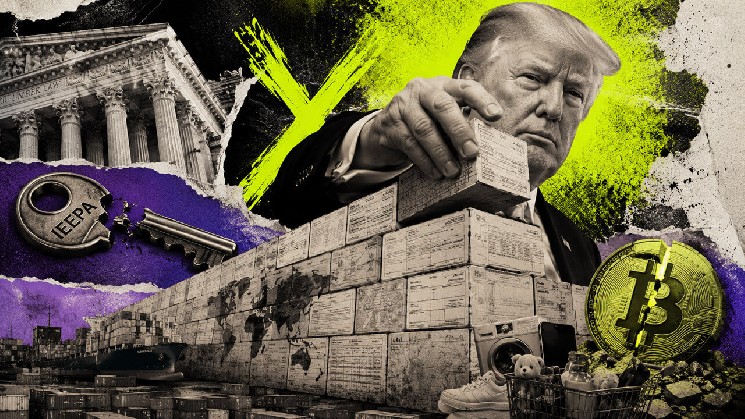
The Supreme Court Rejected the Tariff Key, Not the Wall
Trump's original tariffs rested on the International Emergency Economic Powers Act (IEEPA). Presidents have traditionally used that law to freeze assets, block transactions, and impose sanctions during national emergencies. Trump contended that its authority to regulate imports also permitted broad tariff imposition.
On Feb. 20, the Supreme Court rejected that interpretation. The holding was narrow but devastating to the administration's original framework: IEEPA does not authorize the president to impose tariffs.
The justices did not outlaw tariffs altogether, abolish presidential trade powers, or declare import duties unconstitutional. They ruled solely that this specific statute could not support this specific application, leaving the broader presidential tariff toolkit largely intact.
That distinction gave the administration room to maneuver. Congress has delegated several narrower tariff authorities to presidents over the years, each addressing a particular category of economic grievance. Losing IEEPA meant Trump could no longer deploy a single emergency declaration as a near-universal import-tax instrument — but the alternative mechanisms already embedded in federal law remained available.
The first replacement came almost immediately. Trump invoked Section 122 of the Trade Act on Feb. 24 to impose a temporary 10% import surcharge, citing a serious balance-of-payments problem. Section 122, however, imposed a constraint: without congressional action, the surcharge could last no more than 150 days. It served as a bridge rather than a permanent restructuring, and its July expiration created a hard deadline to find something more durable.
The second replacement took longer because Section 301 demands substantially more procedural work. The government must identify a foreign practice it deems unreasonable or discriminatory, explain how that practice burdens US commerce, conduct an investigation, consult affected governments, accept public comments, and then select a response. This is the same statute the first Trump administration used to impose duties on more than $370 billion of Chinese imports beginning in 2018, meaning the infrastructure for Section 301 enforcement — agency expertise, legal templates, and tested procedural playbooks — was already in place when IEEPA fell.
This extended bureaucratic process functions as legal armor — each hearing, footnote, and written finding provides additional material government lawyers can present to a court.
CryptoSlate previously examined the immediate financial fallout of the Court's ruling, including more than $175 billion in potentially refundable tariff collections. The new tariff regime represents the next phase of that confrontation: the Court eliminated one path, and the White House sought another.
Forced Labor Became the New Legal Basis
On March 12, the administration launched 60 separate Section 301 investigations, each examining whether a trading partner had failed to prohibit imports made with forced labor or failed to enforce an existing ban.
In June, the Office of the United States Trade Representative (USTR) concluded that the targeted economies' policies were unreasonable and burdened American commerce. The agency's rationale: goods produced with forced labor can enter countries that do not block them, reducing costs within global supply chains and placing American companies at a competitive disadvantage.
Section 301 authorizes the United States to respond to foreign practices that burden domestic trade, providing Trump a statutory pathway to new duties. The administration's full investigation report details the legal and economic reasoning underlying that approach.
Forced labor is a documented human-rights abuse, and blocking products derived from it is a legitimate policy objective. The more difficult question is whether broad duties applied to nearly every product from dozens of highly diverse economies constitute a targeted remedy for that abuse — or a convenient mechanism for reconstructing tariffs the White House already intended to impose.
Canada, Mexico, the European Union, Pakistan, Ecuador, and Indonesia were among the economies USTR identified as having prohibitions that were not being effectively enforced. Several others had made commitments through trade agreements or adopted partial enforcement systems.
Those groups generally received a 10% rate, while most remaining targets received 12.5%, according to the final White House action.
The uniformity of the rates produces notable disparities. A country with a developing customs apparatus, an advanced economy with an established forced-labor ban, and a government accused of severe labor abuses can all fall within the same basic tariff framework. The distinctions exist but manifest primarily through rate categories, exemptions, and product-specific treatment rather than through fundamentally different remedies for each government.
USTR conducted hearings, consulted more than 45 governments, and processed thousands of comments across the investigative and remedy phases. This record gives the administration more than a slogan to defend in court — but it also gives challengers an extensive body of material to scrutinize for inconsistencies, weak evidence, and indications that the White House chose its outcome before USTR began its work.
The Rates Are Simple Until Someone Actually Imports Something
A tariff is an import tax. The company bringing a product into the United States pays it to the US government at the border, typically through the customs process. China does not receive an invoice from Washington, and France does not wire the Treasury because an American purchased a French handbag. The revenue is collected from the importer — even when politicians describe tariffs as a bill paid by a foreign country.
The economic cost can still spread beyond the importer. A foreign manufacturer may reduce its price to preserve the sale, an American distributor may accept a narrower margin, a retailer may raise prices for consumers, or all parties may absorb a portion.
Consider an American retailer importing a $100 appliance subject to a 10% additional duty. The retailer initially owes an extra $10 at the border and must then decide whether to raise the shelf price, request a discount from the manufacturer, reduce its own profit margin, use cheaper components, switch suppliers, or combine several of these strategies.
Every option carries costs. Relocating production requires capital, reducing quality alienates customers, narrower margins frustrate shareholders, and higher prices affect anyone who has recently visited a grocery store, furniture retailer, or electronics shop.
The 10% and 12.5% labels also do not capture every shipment. The administration exempted categories including materials lacking adequate domestic supply, products whose tariffs could cause wider economic disruption, and goods the United States cannot produce in sufficient quantities at reasonable prices. Oil, gas, fertilizer, certain foods, and critical minerals were among the exclusions reported when the tariffs took effect.
The EU, Taiwan, Japan, South Korea, and Switzerland received special treatment accounting for their existing most-favored-nation rates. Textile quotas and negotiated tariff caps add further complexity for several exporting nations.
An importer therefore cannot simply look at a map, identify a country's assigned rate, and complete the calculation. It must determine the product's customs classification, origin, standard duty, Section 301 treatment, exemption eligibility, and interaction with any other tariff already in place.
The tariff wall is less a single border fence and more an airport baggage policy designed by 60 different committees: the broad rule fits on a sign, while the actual fee appears only after someone measures the wheels.
The Administration Says the Economic Effect Will Be Limited
US Trade Representative Jamieson Greer stated that the new duties should not have a significant economic effect. He argued that companies and markets had already adapted to elevated tariffs and that the action should not alter the Federal Reserve's policy decisions.
That assertion is not as implausible as the scale might initially suggest. Many imports were already subject to higher duties, some products are exempt, several countries received rates adjusted for existing tariffs, and companies have spent more than a year adjusting suppliers and prices. The latest action also replaced an expiring 10% surcharge rather than landing in a tariff-free environment.
Nevertheless, replacing an expiring tax with a similar tax still leaves consumers paying more than they would have if the surcharge had simply disappeared.
The Budget Lab at Yale estimates that current US tariffs will cost the average household approximately $1,100 annually and raise roughly $1.9 trillion over ten years after accounting for their effect on economic growth. Those estimates cover the broader tariff regime, not solely the forced-labor action, but they demonstrate why the debate over who pays is not merely semantic.
Revenue is an underappreciated dimension of the tariff rebuild. The invalidated emergency tariffs created a massive refund problem, and allowing the temporary surcharge to expire without a replacement would have eliminated a significant stream of federal income.
CryptoSlate's report on Trump's first 100 days showed how tariffs became entangled with the administration's wider economic and crypto agenda from the outset.
Tariffs now serve multiple functions simultaneously: punishing foreign practices, pressuring countries to change their laws, encouraging domestic production, providing negotiation leverage, and generating revenue. These objectives do not always align. A tariff that eliminates imports produces no ongoing customs revenue, while a tariff that becomes a dependable revenue source works best when Americans continue importing the taxed goods.
Washington wants factories to return home while tariff payments keep flowing through the border — an ambitious combination even by government standards.
Bitcoin Receives the Bill Through the Fed
Bitcoin does not react to tariff schedules because traders are preoccupied with customs classifications. It is affected because tariffs can shift the expected trajectory of inflation, interest rates, and the dollar, which in turn forces large portfolios to recalibrate their risk exposure.
The first channel runs through consumer prices. When importers pass higher costs to customers, inflation can remain elevated for longer. The Federal Reserve's July Monetary Policy Report stated that earlier tariff increases had already pushed up domestic prices for certain imported goods. Separate Fed research estimated that tariffs implemented through November 2025 had raised core goods inflation considerably.
Higher inflation does not automatically trigger a rate increase, particularly when policymakers expect the price impact to be temporary. It does, however, make rate cuts harder to justify and gives hawkish officials more ammunition to keep financial conditions restrictive.
Bitcoin has spent much of 2026 responding to that calculation. Strong economic data, persistent inflation, or any shock that reduces the probability of easier policy can lift yields, strengthen the dollar, and dampen demand for speculative assets.
CryptoSlate's labor market analysis demonstrated why a resilient economy can repeatedly function as a Bitcoin sell signal. Bitcoin frequently responds to what a data release implies for the Fed rather than whether the release sounds positive on its face.
The second channel runs through bonds. Investors purchasing long-term Treasury debt demand compensation for inflation, fiscal risk, and uncertainty about future interest rates. Rising yields compete directly with Bitcoin: government bonds offer better returns, corporate financing becomes more expensive, and investment funds reduce exposure to assets that do not generate cash flows.
This pressure extends to public miners, companies holding BTC on their balance sheets, and spot Bitcoin ETF issuers. During an earlier tariff scare, US funds recorded approximately $235 million in net Bitcoin ETF outflows, with products from Fidelity, Grayscale, Bitwise, and ARK Invest among those affected.
Tariffs can also affect crypto through hardware. Asia dominates global production of Bitcoin mining equipment, and companies like Bitmain, Canaan, and MicroBT — the three largest manufacturers of application-specific integrated circuit (ASIC) mining rigs — began shifting portions of their production toward the United States as trade tensions intensified. That illustrates how customs policy can reshape the physical supply chain behind a digitally native industry, raising the capital cost of the machines that secure the Bitcoin network.
The third channel runs through the dollar, though this relationship is less consistent. Tariffs can strengthen the dollar when global investors seek safe-haven assets or anticipate sustained US rate levels. Conversely, tariffs can weaken the dollar when investors focus on policy disorder, slowing growth, or eroding confidence in American assets.
Bitcoin does not automatically rise when the dollar falls. CryptoSlate's examination of the "Bye America" trade showed that the connection passes through real yields, currency-hedging costs, and institutional risk limits rather than simple chart symmetry.
The fourth channel is speed. Bitcoin trades around the clock, including weekends when bond markets are closed and many institutional desks operate with skeleton staffing. A tariff announcement can therefore generate a crypto reaction before traditional markets fully reopen. Trump's earlier tariff escalation contributed to $2 billion in crypto liquidations, while another US-European trade confrontation pushed Bitcoin lower as gold advanced.
BTC can appear unusually fragile during the opening phase of a macro shock because it is one of the few large assets available for immediate sale. The same characteristic later enables it to reprice before the rest of the financial system catches up.
The bearish case for Bitcoin typically emerges first: tariffs raise costs, inflation persists, yields climb, the Fed holds policy tight, and leveraged crypto positions unwind. Bitcoin behaves like a high-volatility macro asset during liquidity pressures because that is how many institutions own and trade it. A fixed supply does not prevent investors from selling when their financing costs rise or their portfolios breach internal risk thresholds.
Tariffs can also exert a bullish effect on Bitcoin, but this takes considerably longer to materialize. Trade fragmentation weakens growth, governments respond with subsidies or fiscal support, debt expands, and pressure builds for easier monetary policy. Investors may then gravitate toward an asset with a fixed issuance schedule and no attachment to national trade policy.
Bitcoin can decline during the initial inflation shock and recover when the policy response shifts toward accommodative money. It can also fail to recover if inflation remains high enough to forestall that response. Five indicators will signal which scenario is unfolding: inflation expectations, two-year and ten-year Treasury yields, the dollar index, Fed rate pricing, and Bitcoin's own leverage levels.
A tariff announcement alone tells traders little without revealing how those variables react.
This Tariff Framework May Outlast the First
Section 301 provides a more explicit tariff authority than IEEPA, and the administration built a supporting structure of investigations, findings, hearings, and product exemptions around its use. Federal courts have historically granted substantial deference to USTR Section 301 determinations, a precedent that further strengthens the new framework's legal posture compared with the invalidated IEEPA approach. None of this guarantees success in court, but it shifts the legal contest from a broad question about emergency power into a detailed dispute over evidence, procedure, and whether the remedy fits the alleged foreign practice.
Challengers can argue that duties covering nearly every product are excessively broad, that USTR treated vastly different economies identically, or that forced labor served as a pretext for reinstating invalidated tariffs. The administration can counter that Section 301 expressly permits responses to foreign practices burdening US commerce and that its record includes consultation, public comments, differentiated rates, and exemptions.
Trade attorneys told Reuters that the newer tariff wave is likely to prove more durable because it rests on traditional trade statutes rather than a sweeping emergency claim. Additional Section 301 investigations could introduce further barriers, including measures tied to industrial overcapacity.
Judges may ultimately determine whether the existing record is sufficient. In the meantime, importers must pay under the current framework while legal arguments proceed, and companies must plan supply chains without knowing whether the wall will hold, lose another foundation, or reappear under yet another statute.
That uncertainty may be the most enduring feature of Trump's trade policy. Once tariffs generate federal revenue, shield favored industries, and serve as bargaining chips in international negotiations, removing them creates a new constituency with something to lose. Future presidents may disapprove of Trump's methods while benefiting from the leverage he established.
The Supreme Court established that presidential tariff power has limits, but it could not eliminate the political demand for tariffs. Trump responded by substituting a broad emergency claim with a slower system assembled from formal investigations and older congressional delegations. The new wall contains more doors, exemptions, and technical provisions than the old one — but an American household still encounters it through the price of everyday goods.
Bitcoin meets it several steps later, after the import tax works its way through inflation, bonds, the dollar, and the Fed. Trade lawyers will debate which statute supports the structure; crypto traders only need to know whether it keeps money expensive.

