Supreme Court Weighs Emergency Appeal on Trump Mail-In Voting Restrictions Ahead of Midterms
Key Takeaways
- •The Trump administration's emergency appeal asks the Supreme Court to overturn a Massachusetts federal judge's injunction that halted a March 2026 executive order seeking to restrict mail-in voting by requiring the Postal Service to verify voter eligibility.
- •The Supreme Court case centers on whether lower courts acted prematurely in blocking the executive order before implementing rules were finalized, rather than on the underlying constitutional questions about presidential authority over elections.
- •Justice Ketanji Brown Jackson, handling emergency appeals from the 1st Circuit, ordered plaintiff states to respond to the administration's filing by Monday, with a ruling possible at any time.
- •The U.S. Postal Service stated in July court filings that insufficient time remains to implement the demanded changes before the November elections, and legal experts across the political spectrum agree full implementation in 2026 is unlikely.
- •If the Supreme Court sides with the administration, a coalition of attorneys is prepared to mount fresh legal challenges once the new rules are finalized, as even appellate judges who found the current challenges premature expressed concern about the order's lawfulness.
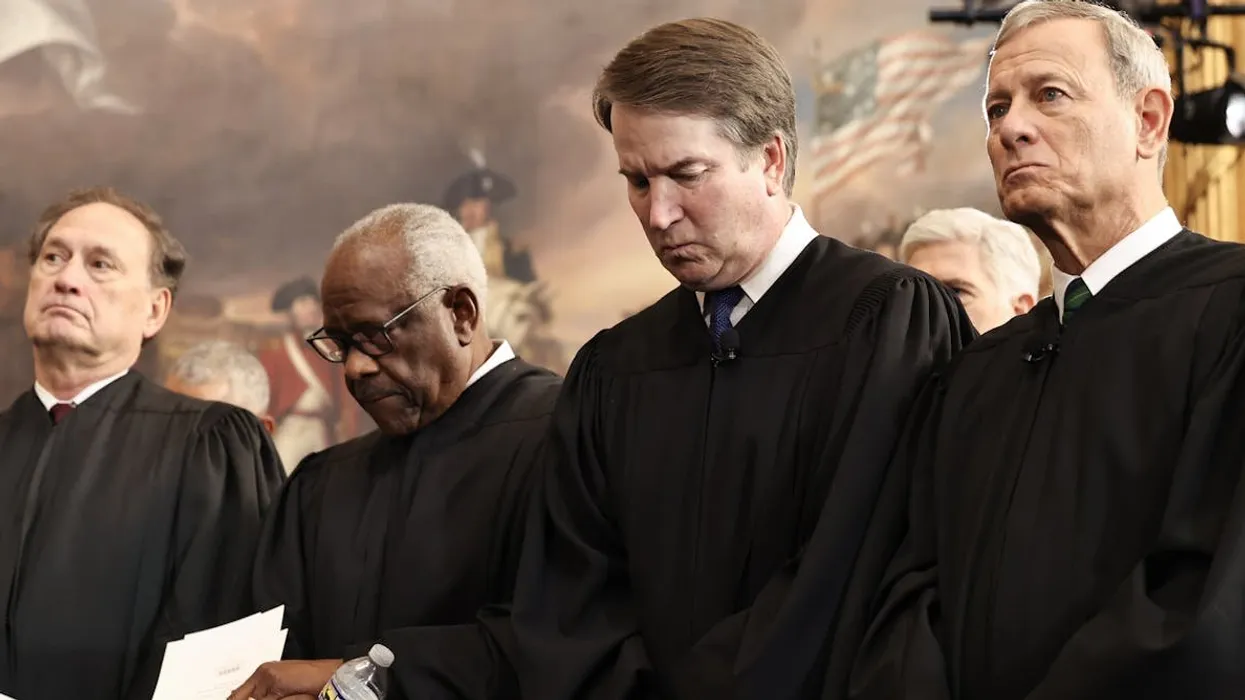
Election law has returned to the U.S. Supreme Court, as the Trump administration seeks an emergency order to lift a lower court injunction blocking new restrictions on mail-in voting for the rapidly approaching midterm elections.
The case, while high-profile, turns on a narrow procedural question: whether the lower courts acted prematurely in their rulings, rather than addressing the broader constitutional questions surrounding the legality of the executive order itself. Regardless of how the justices decide, however, a combination of practical and legal hurdles makes it increasingly unlikely that the federal government could impose new rules granting the U.S. Postal Service authority to block Americans from voting by mail in November's elections.
Supreme Court Justice Ketanji Brown Jackson — the justice designated to handle emergency appeals from the 1st U.S. Circuit Court of Appeals — ordered the plaintiff states to respond by Monday to the Trump administration's filing. A decision could follow at any time. With fewer than 100 days remaining before the election, the U.S. Postal Service stated in July court filings that it is running out of time to implement the changes the president is demanding. The compressed timeline also intersects with a longstanding Supreme Court doctrine often called the Purcell principle, under which justices are reluctant to permit changes to election procedures close to voting day to avoid voter confusion and administrative disruption.
The dispute centers on President Donald Trump's March 2026 executive order, which seeks to restrict mail-in voting by requiring the creation of multiple voter eligibility lists. Among these, the order mandates that the U.S. Postal Service obtain from states a comprehensive list of all voters eligible to use mail ballots. The order would grant the Postal Service unprecedented authority to prevent the delivery of mail ballots to anyone not appearing on these lists — a dramatic departure from the agency's historical role as a delivery service with no involvement in determining voter eligibility.
States, nonprofit organizations, and Democratic Party committees swiftly challenged the order in court, arguing it is unconstitutional because the president lacks authority over elections. Under the Constitution's Elections Clause, states hold primary responsibility for administering federal elections, with authority granted to Congress — not the executive branch — to alter those procedures. Federal courts have since issued conflicting rulings on whether blocking the order's major provisions would be premature, given that government agencies have not yet taken final action to implement it.
A federal judge in Washington, D.C. declined to block the challenged provisions. However, last month, in a separate case brought by states, a federal judge in Massachusetts prevented the Trump administration from proceeding with the plans, effectively putting the entire initiative on hold. Separate appeals courts upheld both rulings, leaving the Massachusetts injunction in place — which prompted the Trump administration to file its emergency appeal with the Supreme Court last week. The administration's 116-page filing is available from the Supreme Court's docket: Trump v. California Application and Appendix (PDF).
"I think everyone agrees that it's not going to be implemented for 2026," said Derek Muller, an elections specialist at the University of Notre Dame Law School. "The logistics are so horrific."
The issue before the Supreme Court is not about the legal merits of the executive order, nor whether Trump possesses the authority to issue it. Instead, the Trump administration contends that the federal courts blocked the executive order prematurely, because the government is still drafting the relevant rules, which have not been finalized. Until the rules are final, the administration argues, the states cannot demonstrate any harm warranting judicial intervention, nor can they show that agencies will fail to carry out the order in a lawful manner.
The Massachusetts court's injunction "is especially indefensible because the agencies are still deliberating over how (if at all) to implement the Order, yet the district court preemptively decided that whatever the agencies may choose to do will necessarily be unlawful," the Trump administration argued in its filing.
A panel of judges from the U.S. Court of Appeals for the District of Columbia reached a similar conclusion in a ruling Tuesday, upholding a lower court's decision not to block the executive order. The plaintiffs in that case, however, are nonprofit groups and party committees rather than states.
"The scope of the issues at play" before the Supreme Court "are really, really narrow," said Danielle Lang, vice president for voting rights and rule of law at the Campaign Legal Center, one of the attorneys involved in bringing the Washington, D.C. case.
Like Muller, Lang said it appears unlikely the government would have sufficient time to implement the changes before November.
"The kinds of dramatic changes they are asking for in election administration are not the kinds of things that you get done in a few months' time," Lang said. "As a practical reality, I don't think they can do this in any non-chaotic way."
If the Supreme Court sides with the Trump administration, a broad coalition of attorneys across the country is prepared to again seek judicial intervention as soon as the new rules are finalized. Even the appeals court judges in Washington who agreed the legal challenges were premature signaled reservations about the executive order.
"Plaintiffs have identified a number of serious questions concerning the lawfulness of proposed actions if implemented on the threshold of the upcoming federal election," the court stated in its ruling.
This article was originally published by Votebeat, a nonprofit news organization covering local election administration and voting access. The original report is available at Votebeat's full coverage. Additional background on the executive order and related litigation is available at Votebeat's earlier reporting. Reporting on the Massachusetts injunction is available here, and coverage of the earlier appeal is available here.
Dion Nissenbaum is Votebeat's senior national reporter, based in Houston. He can be contacted at dnissenbaum@votebeat.org.

