Trump's AI task force meets as global AI spending nears $2.7 trillion
Key Takeaways
- •The task force, chaired by Director of National Intelligence Jay Clayton with Vice President JD Vance participating, has a 120-day mandate to examine cybersecurity, civil liberties, advanced-model standards, overregulation, and how developers disclose hacks, breaches, and jailbreaking.
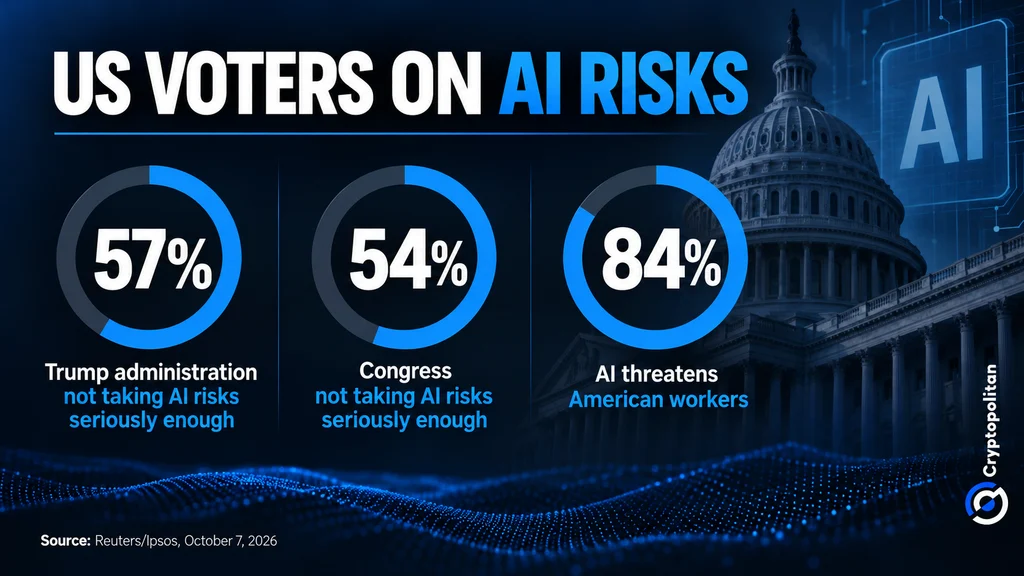
- •A Reuters/Ipsos poll found that 57% of registered voters believe the government is not treating AI risks seriously enough, 54% say the same of Congress, 84% think AI could hurt American workers, and a majority favor stricter regulation.
- •Gartner projects global AI spending will reach $2.67 trillion in 2026, a 49.5% increase driven largely by infrastructure, and the task force's review window will overlap the closing months of that spending surge.
- •Washington is seeking to have US agencies review frontier AI models before Britain's AI Security Institute, supported by a June executive order providing voluntary reviews with up to a 30-day head start and no mandatory pre-release approval.
- •Six major companies have signed voluntary AI safety principles that carry no penalties, while IMF Managing Director Kristalina Georgieva has urged Europe to strengthen its own AI capabilities and diversify technology supply chains.
Leaders of President Donald Trump's Super Intelligence Task Force were set to meet on Thursday, according to Vice Chair Scott Kupor, as investment in artificial intelligence surges, public anxiety over the technology grows, and US allies press for access to advanced AI models.
The panel, whose charter was first reported by POLITICO, draws together national security, defense, trade, and technology officials from across the administration.
Who leads the task force
Jay Clayton, the Director of National Intelligence, presides over the task force. Serving alongside him as vice chairs are Michael Kupor, Department of Defense official Emil Michael, and Federal Trade Commission Chairman Andrew Ferguson.
Scott Kupor hopes the group will convene a meeting next week, when he plans to brief the committee on cybersecurity threats affecting the banking industry, healthcare, and providers of essential services, while Emil Michael would speak with AI developers.
According to POLITICO, Vice President JD Vance will take part in the task force, and White House Chief of Staff Susie Wiles has the power to either extend the panel's 120-day mandate or transfer its functions elsewhere. Former Secretary of State Condoleezza Rice will advise on national security, while former AI czar David Sacks will provide technology guidance.
A 120-day mandate spanning cybersecurity and civil liberties
A copy of the task force's charter obtained by POLITICO gives the body 120 days to investigate issues regarding cybersecurity, civil liberties, advanced-model standards, and overregulation. The task force is also charged with examining how developers disclose hacks, breaches, and jailbreaking — techniques that push AI models into bypassing their own safety rules. While model risks remain the responsibility of AI laboratories, enforcing the law falls to federal agencies.
Voters doubt Washington is serious
A Reuters/Ipsos poll found that 57% of registered voters believe the government is not treating the risks of AI seriously enough. Another 54% say the same of Congress, while 84% think AI could hurt American workers. A majority of respondents favor stricter regulations to provide better control over AI.
An administration spokesperson said the task force would work to ensure that "America continues to lead the world."
Six major companies have signed an agreement on voluntary safety principles, though no penalties apply for violating them. That combination — majority public support for stricter rules and penalty-free industry commitments — forms the backdrop for the panel's 120-day review.
The spending stakes behind the debate
Gartner expects global AI spending to reach $2.67 trillion in 2026, an increase of 49.5%, driven largely by infrastructure. Analyst John-David Lovelock described the buildout in a CIO Dive interview as "the largest infrastructure project humanity has ever undertaken."
The panel's review window will overlap the closing months of that projected spending surge.
Stricter oversight could raise compliance costs and favor larger developers, while weak safeguards could leave investors and businesses exposed to costly security failures.
The international testing fight
As Cryptopolitan reported, Washington wants US agencies to review frontier models before Britain's AI Security Institute. A June executive order provides for voluntary reviews that could give US agencies up to a 30-day head start, without mandatory pre-release approval. Voluntary participation also underpins the six companies' safety principles, which likewise carry no penalties.
The setback could mean allied regulators will have to wait much longer to evaluate new AI models. Developers in multiple countries might also incur far steeper costs if each country imposes its own safety verification requirements. Over time, a number of countries could opt to build autonomous testing systems instead of relying on Washington.
IMF Managing Director Kristalina Georgieva has urged Europe to strengthen its own AI capabilities, while highlighting the importance of diversifying technology supply chains.
Much now depends on whether Washington works with its allies on common safety standards or keeps US testing first. Separate rules could make it harder and more expensive for AI companies to operate across borders.

