Trump tells CNBC Nvidia's Blackwell chips are 'uncopyable' as he defends Jensen Huang's reinstatement
Key Takeaways
- •President Donald Trump called into CNBC to defend Nvidia's decision to reinstate CEO Jensen Huang following Huang's affair with an alleged Chinese spy, despite earlier board assurances that he would not return.
- •Reporting cited in the article states that U.S. intelligence agencies knew for about a year that Alice Huang was a Chinese spy while Nvidia routed AI chips through a shell company in Singapore.
- •Trump argued that selling Nvidia's most advanced AI chips to China posed little risk because he claimed the technology is too complex to copy, and that Blackwell would become obsolete within roughly a year.
- •Under U.S. export rules in effect since October 2022, shipments of Nvidia's most advanced AI chips to China face restrictions, and the company says its Blackwell line is not approved for sale there.
- •Trump said Huang had apologized for the affair, which everyone had accepted, and predicted the renewed attention would ultimately work in Nvidia's favor.
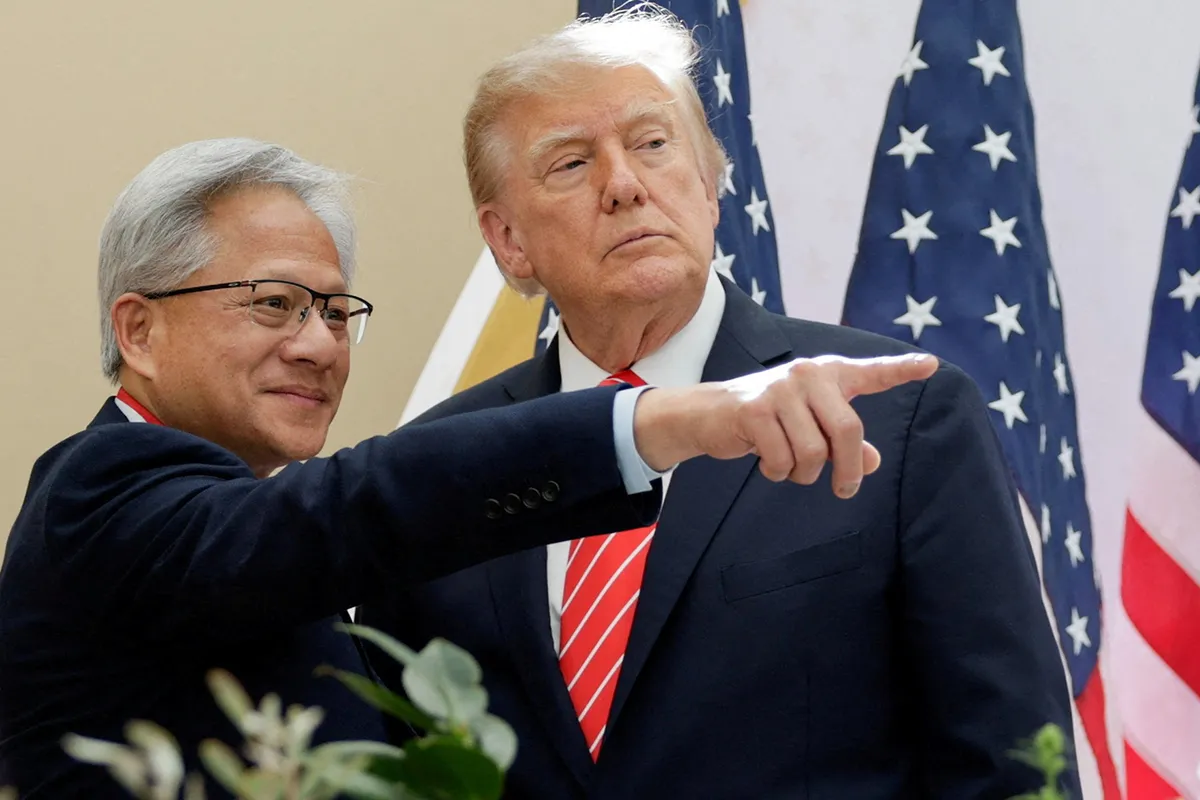
President Donald Trump called into CNBC on Monday morning to discuss the reinstatement of Nvidia CEO Jensen Huang, who was brought back to the company despite the board's assurances that he would not return following his affair with an alleged Chinese spy.
According to reporting by Alternet, U.S. intelligence agencies knew that Alice Huang was a Chinese spy for about a year while Nvidia funneled its AI chips through a shell company in Singapore.
After posting on Truth Social about the "correct and proper decision," Trump called in to the network to argue that it was no big deal that Huang was sending the top AI chips to China, because they "can't be copied like the Blackwell is." That claim lands in one of the most heavily regulated corners of the semiconductor industry: U.S. export rules have restricted shipments of Nvidia's most advanced AI chips to China since October 2022, and Nvidia has said its Blackwell line is not approved for sale there under the current restrictions.
"You know, I used to hear ten years, I don't know what it is, maybe two, three, four years, but ten years advanced and nobody can copy it," Trump said. "You know, I have a friend, David from WeatherTech, right? He does a rubber mat. He does a great company, but he says everybody copies it within two minutes. They're copying it. ... I have another friend. He makes movies. He puts a movie out within — within 24 hours. Millions of copies are made of the movie sold all over the world. It's terrible with a chip. You can't do that with a, you know, an advanced chip like, like the top ones."
Trump claimed that no one could copy the chips "because nobody understands it." That argument is also the premise underpinning U.S. export policy, which assumes China cannot yet produce leading-edge chips on its own; Chinese fabs have been cut off from the extreme-ultraviolet lithography tools needed to manufacture them under U.S. and Dutch export restrictions.
"But a guy like Jensen, they can't copy it," he continued. "It's uncopyable. I asked him, I said, why doesn't somebody pirate it like they do everything else? He said, nobody else can. Nobody else has the — it's really the brainpower but the technology to do it. Nobody else is able to copy it. ... And it's not only China, it's other countries too, but they copy everything. It's called pirating and it's a huge problem, a huge problem. But this is — it's not a problem with the chip because the complexity of the chip is so vast, it's so incredible that you can't copy it. And he's got other chips in mind that are far beyond the Blackwell."
Trump then claimed that the Blackwell would ultimately become "obsolete" even after representing "something that's unbelievable. A year later it's obsolete. And when it is obsolete, then you can go out to the market. I would have no problem with that." Nvidia has said it now works on an annual release rhythm for new AI accelerator generations, and its publicly announced roadmap names Rubin as the next architecture beyond Blackwell, with a company-stated debut planned for 2026.
By the time China has its own version of the chips, he argued, it will not matter, because "there's a difference between selling a very highly advanced chip that nobody else has and selling a chip that they make themselves pretty much."
Asked what comes next for the company after the affair with the spy and a subordinate, the president said Huang would come back even bigger and better.
"I think he's going to start off at a higher level. He's apologized for indiscretion, which was unfortunate. That was probably — that's what brought it to such a level, because sex sells fellas. Now, Cramer would not know that because he's a — he's a very, very, very committed person. But sex sells." Trump was referencing Jim Cramer, the longtime host of CNBC's "Mad Money."
Trump added that Huang had apologized for the affair and that everyone had accepted it, while not addressing the significance of the relationship having involved a Chinese spy.
Because Huang had drawn more attention to the company through the affair, Trump argued, the episode would ultimately work in Nvidia's favor.

