Expert Says Trump May Not Object to Acknowledging North Korea's Nuclear Arsenal
Key Takeaways
- •Victor Cha of CSIS said Trump likely has no problem acknowledging North Korea's nuclear weapons because he views their development as the failure of 35 years of prior U.S. policy rather than his own.
- •Cha expects North Korea to wait until after the November U.S. midterm elections before any potential summit with Trump, believing it would have more leverage against a weakened president.
- •Retired Gen. Vincent Brooks said the earliest realistic window for Trump-Kim summitry lies between November and the G20 summit in Florida in December, with later meetings more likely to produce substance.
- •A White House official said U.S. policy on North Korea has not changed but stopped short of reaffirming the denuclearization goal, following Trump's claim that the North holds 57 nuclear weapons.
- •Cha raised the possibility of Trump inviting Kim to the G20 summit, and said Pyongyang may still seek talks to hedge against China and Russia and to discuss South Korea's pursuit of nuclear-powered submarines.
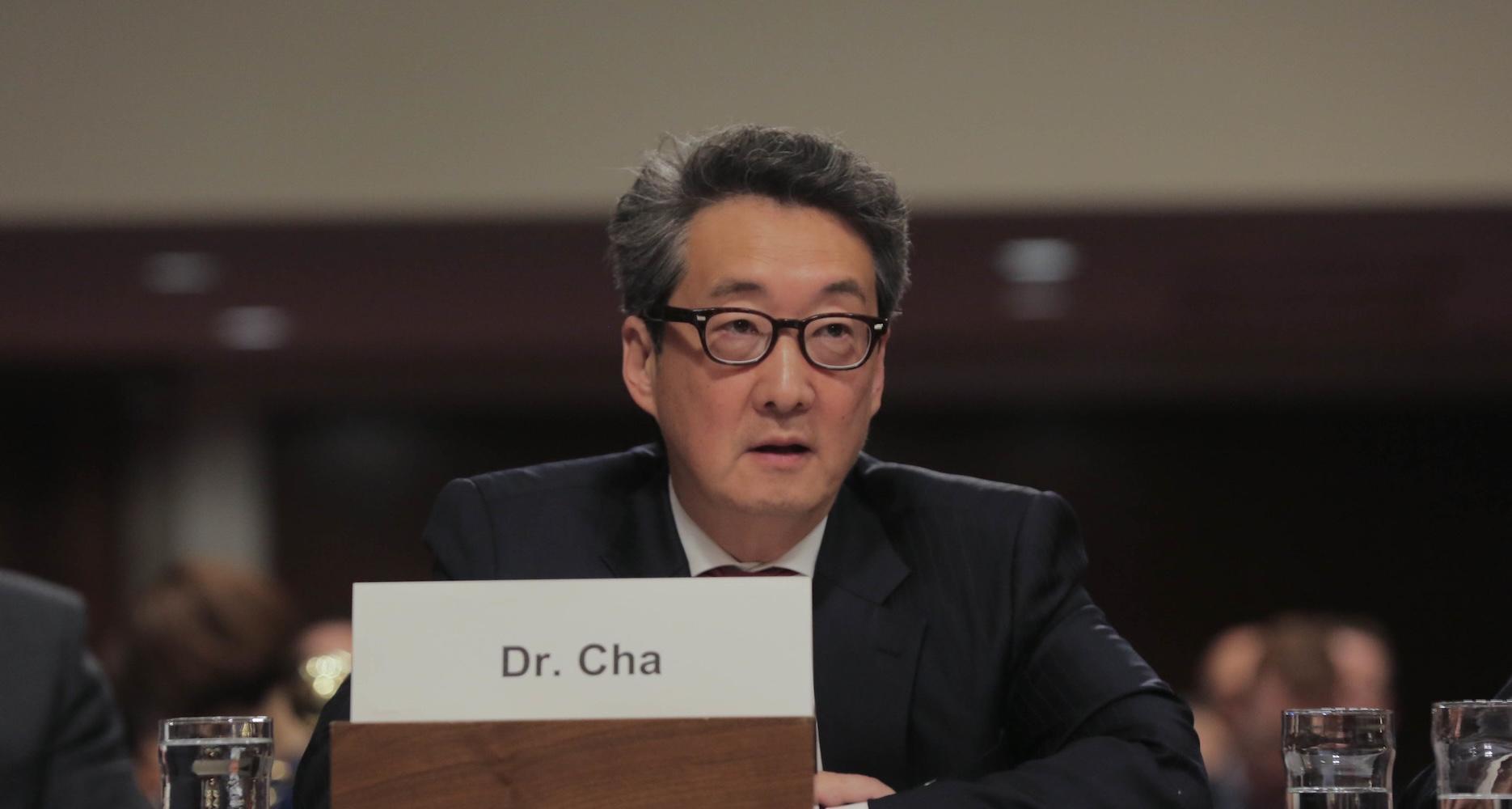
WASHINGTON — A prominent expert said Thursday that U.S. President Donald Trump may have no problem acknowledging North Korea's possession of nuclear weapons, reasoning that he views the situation as "not his fault," while also suggesting that Pyongyang may hold off on any potential summit with Trump until after the November midterm elections.
Victor Cha, president of the Geopolitics and Foreign Policy Department at the Center for Strategic and International Studies (CSIS), made the remarks during a CSIS podcast. His comments come as Trump seeks a meeting with North Korean leader Kim Jong-un later this year, amid ongoing questions about whether the U.S. president would adhere to the long-elusive goal of the North's denuclearization. Successive U.S. administrations, both Republican and Democratic, have long made the complete denuclearization of North Korea a stated policy goal, but the North has continued to build its arsenal, making any formal U.S. acknowledgment of it as a nuclear power a significant shift in principle.
"When it comes to Trump and North Korea as a nuclear weapons state, I actually don't think President Trump has a problem with acknowledging North Korea's possession of nuclear weapons, or that they are, in fact, a nuclear weapons power," Cha said during the podcast.
"I don't think he has a problem with that because ... in his mind, that is not his fault. That is the failure of 35 years of U.S. policy, everybody before him, and that is why he is in this situation," he added.
Last month, Trump said that Pyongyang holds 57 "very powerful" nuclear weapons, adding that if he had been president during the North's pursuit of nuclear weapons, he would not have allowed it. He also reiterated that he gets along with Kim "very well."
In response to concerns about whether the Trump administration would maintain the denuclearization goal, a White House official told Yonhap News Agency earlier this week that U.S. policy on North Korea has not changed. The official, however, stopped short of reaffirming the denuclearization goal.
Cha said he expects North Korea might wait until after the U.S. midterm elections, calculating that it could gain more leverage in potential talks with the United States at that point.
"I think that if the North Koreans are at all interested in meeting Trump again, they will wait till later in the year. In particular, from their perspective, they will believe they have more leverage after the president is more likely weakened by the midterm elections in November," he said.
Retired Gen. Vincent Brooks, who led U.S. Forces Korea from 2016 to 2018 and also appeared on the podcast, said the earliest window for potential summitry between Trump and Kim might fall between November and the Group of 20 summit scheduled to take place in Florida in December.
Brooks noted that North Korea can afford to wait for a meeting with the U.S., as it may want to assess "where the wind is blowing" amid a series of major events: Chinese President Xi Jinping's planned visit to Washington this month, a major Central Committee session of the Chinese Communist Party next month, and the U.S. midterm elections the month after that.
"I think the consequences are: the sooner it happens, the more performative it will be," Brooks said. "The later it is, the more likely there can be some substance."
He assumed that both Washington and Pyongyang would want an "early touch point" during the fall, followed by opportunities for substantive follow-up discussions thereafter.
Commenting on the G20 summit later this year, Cha raised the possibility of Trump inviting Kim to the gathering.
"Can you imagine the idea that Trump would invite North Korea to the G20? Because the G20 itself is not something that president Trump cares much about, but this would be something that would gather all the attention, global attention of the U.S. hosting the G20," he said.
While questions remain over whether Kim would have any interest in reengaging with Trump — given North Korea's deepening cooperation with Russia and improved ties with China — Cha outlined a range of reasons why Pyongyang might still want a meeting with Washington.
"I don't think North Korea is a status-quo power. They are always looking to improve their position, and meeting with the U.S. could improve their position vis-a-vis both China and Russia by showing they have an active hedge," he said.
"The second thing is that ... I don't think they worry every day that the U.S. is going to attack them. But they have seen what the U.S. has done in Iran and Venezuela and potentially in Cuba, and so there is something on their side to be said for having a touch point with the president to minimize the chances of that."
Cha also argued that North Korea may want to speak with Trump about South Korea's push to acquire nuclear-powered submarines and other stronger military capabilities.
He further anticipated that if a Trump-Kim summit takes place, it could be a "bigger meeting" that reaffirms the agreement from their first meeting in Singapore in June 2018, which included establishing new relations between the two countries and building a "stable and enduring peace" on the Korean Peninsula.
Trump held three in-person summits with Kim during his first term: the first in Singapore in June 2018, the second in Hanoi in February 2019, and the third at the inter-Korean border village of Panmunjom. The Hanoi summit ended without an agreement after the two sides failed to bridge differences over sanctions relief and the scope of the North's denuclearization — a precedent that looms over any new round of diplomacy.

