Trump's Unblended Makeup and Bruised Hands Raise New Questions About His Health
Key Takeaways
- •A report from The Daily Beast on Tuesday described a visible line where President Trump's facial makeup ended, with his face and neck appearing as noticeably different shades as he spoke to reporters before boarding Air Force One.
- •The same report observed a thick layer of makeup on Trump's hands, which have frequently shown bruises that some health experts worry could stem from blood draws or intravenous medication or hydration.
- •Sitting presidents traditionally undergo periodic medical evaluations, with results typically summarized for the public by the White House physician, making a president's physical condition a matter of standing public interest.
- •Dr. Henry Abraham, a psychiatrist formerly of Tufts University, led about three dozen health experts in May to urge Congress to invoke the 25th Amendment, characterizing Trump's late-night Truth Social posting as a nocturnal form of mania.
- •Forensic psychologist Dr. Alan D. Blotcky offered a contrasting view, suggesting Trump's behavior may reflect narcissism rather than mental illness and arguing that he understands the difference between truth and falsehood even if he disregards it.
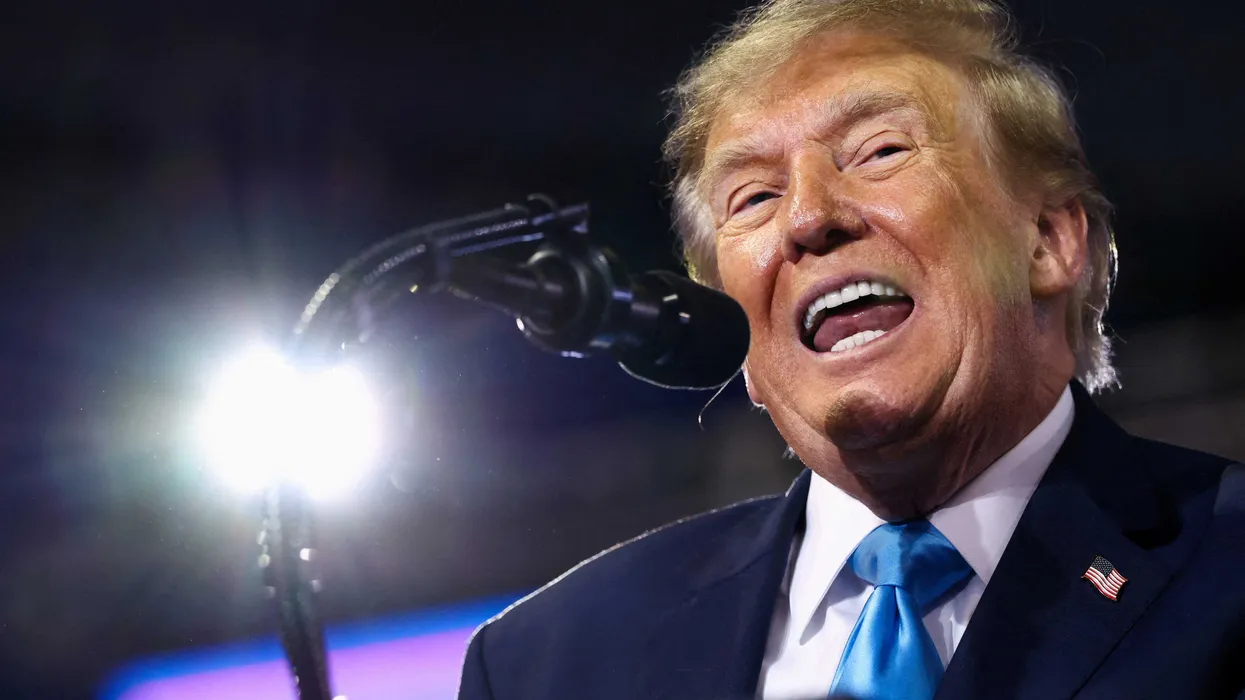
President Donald Trump reportedly uses makeup to conceal pale facial skin and bruised hands, and both were plainly visible — at least according to a report from a recent rally in Texas.
"In a rare move for the president, he wore no tie and left his dress shirt collar unbuttoned as he briefly spoke with reporters before boarding Air Force One at Joint Base Andrews," reported The Daily Beast's Sarah Ewall-Wice on Tuesday. "Not only were Trump's tanned face and neck completely different colors, but onlookers could see the exact line where the president's repeated application of makeup completely stopped."
Ewall-Wice added that Trump "has long used a mix of tanning, bronzer, and makeup to achieve his signature permanently tanned look, which some critics argue is much closer to orange," noting that his makeup use and failure to blend it in have drawn additional scrutiny since his return to office for a second term.
The Daily Beast also reported a noticeably thick caking of makeup on Trump's hands, which have frequently been seen with bruises. Health experts have worried that the marks could be signs that he requires blood draws, or perhaps medication or hydration delivered intravenously. The observations about his face, by contrast, are more analogous to earlier speculation that he had work done on his scalp for a receding hairline — commentary that falls into the realm of gossip about the president's reputed obsession with his physical appearance. Observations like these draw attention in part because a president's physical condition is treated as a matter of standing public interest: sitting presidents traditionally undergo periodic medical evaluations, with results typically summarized for the public by the White House physician.
More broadly, Trump — the oldest person ever elected to the presidency — has displayed fixations and traits that have raised concerns about his mental fitness for office. He is often up until late at night posting on Truth Social, his social media platform.
"He's pathologically hyped up and manic," Dr. Henry Abraham, a psychiatrist formerly of Tufts University who in May led an effort by three dozen health experts to warn Congress to invoke the 25th Amendment against Trump, told AlterNet earlier in October. "In fact, the noun for this is maniac. He's a maniac at night, but he's not a maniac during the day, generally. So it's a nocturnal form of mania which remains to be explained." Section 4 of the 25th Amendment, ratified in 1967, allows the vice president and a majority of the Cabinet to declare a president "unable to discharge the powers and duties of his office," with Congress empowered to resolve any dispute — a process that has never been used against a sitting president. Long-distance commentary of this kind also sits within a long-running professional debate: the American Psychiatric Association's ethics code, a rule adopted in 1973 known as the Goldwater Rule, advises psychiatrists against offering professional opinions on public figures they have not personally examined.
Forensic psychologist Dr. Alan D. Blotcky offered a contrasting view, suggesting that many of the behaviors mental health analysts attribute to illness could in fact simply be narcissism.
"It's his narcissistic game that he plays," Blotcky told AlterNet earlier in October. "He sees everybody else as pawns to be manipulated, and so he manipulates the world around him to fit his needs. But I don't think his particular beliefs are so fixed that he does not understand the difference between the truth and not the truth. He doesn't care, but he knows the difference."

