Trump Loses Ground Among Non-College Voters, a Core MAGA Coalition Group, Data Analyst Warns
Key Takeaways
- •A Marquette Law School survey shows Trump's support among non-college voters within the MAGA movement swung 28 points, from an 8-point advantage in October 2024 to a 22-point deficit.
- •Among the broader non-college electorate, Trump has experienced a 32-point decline, falling from a 13-point victory margin in 2024 to a 19-point deficit in current polling.
- •Non-college voters were a foundational demographic for Trump across all three of his presidential campaigns, having shifted decisively to him beginning in 2016 after decades in the Democratic coalition.
- •Congressional Republicans now trail by 13 points among non-college voters while Democrats hold a 1-point advantage with the same group.
- •The findings carry significant implications for the 2026 midterm elections, when control of both the House and Senate will be contested.
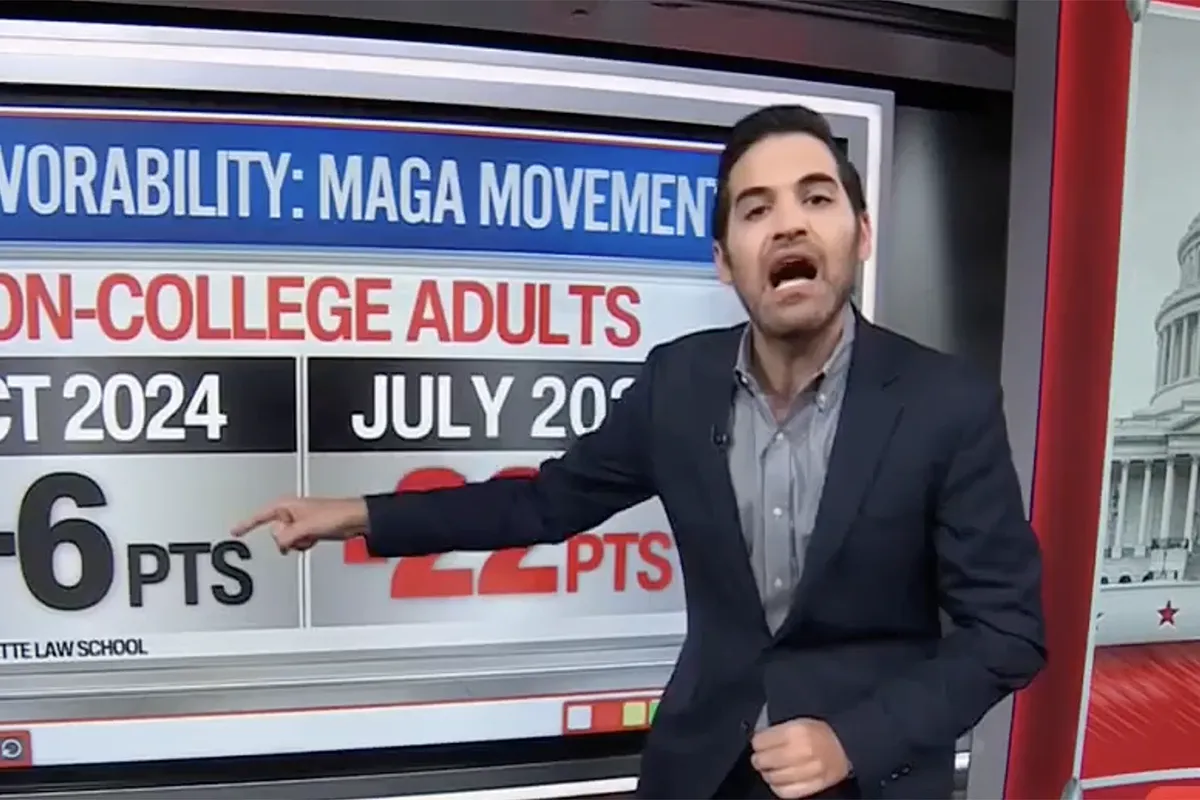
President Donald Trump is experiencing a significant erosion of support among his own base, according to CNN senior data analyst Harry Enten, who detailed the shift during a Friday appearance on CNN with host John Berman.
Non-college voters, a demographic that was central to Trump's electoral success across all three of his presidential campaigns, are now moving away from the MAGA movement in substantial numbers, Enten explained. The group — particularly white voters without a college degree — had been a reliable component of the Democratic coalition for decades before shifting decisively toward Trump beginning in 2016, a realignment that remapped the electoral battlefield in states like Pennsylvania, Michigan, and Wisconsin.
A Marquette Law School survey illustrates the magnitude of the shift. In October 2024, Trump held an 8-point advantage among non-college voters within the MAGA movement. That margin has now reversed dramatically, with Trump sitting 22 points underwater — a 28-point swing.
"So the bottom line is this: The group in which the Trump movement was built upon — they are shifting away and saying, we don't like MAGA anymore," Enten said.
For months, even as Trump lost ground among non-MAGA Republicans and independents, he retained the backing of his core MAGA loyalists. That foundation now appears to be cracking. The development is notable because non-college voters constitute a substantial share of the American electorate, making their partisan leanings a critical factor in both presidential and congressional races.
Enten highlighted an even starker figure when looking at the broader non-college electorate. "In the 2024 election, he won them by 13 points. Right?" Enten said. "That was the reason he won. He won among non-college voters a very strong performance amongst them. And that, of course, was the reason he was able to win because college voters were against him. But look at this now, minus 19 points! Minus 19 points! We're talking about an even bigger shift here."
Enten calculated a 32-point shift away from Trump within what he described as the president's "key core political group."
"This is why he's in so much trouble," Enten continued. "It's not just that college voters are against Trump. Now, it turns out that non-college voters, the ones that he built his presidential bid on, have waved adios, goodbye. See you later, Mr. Trump. We don't like you anymore."
When asked whether that disillusionment translates into active support for Democrats or merely opposition to Trump-aligned Republican candidates, Enten delivered a grim outlook for the GOP.
"Well, if you're a congressional Republican, you wish" non-college voters still disliked Democrats, Enten said. "I have bad, bad news for you, because it turns out that the non-college voters are turning on you, too. And it may, in fact, turn you out of power in the congressional elections coming up in the midterms."
Current polling shows Republicans down by 13 points with non-college voters, while Democrats are up by one point among that same group. The findings carry particular weight ahead of the 2026 midterm elections, when control of both the House and Senate will again be at stake and when the party holding the White House historically faces headwinds.
"It's just a point, but you know what? When it comes to a point and given how well the Democrats are doing among college voters, these are the types of numbers in which blue waves are built," Enten concluded. "And therefore, we can say that the key group that put Donald Trump in the White House, the key group that he built the MAGA movement upon, is leaving him. And it's leaving congressional Republicans too." Polling snapshots this far from Election Day reflect current sentiment and are not predictive of future outcomes, but they offer an early read on where the electorate stands as both parties begin organizing for the cycle ahead.
