Trump Biographer Seth Abramson Warns Lake Ontario Renaming Amounts to 'Invading Canada'
Key Takeaways
- •Seth Abramson, a Trump biographer, argued that renaming Lake Ontario via executive order effectively claims the entire lake, which is bisected by the U.S.-Canada border, constituting an 'invasion by declaration.'
- •Abramson contended the order could be seen as launching a technical war without congressional authorization and placed responsibility on Congress to act.
- •Canadian journalist Annie Dufour highlighted that Section 2(a) of the executive order claims most of the lake's volume based on where its deepest waters lie.
- •Dufour compared the renaming strategy to China's approach in the South China Sea, where renaming and charting territory preceded assertions of physical control.
- •Lake Ontario's binational management is governed by the 1814 Treaty of Ghent and the 1909 Boundary Waters Treaty, which established the International Joint Commission; Canada's response remains to be seen.
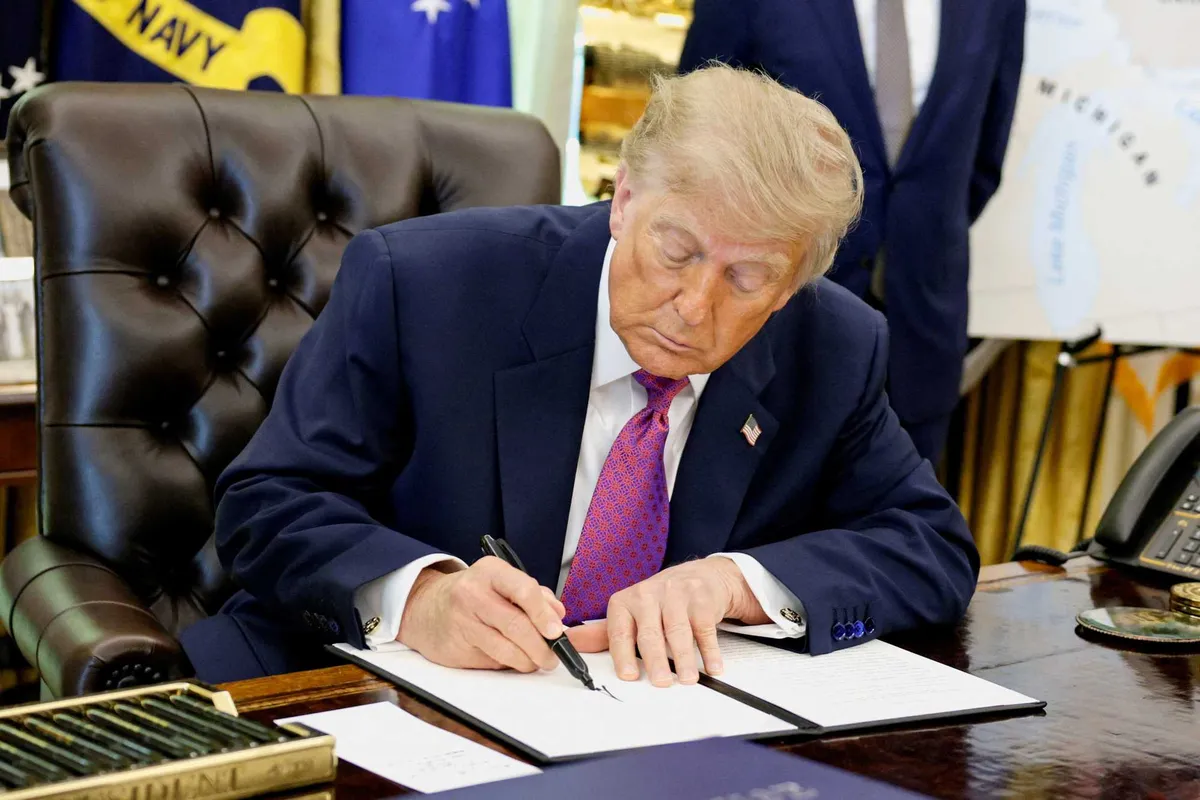
A prominent biographer of President Donald Trump warned on social media on Friday that the commander-in-chief had effectively "invaded Canada." According to Seth Abramson — author of three bestselling books on Trump — the president's renaming of Lake Ontario is a more significant development than many realize, calling it "a bit of an emergency."
"The argument that Trump invaded Canada today is more compelling than many realize," Abramson posted. "The border between Canada and the U.S. runs through the middle of Lake Ontario. By claiming to have the power to rename the entire lake, Trump is claiming the lake. That's invasion by declaration."
Lake Ontario is one of the five Great Lakes, and the U.S.-Canada boundary through it — and the lakes' binational management — rests on a framework dating back to the 1814 Treaty of Ghent and, since 1909, the Boundary Waters Treaty, which established the International Joint Commission to govern shared waters. It is against that two-century-old legal architecture that Abramson's charge of a unilateral American claim has drawn attention.
While many have been dismissive or even joking about Trump's order, Abramson argued that "the practicalities of what just happened today will hit like a ton of bricks in a matter of hours or days — not weeks. Trump declaring sovereign authority over a body of water half owned by Canada is a big f—— deal."
"From a legal standpoint," he elaborated, "it could be argued that what Donald Trump just did today with an executive order was launch what is technically a war — but without any Congressional authorization. That's a bit of an emergency." Abramson added that "the onus this puts on Congress to act is almost surreal."
"We must be very careful in how we think about this," he warned. "If your view is that this wasn't war because the military wasn't deployed, then you're telling Trump he can declare Greenland to be American soil as long as he doesn't deploy the military — which candidly he wouldn't need to do. By way of analogy, this is what conquistadors did in the Age of Exploration — plant flags on foreign soil and declare it home soil. In Literary Studies, we call this a 'speech-act.' Mind you, there are counter-arguments, but this is clearly a major international incident. Speech-acts — including attempted ones — have a complicated history in the law. Don't presume that you can just look at this situation and spitball what did or didn't happen as a layperson. What Trump did today was historically controversial and problematic. It can't be waved away."
Abramson is not alone in that assessment. Canadian journalist Annie Dufour wrote: "The Sharpie was the spectacle. Section 2(a) of the executive order is the territorial claim. While most people stared at Donald Trump's big, fat signature — scribbled with his favourite instrument of international policy, the Sharpie — the fine print of the executive order went unnoticed. As always, the devil is in the details. The name change was the tip of the iceberg. And maps are more than names. Read the executive order. 'With the deepest parts of the Lake's waters lying within United States territory, the United States claims most of the Lake's volume'... The verb is the weapon. Claims."
Dufour argued that China has used the same playbook to seize aquatic territory: claim the deepest point, change the name in all federal databases while deleting all old references, and then "order the entire federal apparatus to speak as if the deletion had always been true." As Dufour wrote, "China perfected the method in the South China Sea. Rename the reef. Inscribe the name on the official chart. Send the ships. Treat the chart as verdict. The name goes first. The patrol follows the name." China's sweeping claims in the South China Sea were rejected by an international arbitration tribunal in 2016, a ruling Beijing has refused to recognize — a precedent Dufour invokes to argue that renaming and charting can precede assertions of physical control.
From there, she asserted, the future is "foreseeable": the United States will no longer treat the lake as a "binational lake. They are on a body of water the United States has already renamed and claimed by volume. Presence follows paperwork." She said the same strategy has long been used by China to "subjugate" its neighbors. How Ottawa responds — whether through diplomatic protest, the International Joint Commission, or other channels — remains to be seen.
While many joke about the matter, Abramson cautioned that dismissing it could be a grave mistake, noting that on Trump's first day back in office, "he signed dozens of unconstitutional EOs that many decided not to take seriously because they were facially preposterous. How soon after did we learn of folks who'd immigrated here from South America getting deported to Africa? Wake the hell up!"

