Detached From Reality: Uproar Grows Over Trump's Suggestion That Iran 'Take Out' Los Angeles or San Diego
Key Takeaways
- •President Trump suggested at a Nebraska campaign rally that Iran could "take out" Los Angeles or San Diego, drawing criticism from local officials and online observers.
- •White House communications director Stephen Cheung defended the remark as conveying that U.S. cities would have faced threats had a nuclear Iran not been stopped.
- •According to the article, Iran has no ballistic missile able to reach the U.S. mainland, while San Diego hosts a major Navy port, the nearby Pendleton Marine base, and numerous defense contractors.
- •Ad tracker AdImpact counted more than $10 million in taxpayer-funded "image" ads airing since September under a $20 million Department of Homeland Security contract, and Trump said his PAC would cover future ads without reimbursing earlier spending.
- •The conflict with Iran remains unresolved: the Strait of Hormuz is still blocked, prices remain elevated, and Trump announced plans to deploy a third aircraft carrier group to the region.
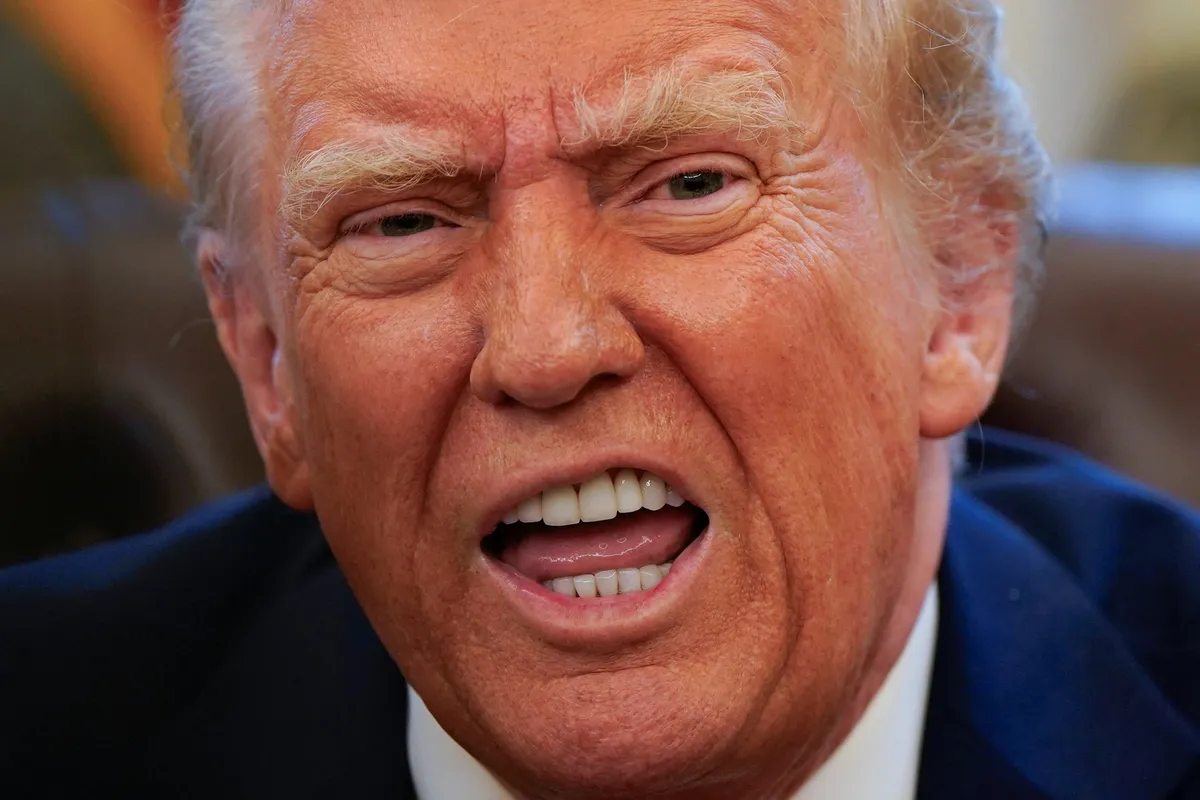
A firestorm of criticism is building around President Donald Trump after he suggested that Iran “take out” Los Angeles or San Diego, with observers asking what kind of delusion could prompt a leader hired to protect the country to float American cities as targets for Iranian attack.
Speaking at a campaign rally in Nebraska on Monday — a heavily Republican state where a successful president should not have to beg voters for support a month before elections — Trump once again promised a “tremendous election victory” amid adverse polling. During his roughly 90-minute ramble, he argued that high prices caused by the war with Iran were a “small price to pay for keeping the world safe – keeping our country safe,” just before adding that the Iranians “can take out a city. . . Let them take out Los Angeles. Let them take out San Diego.”
The crowd applauded.
What exactly were they applauding? Wiping out 5 million Americans? Punishing California for voting blue? The $8-per-gallon prices at the gas tank? Were listeners meant to understand the remark as a joke — an offer of targets for Iranian attack?
Local officials, including the governor and the mayors of both cities, together with much of the internet, saw nothing resembling humor in the comment. Charitably, observers described an untamed tongue putting partisan political smacks above the job of being president.
At the White House, communications director Stephen Cheung rejected the backlash: “The media freakout . . . is not rooted in reality. He was clearly stating U.S. cities would have been threatened if a nuclear Iran hadn’t been stopped.”
Iran, for its part, lacks any ballistic missile capable of reaching the U.S. mainland. San Diego is a major Navy port, the Marine base at Pendleton sits nearby, and countless defense contractor sites are located across Southern California.
Meanwhile, the war is not over. The Strait of Hormuz remains blocked, prices remain high as a result, and Trump just announced that he wants to deploy a third aircraft carrier group to the region.
Trump’s Strange Election Stances
Discussion of the president has widened into open speculation about his mental capacity. Multiple reports each week now describe Trump struggling to stay awake during meetings or events in the Oval Office, having trouble reading what is before him, or confusing whether it was Brazil or India that just held elections this week. He announced an executive order allowing farm equipment to use a weakened red-dye diesel fuel without being able to explain publicly what it was, asking for help from those gathered nearby.
In his speeches, Trump continues to preach that the country is in its “Golden Age,” without acknowledging economic hardships from high prices or health care cutbacks. He has said repeatedly that Iran has been defeated, only to then add that the country will cave the week after the election. He glorifies autocratic leaders in Russia, China and North Korea while launching inexplicable trade wars with Canada and Europe.
Reports suggest that what sets Trump off on angry shouting matches are items such as moving rallies into high school gyms to make them look full, or the choice of a supposedly unflattering photo of the president playing golf — rather than, say, the fact that AI chip imports are worsening trade deficit figures.
Taxpayer-Funded Image Advertising
This week, after plenty of negative pushback over the use of public tax dollars to float millions of dollars’ worth of Trump “image” patriotic advertising — the dissembling term for Trump campaign ads in a year when he is not officially on any ballot — Trump decided his overstuffed PAC could pay for ads going forward.
More than $10 million in taxpayer-funded ads have run since September, according to AdImpact, the ad-tracking service, but Trump said last night that he would not reimburse those payments. The ads on cable and network television were paid for through a $20-million contract that used funds from the Department of Homeland Security.
Using government money for “publicity or propaganda purposes” is a violation of federal law. Rather than acknowledge that, Trump made it sound like a moment of personal generosity — after having credited himself with ordering the ad campaign, which carried the tag “Paid for by the U.S. Government.”
Guardian columnist Steven Greenhouse noted last week that “Trump’s delusional statements on the economy show that he is becoming more detached from reality and from rational understanding of how the world works.” The observation appears to apply to far more than trade deficit math.
The simple fact, the author argues, is that at this point — and perhaps for a long time — Trump has been unable to distinguish between what serves his personal appetites and what his job as president of the entire country demands. What a widening population sees is a delusional man, perhaps starting to show signs of mental deterioration: someone who cannot see foreign affairs except through transactions that benefit himself or his family, who cannot acknowledge the ill effects of his policies on economics and immigration, and who cannot seem to distinguish between fact and non-fact.
The question lingers: why isn’t Trump’s mental state — and the failure of his administration to deal with it — the leading issue of the election?
Terry H. Schwadron retired as a senior editor at The New York Times, served as Deputy Managing Editor at The Los Angeles Times and held leadership roles at The Providence (RI) Journal-Bulletin. He was part of a Pulitzer Gold Medal team in Los Angeles, and his teams were part of several Pulitzers in New York.
This article originally appeared on Alternet.

