Trump Signs Executive Orders to Expand Beef Processing Options and Boost Competition
Key Takeaways
- •President Trump signed two executive orders on Friday aimed at improving market access and competition for America's farmers and ranchers.
- •One order directs the USDA to robustly enforce the Packers and Stockyards Act, requires regulatory assessments across several agencies, evaluates gray wolf impacts under the Endangered Species Act, and reviews country-of-origin labeling.
- •The President said producers will be allowed to process, package, and sell meat across state lines, subject to inspection, in order to bypass the largest processors.
- •The U.S. will source 300,000 metric tons of ground beef from Argentina, Brazil, and other countries, according to the President.
- •The National Cattlemen's Beef Association expressed frustration with the President's comments on falling beef prices, saying producers have lost tens of millions of dollars in recent weeks due to market shocks from the latest round of imports.
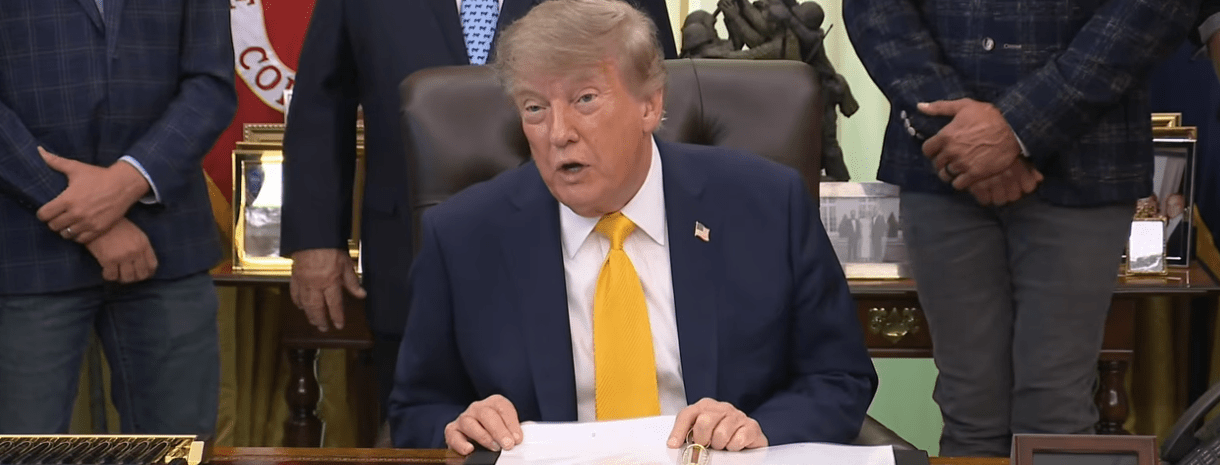
President Trump has signed a pair of executive orders aimed at addressing market access and competition for America's farmers and ranchers.
Speaking at a signing ceremony on Friday, the President said the goal is to improve the financial viability of producers. "The livestock industry has been ripped off by a meat-packing monopoly, which we are probably taking care of pretty well today, driving down what ranchers earn. They were charging them numbers that were unsustainable."
One executive order asks the USDA for robust enforcement of the Packers and Stockyards Act, requires several agencies to assess current regulations, calls for an evaluation of the impact of gray wolves under the Endangered Species Act, and directs a review of country-of-origin labeling. The Packers and Stockyards Act, passed in 1921, was designed to curb monopoly power in the meatpacking industry, and debates over its enforcement have persisted for decades as the sector has consolidated into a handful of major processors that handle the large majority of U.S. cattle slaughter.
The President said one of the orders allows producers to process, package, and sell meat across state lines in an effort to bypass the country's largest processors. "They'll have inspections. They'll have inspectors just how like the big plants have them, but I would be willing to say that our ranchers will be more sanitary than those plants. I think it's going to be a great thing." Interstate meat sales have generally required federal inspection, a hurdle that has long limited smaller, locally oriented processing operations.
American Farm Bureau President Zippy Duvall, who attended the signing, said the move will help small, beginning, and young producers grow their herds. "By being able to slaughter or harvest their animals closer to home and being able to give sales directly to the consumer."
Agriculture Secretary Brooke Rollins said the administration's plan helps provide long-term certainty for the industry. "We have to protect this way of life for the future for the 1st gens, but for also the 7th, 8th and 9th gens."
The President also addressed where the U.S. would be sourcing 300,000 metric tons of ground beef. "It's coming from Argentina. It's coming from Brazil. It's coming from a couple of other places. We have our inspectors down there. It's very clean it's very good."
Ethan Lane, senior vice president of government affairs for the National Cattlemen's Beef Association, said the executive order asks the USDA and the office of the U.S. Trade Representative to review their authorities as they relate to mandatory Country of Origin Labeling. "That is something that's been done numerous times over the last few decades and kind of tends to lead to the same result of kind of the same barriers that we've seen previously." Mandatory COOL for beef and pork was implemented in the 2000s but was repealed in 2015 after the World Trade Organization ruled against the U.S. requirement in challenges brought by Canada and Mexico.
However, Lane also expressed frustration with the President's remarks on beef prices. "From producers' perspective, it was disappointing to hear the president talk about how excited he is that beef prices are coming down," he said. "Cattle producers around the country have lost 10s of millions of dollars in the last few weeks alone, given these market shocks from this latest round of imports."
Bill Bullard, CEO of R-CALF USA, said the executive order is a good first step. "It provides options, for example, that the Secretary of Agriculture could make recommendations for legislative action."
He told Brownfield the move could help advance pending legislation. "This will just add to the momentum that has already been demonstrated in support of mandatory country boards and labeling."
Brownfield's Meghan Grebner contributed to this story.
Source: Brownfield Ag News
