Trump’s Dallas convention speech includes claims about crowd size, inflation and voting
Key Takeaways
- •Trump spoke Thursday in Dallas at the 2026 Republican midterm convention before a visibly sparse crowd while repeatedly describing the venue as 'packed,' despite images showing empty seats.
- •He claimed to have ended the 'transgender mutilization' of children, using a nonstandard term that the report says mischaracterized transgender medical treatment.
- •Trump asserted the United States is more respected than ever and no longer a 'laughingstock,' but the article says the country was losing its war with Iran and its trade war with Canada, with Iran controlling the Strait of Hormuz and prices rising for oil and fertilizer.
- •He blamed Joe Biden and Democrats for the worst inflation in American history, while the article noted Americans were spending about $700 more on average during his second term and quoted economists linking inflation to his tariffs, the Iran war, and pressure on the Federal Reserve.
- •Near the end of the speech, Trump asked attendees to pledge allegiance to him as 'the greatest president,' urged them to vote and recruit others, and said nonvoters would 'go to hell.'
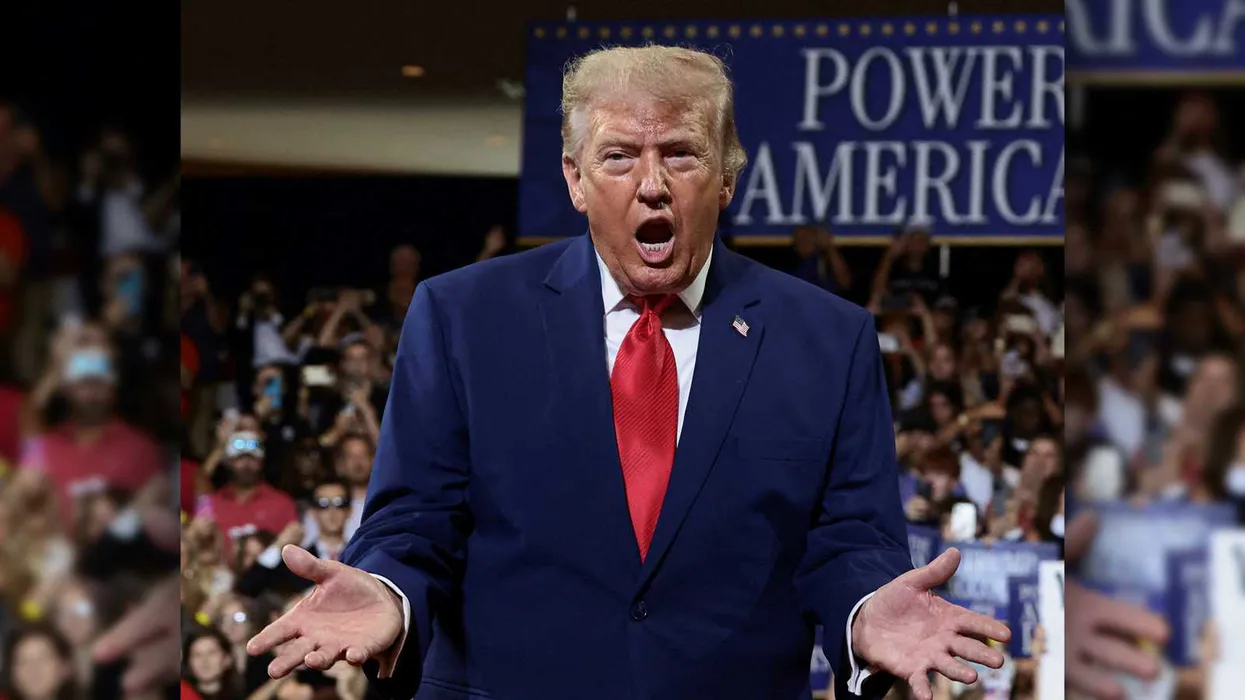
President Donald Trump followed his Wednesday address at the 2026 Republican midterm convention with another speech in Dallas on Thursday. The remarks came before a still-sparse crowd, following a lengthy speech by Vice President JD Vance and an off-key performance by musician Lee Greenwood of “God Bless The USA.”
The speech continued Trump’s focus on his own record and persona, despite calls from some Republicans for him to concentrate less on himself during an election cycle in which his approval ratings are reportedly underwater by double digits. The most notable moments included the following:
- Claims about the size of the crowd. Trump repeatedly described the convention as “packed,” saying it was “packed last night” as well. Images from both events showed empty seats. He later said the “highest rafter” was full and urged attendees not to use the bathroom so that the media would have fewer opportunities to photograph vacant sections.
Trump also said the arena had been “packed last night,” with “thousands” of people waiting outside. He pointed to sections that appeared full while overlooking other empty areas. Later, he acknowledged that he should not have looked “back there” toward a section where he disliked seeing “the little bit of skin” showing through the seating area.
-
The use of “mutilization.” Trump said, “I ended the transgender mutilization of our beautiful children — no more of that,” and repeatedly accused Democrats of supporting the “mutilization” of American children. The remarks mischaracterized transgender medical treatment, according to the source article, and “mutilization” is not a standard English word. Trump likely intended to say “mutilation.”
-
The claim that the United States is no longer a “laughingstock.” Trump repeated a statement that had received a notably tepid response during his Wednesday speech, asserting that he had ended the period when the United States was a “laughingstock.” He also said the country was more respected than ever.
The article disputes that characterization, stating that the United States was then losing both its literal war with Iran and its trade war with Canada. It said Iran had seized control of the Strait of Hormuz, leaving Trump in a quagmire and pushing up prices for vital American goods, including oil and fertilizer. It also said Canadian Prime Minister Mark Carney had outmaneuvered Trump economically and in public opinion.
Dr. Richard Wolff, professor emeritus of economics at the University of Massachusetts Amherst, told AlterNet earlier this month: “It's not just Mr. Carney, he is the expression of something that he knows as a politician is now a very popular view in Canada. He's not going to be held to blame because this or that difficulty happens. If he can show, as he often can, that the United States' hostility, tariff policy number one, is the root cause, then he gets a pass. The kind of anger that might often be addressed to a politician won't be, because they correctly perceive that the problem is something else. And so they appeal to the politician when he comes up with solutions or attempted solution to keep workers' needs in mind.”
- Claims about inflation and his record. Shortly before his “laughingstock” remark, Trump said: “in 19 months, I've delivered on every single promise I made, and I think I delivered on far more. Joe Biden and the radical Democrats created the worst inflation in American history.”
The article said Trump’s statement ignored that Americans were spending an average of $700 more because of inflation during his second term and that his approval rating on inflation was worse than Biden’s had ever been. It also stated that President Jimmy Carter recorded the highest year-to-year inflation of any president in American history.
Dr. Robert J. Shapiro, an economist who worked for President Bill Clinton, told AlterNet in August that several Trump policies had contributed to higher inflation. The article identified the ongoing trade wars with countries including Canada, the war against Iran and Trump’s pressure on the Federal Reserve as examples.
“Trump has been attacking the Fed for as long as he's been in office for not cutting interest rates,” Shapiro wrote. “But you don't cut interest rates when inflation is rising, because cutting rates stimulates the economy — meaning you increase demand without increasing supply, so prices go up. Powell refused to cut rates because he said, in effect, 'We're in an inflationary period; once we contain inflation, we can cut rates.' Trump has made that much harder by increasing inflation through both the tariffs and the effects of the war on Iran. Even [Kevin] Warsh, Trump's handpicked successor to [Jerome] Powell, hasn't cut rates. But the market believes there's a significant possibility that he will, given the pressure Trump has been putting on him — and in anticipation of that, they've been driving long-term rates up.”
- A demand for political allegiance. Near the end of the speech, Trump asked the crowd to pledge allegiance not to the United States or to God, but to “the greatest president,” whom he said loved them “so much he can't even breathe.” He urged attendees to vote for him and to persuade members of their personal networks to do the same. He also said that people who did not vote, presumably for him, would “go to hell.”
The original report was published by AlterNet: https://www.alternet.org/midterms-convention-2677845054/
