White House insider: Trump's $4 billion windfall is making everything you buy more expensive
Key Takeaways
- •Trump and his family have reportedly netted about $4 billion since the start of his second term, while alleged corruption and abuses of power across his administration reach an estimated $377 billion.
- •Economist Justin Wolfers warns that competing for presidential favor instead of innovating leads to worse and more expensive products for consumers.
- •The U.S. national debt stands at $40 trillion, exceeding annual GDP, and economist Robert Shapiro attributes a majority of the current deficit crisis to Trump's tax cuts and defense spending increases.
- •White House spokesperson Lauren Bis, who as journalist Lauren Bowman once demanded transparency over roughly $1 billion in annual government public-relations spending, has sidestepped questions about the accusations against Trump.
- •Bill Galston says political accountability has already taken hold, with Democrats' 14-point popular-vote midterm victory reflecting public anger over self-enrichment, even as legal accountability remains elusive.
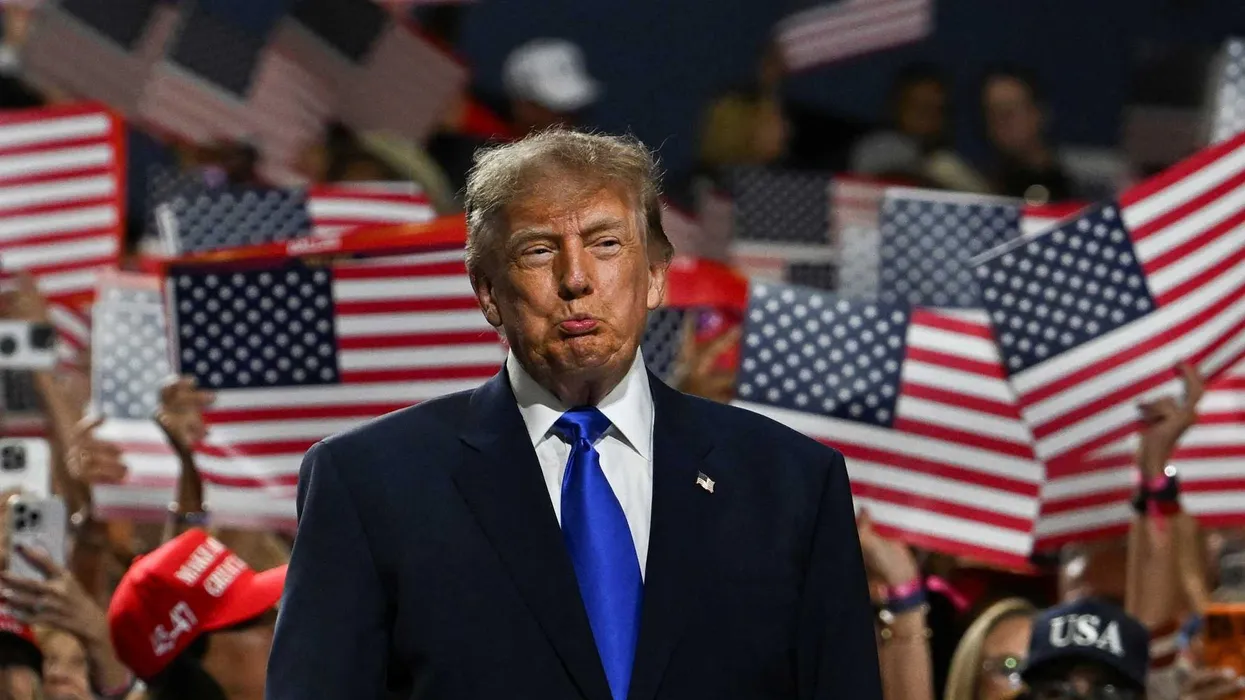
President Donald Trump faces accusations of corruption and fiscal irresponsibility on multiple fronts — some of them documented, through a chronologically circuitous route, by his own communications team.
Start with the corruption. Since taking office at the start of his second term, Trump and his family have netted roughly $4 billion — by far the most money any president and their relatives have profited from being in office since America's earliest days. When the analysis is widened from the president and his relatives to include his administration, the alleged corruption and abuses of power amount to as much as $377 billion.
If Trump and his supporters are to be believed, Americans simply do not care whether their leaders are corrupt — notwithstanding the nation's long history of supporting anti-corruption populists, from presidents (Theodore Roosevelt, Jimmy Carter) to would-be presidents (Samuel Tilden, John McCain). That may not be true, at least when corruption impacts their own bottom lines.
'Expensive products will win'
According to Justin Wolfers — a non-resident senior fellow at the Brookings Institution and the Peterson Institute, and a University of Michigan professor of economics and public policy — "the basic idea of a market economy is that you and I compete with each other. If I can bring goods to market at a lower price than you, then people will buy them from me rather than you. If I can create higher-quality goods than you, people will buy from me rather than you."
Speaking to AlterNet in September, Wolfers elaborated: "The problem with the Trump family corruption — and not all of it's the legal definition of corruption, by the way; some of it meets the standard English-language definition, if not a legal definition — is what you do is you change the nexus of competition. If the best way for me to get ahead is to go to the White House bearing gifts, and then they pass a rule and they ban you from competing against me, then that means the basic dynamics of competition and markets delivering good outcomes for regular folks just gets broken."
He continued: "That in turn means that if I'm the CEO of a company, I spend less time trying to create products at lower prices, trying to outcompete, or less time creating new or better products. And I spend more time and energy at Mar-a-Lago trying to win over the favor of the president. That means bad products will win. That means expensive products will win."
In that account, the cost of competing through access rather than innovation doesn't stay inside the Beltway — it shows up at the register.
From demanding transparency to deflecting questions
The distance Trump's supporters have traveled from their own stated principles is measurable. White House spokesperson Lauren Bis, a decade ago, demanded transparency for millions in government spending — yet, in comments to AlterNet, sidestepped questions about a president who refuses transparency on something far worse than potential waste: outright abuse of power.
"U.S. government spending on public relations campaigns, including NASA's Green Ninja videos on global warming and the Pajama Boy ads for Obamacare, should raise serious questions about fiscal responsibility and where to draw the line between appropriate communication and propaganda," journalist Lauren Bowman wrote for The Daily Signal — the Heritage Foundation's conservative news outlet — in 2016 with Romina Boccia.
Bowman — now Bis — added: "The government spent about $1 billion annually on advertising and public relations from 2006 to 2015, according to a Government Accountability Office report on such federal spending," while cautioning that the figure could be incomplete. Ultimately, she argued: "So much PR spending appears to be largely unaccountable 'black box' spending."
Deficits 'as far as the eye can see'
That brings the story to Trump's deficit spending, which, like his personal finances, remains something of a "black box" — at least if the term is defined as public money being abused without anyone being held responsible. Two years later, and again with Boccia, Bowman addressed America's budget in The Daily Signal, arguing that the country needed to go down a "saner fiscal path." Yet Trump has added so much to the national debt that America currently owes $40 trillion — an expense run up through his tax cuts for the wealthy and massive increases in military spending. That total now exceeds the value of all goods and services the U.S. economy produces in a single year — the measure known as gross domestic product, which economists use to gauge a country's debt load. Speaking to AlterNet in August, Dr. Robert Shapiro — a top economic adviser to Bill Clinton, the last president to balance the budget (and, indeed, to run four surpluses) — explained how Trump blew up America's fiscal situation.
"Trump comes in and doubles down" on bad spending practices, Shapiro said. "What Biden had done would have led to a gradually shrinking deficit over the next ten years, because the economy is growing. What Trump does instead is say, 'No — we're going to have huge deficits as far as the eye can see,' meaning deficits equal to six or seven percent of GDP, which is unprecedented in the postwar era. It's a real outlier. And that's driven entirely by his tax changes, which carry enormous budgetary costs, plus a wholesale, large-scale increase in defense spending."
On America's current deficit crisis, Shapiro concluded: "So how much of this is Trump? A majority of it — not all of it, but a majority."
The White House responds
To examine the damage caused by the alleged corruption and the massive deficit spending in greater depth, AlterNet spoke with Bill Galston, a Wall Street Journal columnist and Brookings Institution senior fellow who, like Shapiro, was famously a top adviser to Clinton. When AlterNet shared Galston's comments with the Trump White House, spokesperson Lauren Bis responded: "President Trump has launched an all-out war on fraud across the entire federal government, holding criminals accountable and saving taxpayers billions of dollars."
She continued: "The Democrats in Congress have refused to do anything to stop waste, fraud, and abuse in our government. Additionally, the Democrats unanimously voted against the Stop Insider Trading Act [in fact, 13 voted for it] which would have ensured that Members of Congress cannot profit from insider information."
AlterNet asked Bis follow-up questions about the specific accusations against Trump, which she did not address, as well as about the fact that the Daily Signal journalist of 2016 appears out of step with the White House spokesperson of a decade later. She had not replied as of the time of this writing. Whether she ever does — and whether any legal check on presidential self-enrichment can emerge to match the political accountability Galston describes below — remain open questions in this story.
The following interview has been lightly edited for clarity, context and length.
Trump and the budget
Matthew Rozsa: You worked for President Clinton, and one of the things that I admire about Clinton is that he did work across the aisle consistently and produced the best economy, in my opinion, in American history. The budget was balanced. We produced four surpluses. Nearly 23 million jobs were created. Incomes went up. Inflation was stable. And I would make the case that it was because Clinton and Republicans were able to work together on issues where both sides saw that everyone would benefit. Do you agree or disagree with my interpretation, as someone who was on the inside?
William Galston: Well, it took some twists and turns to get there, but if you do a search, you'll find the Wall Street Journal column that I wrote on exactly that subject some years ago, in which I reviewed the record on the Clinton economy. He made a very politically difficult decision right at the beginning of his administration, in the famous battle of the Bobs — Bob Rubin versus Bob Reich — to take the Rubin path on fiscal policy. And it turned out to be a good path. It brought down long-term interest rates. It did lead toward four consecutive balanced budgets in his second term. And it was an economic period that the American people would love to return to if they could. And it did require defying his own party on occasion.
He had to be selective. He couldn't do it across the board; he would have lost control of events if he had. But where he felt he had to, he did. He almost failed. His first and most important budget almost went down. It prevailed by a single vote, and it would have been a crushing blow to the administration if he'd lost that battle. So it was a tough decision that nearly failed.
Matthew Rozsa: It's a tough decision that nearly failed, but something that I note is that when Clinton defied his own party, he did it because he believed that he was serving the country's interest. Trump has been defying his own party, but it's because his party wants him to stop self-enriching in ways that they, if you want to be generous, find unethical, and, if you want to be cynical, are concerned is politically toxic. It's probably a combination of both. But either way, Trump is not defying his fellow Republicans with the best interest of the civic estate at heart. I think you and I would agree.
William Galston: Well, let me distinguish between Trump One and Trump Two.
Matthew Rozsa: Okay.
William Galston: When Trump stood up and presented himself as a presidential candidate in 2015, he astounded political observers and members of his own party by questioning the pillars of Reaganism one after another. And I think he genuinely believed at the time that free trade and an internationalist foreign policy and relatively generous immigration policies, et cetera, were not serving the country well. And he either persuaded or mobilized enough of his own party to prevail, and then ultimately to transform the party in his own image. And I do think that, however misguided Trump One was, his approach to his own party, his defiance of long-established pieties, represented sincere opinions about what would be better for the country. I don't happen to share those opinions, but that's not the question you're posing.
What you're talking about is Trump Two, the Donald Trump we've seen since he returned to the White House. And there, once again, I think you have to be selective. We have to acknowledge that the so-called One Big Beautiful Bill brought together a lot of priorities that Republicans have pursued for a long time. They were priorities that brought together different factions of the party, and that's why that bill succeeded.
Matthew Rozsa: What priorities are you referring to?
William Galston: Well, look, Republicans have believed in tax cuts for a long time. Republicans have believed for a long time that welfare programs, such as Medicaid in particular, have become bloated and have expanded to include people who should never have been included. These weren't ideas that Donald Trump made up. They were ideas that the majority of his party embraced, and had embraced for a very long time.
Trump and corruption
Matthew Rozsa: Now I want to talk about the criminality, as I see it. I do want to go back to the issue of corruption, and I want to go back to it for two reasons. First, when I talk to people anecdotally, it's what most upsets them. Second, when I look at the polls, they reinforce what I observe anecdotally: that people are outraged by the corruption, by the self-enrichment, by the fact that Trump is blatantly using his office to benefit himself financially. As someone who's been on the inside of Washington politics for a long time, I was hoping you could explain to my readers what makes Trump's actions so different from those of his predecessors, some of whom were also not angels.
William Galston: Right. I was about to get to that, because that is the feature that has distinguished Trump's second term most sharply from his first term. The enrichment of self, family, and friends has been on a much larger scale than I think the country has ever seen. It's much more open, it's much more blatant, and it's much more unapologetic. There is really no effort to hide what he and the family are doing. As a matter of fact, they seem to be proud of it. And I absolutely agree that the American people have revolted against it. I absolutely agree that it was one of the major factors in the outcome of the recent midterm elections. And I also think the public reaction was made worse by the fact that they are linking the corruption of the president and the people around him with their own financial reverses.
And Democrats campaigned on that linkage. They argued that Trump's corruption has contributed to your misery. And a lot of people accepted that argument, and there is considerable truth in it. And I don't think we know yet whether it rises to the level of outright criminality.
Matthew Rozsa: Is there anything Democrats can do to get this to stop — to not only prevent this from continuing to happen, but to claw back the money that they have illicitly gained, if indeed it was illicit?
William Galston: Good question. I don't know. The efforts to hold the president to account legally haven't been very successful so far. And the Supreme Court has not made it any easier to hold the president accountable.
Matthew Rozsa: No, it has not. They've made it harder.
William Galston: Yes, indeed. So I don't know the answer to your question, but I'd like to offer a distinction that I've been thinking about: a distinction between legal accountability and political accountability. Even if it's the case that efforts to hold the president and the gang around him legally accountable won't succeed, or won't succeed to the extent they should, political accountability has already set in with a vengeance. And we shouldn't forget the fact that the drubbing that the president's party just took is of historic dimensions. I was an optimist about these elections, but I couldn't wrap my mind around the possibility that Democrats would win the national popular vote by 14 percentage points. That's an earthquake.
Matthew Rozsa: It is an earthquake, but it may not be a lasting earthquake if Democrats don't capitalize on it. I only have one more question. Is there anything else you'd like to say that I haven't given you a chance to discuss so far on these subjects?
William Galston: No. I've done my best to give political leaders, including this president, their due. But at the end of the day, I haven't revised my judgment that we could use a lot more humility, and accountability, and responsibility in our politics.

