Trump Has 'Corrupted Every Part of Our National Security,' Biographer Says Amid Nvidia Scandal
Key Takeaways
- •Trump told CNBC he was highly influential with Nvidia's board in the decision to reinstate former CEO Jensen Huang.
- •Nvidia said it rehired Huang after top government officials assured the company he was not a national-security risk.
- •Biographer Tim O'Brien alleged Trump held tens of millions of dollars in Nvidia stock and that Commerce Secretary Howard Lutnick owns 1,000,332 Nvidia shares.
- •Attorney General Todd Blanche, Trump's former personal lawyer, stated there is no evidence Jensen Huang compromised national security.
- •The substance of what Trump actually said to Nvidia's board remains undisclosed, with only his own account and Nvidia's statement on the public record.
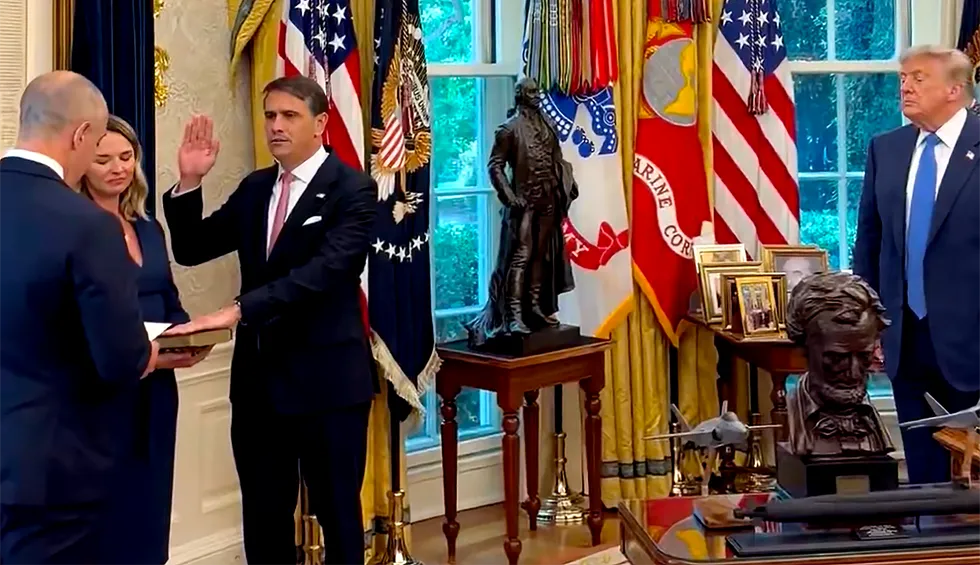
President Donald Trump has reached into every part of government to make it serve his personal and financial interests over those of the United States and national security — and the fallout from the Nvidia CEO reinstatement saga is the latest example, Trump biographer Tim O'Brien argued.
Trump told CNBC in an hour-long call-in that he was highly influential with the Nvidia board in reinstating its former CEO, Jensen Huang. According to Nvidia, top government officials assured the company that Huang was not a national security risk, so it agreed to rehire him. The assurance carries unusual weight: Nvidia's chips anchor much of the global AI buildout, and U.S. export controls on advanced semiconductors have made the company's leadership and sales decisions a recurring matter of national-security policy.
Speaking on MS NOW, O'Brien said the episode is more of the same from a president who puts himself first: while the Nvidia scandal involves national security, it is also about Trump's corruption.
"We know that Donald Trump had tens of millions of dollars in Nvidia stock. We know that his commerce secretary, his family and their business were deeply invested in AI and in Nvidia," O'Brien said, referring to Commerce Secretary Howard Lutnick, who sold his company to his sons upon taking office and, according to Sept. 30, 2026, reporting, owns 1,000,332 Nvidia shares.
"So, there's no independence around this," said O'Brien. "And I would love to have been a fly on the wall when the president contacted the board, which he's now acknowledged doing. And what actually was the leverage he used? Did he say that the Justice Department would investigate Nvidia and the board members? Did he say the SEC would launch an investigation?"
On Monday, O'Brien said the administration "trotted out Todd Blanche," Trump's former personal lawyer and now the attorney general, to claim, "There's no evidence that Jensen Huang has compromised national security."
"The problem is the person saying that is Donald Trump's former personal lawyer," O'Brien said. "Every part of the federal government that we rely on to protect national security and make sure our markets and economy function well, have been corrupted by Donald Trump for deeply personal reasons."
"And now this event happens. And is it no longer wrong for a CEO to have an affair with a subordinate, an affair with an alleged Chinese spy, to lie to the corporate counsel about what was happening, to lie to the board, and then he just gets reinstated after everyone on planet earth, including the board of the company, said he's not coming back. So, what did Trump actually say to the board?"
Stephanie Ruhle said Scott Bessent "clowned himself" while speaking to CBS News about the scandal and who could take over the company. "Like, you are laughing in our face. And it's not just us, right?"
"He is carrying the president's water," O'Brien agreed, noting that all roads lead back to Trump.
Michael Feinberg, a former FBI agent, offered a blunter assessment: the U.S. government and politicians almost always put the stock market and corporations ahead of regulation — and even ahead of national security. Export controls — the rules governing which advanced chips U.S. companies can sell to China — are among Washington's principal tools for managing rivals' access to frontier computing power, which is why gaps in enforcement draw scrutiny.
"This is normally the sort of thing that happens behind closed doors, but it's important for people to remember that much, much more of the government writ large is concerned about economics and promoting trade and investment than they are with protecting national security equities," Feinberg said.
The numbers, he added, favor those who escape consequences: serious punishments for export-control violations — or for what he called "dalliances with the Chinese government or the Chinese military complex" — are rare compared with "the number of U.S. companies that have gotten away completely or merely had a slap on the wrist. Like the ratio isn't even close."
Still, Ruhle suggested the dynamic could shift after American voters delivered an indictment on Nov. 3. Americans, she argued, have made clear they will not stand for corruption any longer — and that even voters who support AI do not back a group of seven tech bros lining the pockets of the president and deciding what the rules for AI are.
National security reporter David Rohde, meanwhile, called the episode unprecedented — unlike the earlier incidents Feinberg referenced — and said it could be the line. The outstanding question hanging over the episode is the one O'Brien posed: with Trump's own account of his influence and Nvidia's statement that officials vouched for Huang as the only public record, the substance of what was actually said between the president and the board remains undisclosed.
Original reporting: Alternet. Related coverage: Alternet, Alternet. Segment video: YouTube.

