Trump Delivers Error-Filled Speech to World Leaders at APEC Summit in Shenzhen
Key Takeaways
- •Trump claimed inflation had stayed below 2 percent for three consecutive months, but official data showed the most recent reading at 3.7 percent in September, with the past year's lowest level at 2.4 percent in January and February.
- •The president has rebranded artificial intelligence as 'Super Intelligence,' or 'SI,' and has directed federal agencies to replace 'AI' with the new term.
- •Trump asserted that Americans invented artificial intelligence, a claim that conflicts with Alan Turing's foundational 1950 paper, which introduced the concept known as the Turing Test.
- •At the APEC Summit, Trump opposed international oversight of artificial intelligence, setting the United States apart from governments such as the European Union that have adopted AI regulatory frameworks.
- •The speech echoed themes Trump used at midterm campaign rallies, in which Republicans lost control of both the House and Senate.
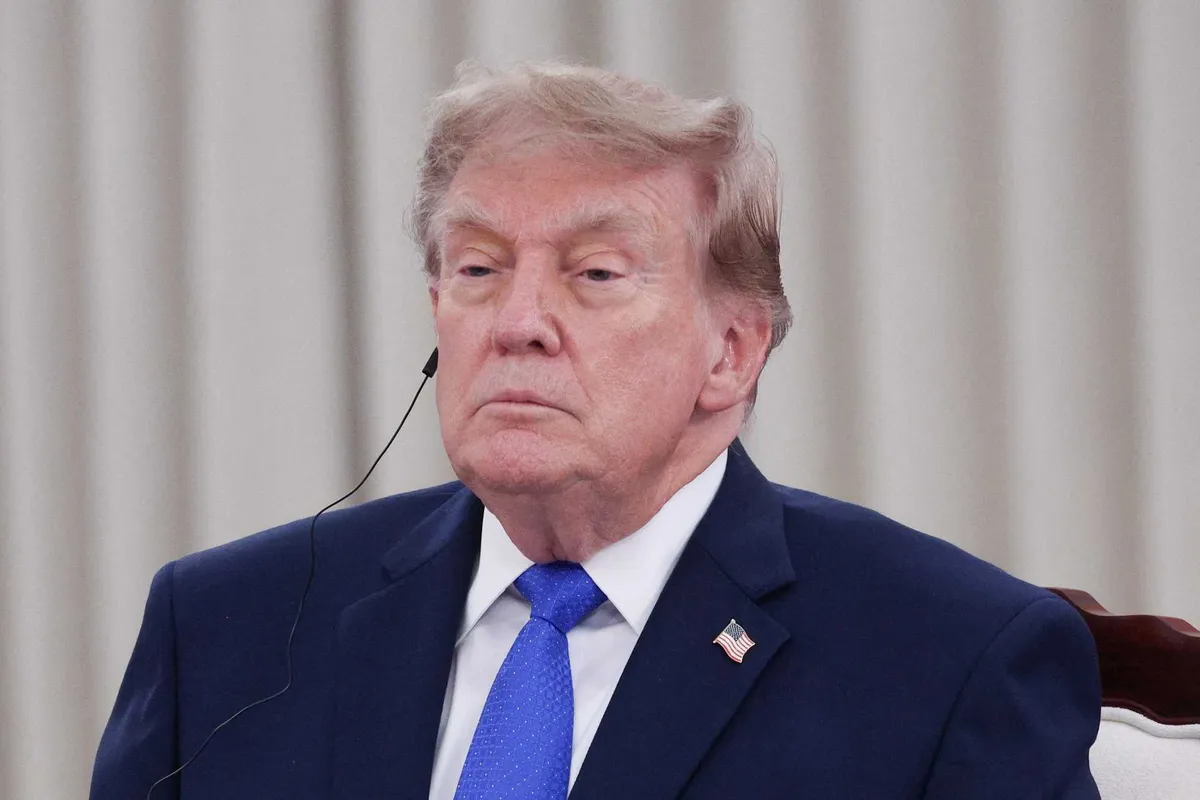
President Donald Trump delivered an error-filled speech to world leaders on Thursday at the Asia-Pacific Economic Cooperation (APEC) Summit in Shenzhen, China, where he is also holding meetings with host President Xi Jinping and Russian President Vladimir Putin, according to The Daily Beast. APEC is a forum of Pacific Rim economies that works to promote trade and economic cooperation across the region, and its host city has grown into one of China's leading technology and manufacturing hubs.
The address echoed many of the same themes Trump had emphasized at rallies ahead of the midterm elections, in which Republicans suffered significant losses.
Turning to inflation, Trump blamed the Biden administration for stubbornly high prices in the United States. "The last three months, inflation was down to a number that was not expected," he said. "We've got it less than 2 percent for the last three months."
The figures did not match official data. The most recent inflation reading was 3.7 percent in September, and the lowest level recorded over the past year was 2.4 percent in January and February.
Trump then pivoted to artificial intelligence, a field he has rebranded as "Super Intelligence," or "SI." He described it as "the greatest technological transformation since the Industrial Revolution," before veering off-script to add, "It's amazing when you say that, but it... seems to be true."
"Americans invented, we just invented SI, and it is unleashing extraordinary prosperity and growth for people all around the globe," he continued.
That framing departs from the accepted history of computing: the British mathematician and logician Alan Turing, widely regarded as the father of theoretical computer science, posed the question of whether a machine could learn to think in his 1950 paper, Computing Machinery and Intelligence, a work that laid out what became known as the Turing Test.
Trump went on to say he did not want to "destroy the tremendous potential" of AI. "It's Super Intelligence, that's what it is," he said. "It's Super Intelligence, but we have to watch it. We have to be careful. We have to cherish it. It's almost completely good, but it's got some bad elements, and we have to be very careful in managing those bad elements."
The president's attachment to the terminology extends into policy: he has directed federal agencies to replace "AI" with "SI."
Trump has also regularly posted AI-created videos to his Truth Social platform, including one showing former President Obama being arrested. In September, as voter backlash over potential energy bill costs grew ahead of the midterm elections, he said an AI "Hoax" was being perpetrated by the Democrats. Republicans went on to lose control of both the House and Senate.
Data centers across the United States that power the AI boom have fueled unrest among voters worried about the technology's impact on their jobs. In his APEC speech, however, Trump warned countries against oversight, saying, "We oppose any form of globalist regulation or anything to control or stifle SI, and we won't allow that to happen, frankly." The stance set the United States apart from many governments abroad, including the European Union, which has adopted its own framework for regulating AI.

