Trump's $5,000 Dividend Checks Could Send Billions Into Bitcoin and Crypto — but Hurdles Remain
Key Takeaways
- •Donald Trump has promised a $5,000 direct government payment to every adult US citizen, contingent on Republicans retaining congressional control in the November elections.
- •Analyst Crypto Rover estimates that 5%–10% of the proposed liquidity reaching crypto markets could inject $60–$130 billion into Bitcoin and other digital assets under the revised cost estimate of $1.2–$1.3 trillion.
- •The program's projected cost has fallen from an initially considered $1.7 trillion to roughly $1.2–$1.3 trillion because the payments would go only to adult citizens rather than every American.
- •Several Republicans have voiced skepticism, arguing that payments exceeding $1 trillion could deepen the federal deficit and stoke renewed inflation, with some preferring that additional revenue be directed toward debt reduction.
- •The scenario depends on multiple uncertain steps, including a GOP election victory, legislation authorizing the spending in both chambers of Congress, actual distribution of checks, and recipients choosing to allocate a portion to crypto.
Trump's $5,000 Dividend Checks Could Send Billions Into Bitcoin and Crypto — but Hurdles Remain
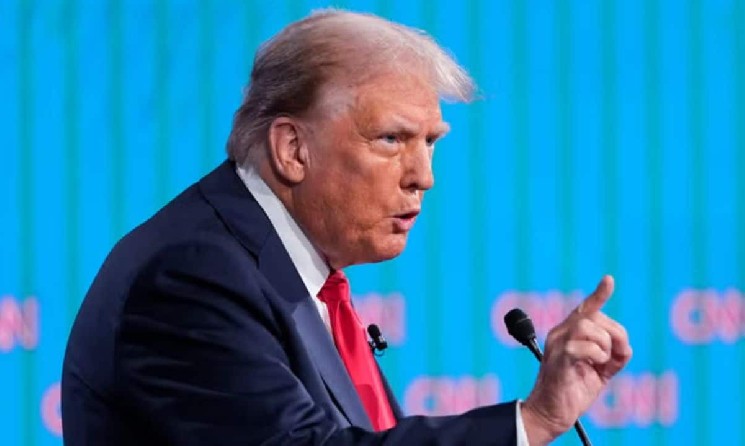
US President Donald Trump has doubled down on his promise to distribute a $5,000 "dividend" payment to every adult US citizen if Republicans retain control of Congress in the November elections.
The "dividend" label refers to a direct government payment to households rather than a payout from corporate profits — a mechanism similar to the stimulus checks Washington issued during the 2020–2021 pandemic cycles.
Popular analyst Crypto Rover outlined his view on the matter, arguing that the enormous liquidity injection — which remains far from certain at this point — could send tens of billions of dollars into $BTC and other digital assets.
Billions Into Bitcoin?
An important caveat comes first: Trump's promise continues to face significant political and economic hurdles, and even some Republicans have spoken out against it. At the same time, the president has shown in the past that he is willing to make unpopular decisions, so the proposal cannot be dismissed outright despite the uncertainty surrounding it.
Rover noted that the potential impact on digital assets is being underestimated, even though many other analysts have speculated recently that the payouts could lead to major rallies, especially for altcoins. His thesis is straightforward: households would undoubtedly use much of the money for bills, consumption, and debt, but even a relatively small portion finding its way into investments could represent substantial new demand for crypto.
He estimated that 5%–10% of a $1.7 trillion liquidity injection would amount to somewhere between $85 billion and $170 billion potentially entering the market.
There is, however, a catch. Trump promised the payment to adult US citizens, not to every American. New estimates from major news organizations put the program's likely cost at around $1.2–$1.3 trillion, rather than the $1.7 trillion initially considered. The distinction matters because it reduces the total size of the potential payout.
Even with this lower figure, a hypothetical 5%–10% allocation would represent $60 billion to $130 billion. Rover argued that today's market is better positioned to absorb retail capital than during previous stimulus cycles, pointing to spot ETFs, broader institutional infrastructure, improved access, and a much more developed regulatory framework.
Far From Guaranteed
Beyond the arithmetic, the proposal faces a difficult political path before any such liquidity boost can materialize. Several Republicans have expressed skepticism about the plan, concerned that payments exceeding $1 trillion could worsen the federal deficit and further reignite inflation. According to Reuters, some GOP lawmakers instead want additional government revenue directed toward reducing debt.
Separately, Congress would have to authorize the spending if Republicans win in November, meaning a program of this scale would need legislation to pass both chambers before any checks could go out.
Consequently,'s scenario rests on several major assumptions: a GOP victory at the polls, congressional approval, actual distribution of the checks, and recipients subsequently allocating even a small portion of that amount to crypto. All of these steps remain uncertain at this stage. The next signals to watch are the November election results, the budget negotiations that would follow, and any further revisions to the program's cost estimates.

