TronBid Expands TRON Resource Marketplace to Rent Energy and Reduce USDT Fees
Key Takeaways
- •TronBid expanded its marketplace to support renting and trading TRON Energy and Bandwidth through a two-sided order system.
- •Users can create BUY orders or SELL offers, and buyers can purchase part or all of a seller’s Energy offer.
- •The platform added Quick Rent and Flash Recharge for immediate resource access and wallet resource management.
- •TronBid launched a B2B Quick Rent API for businesses such as exchanges, wallets and payment processors that handle frequent TRON transactions.
- •TronBid said it has become a TRON Super Representative Partner and joined TRON’s delegated proof-of-stake governance ecosystem.
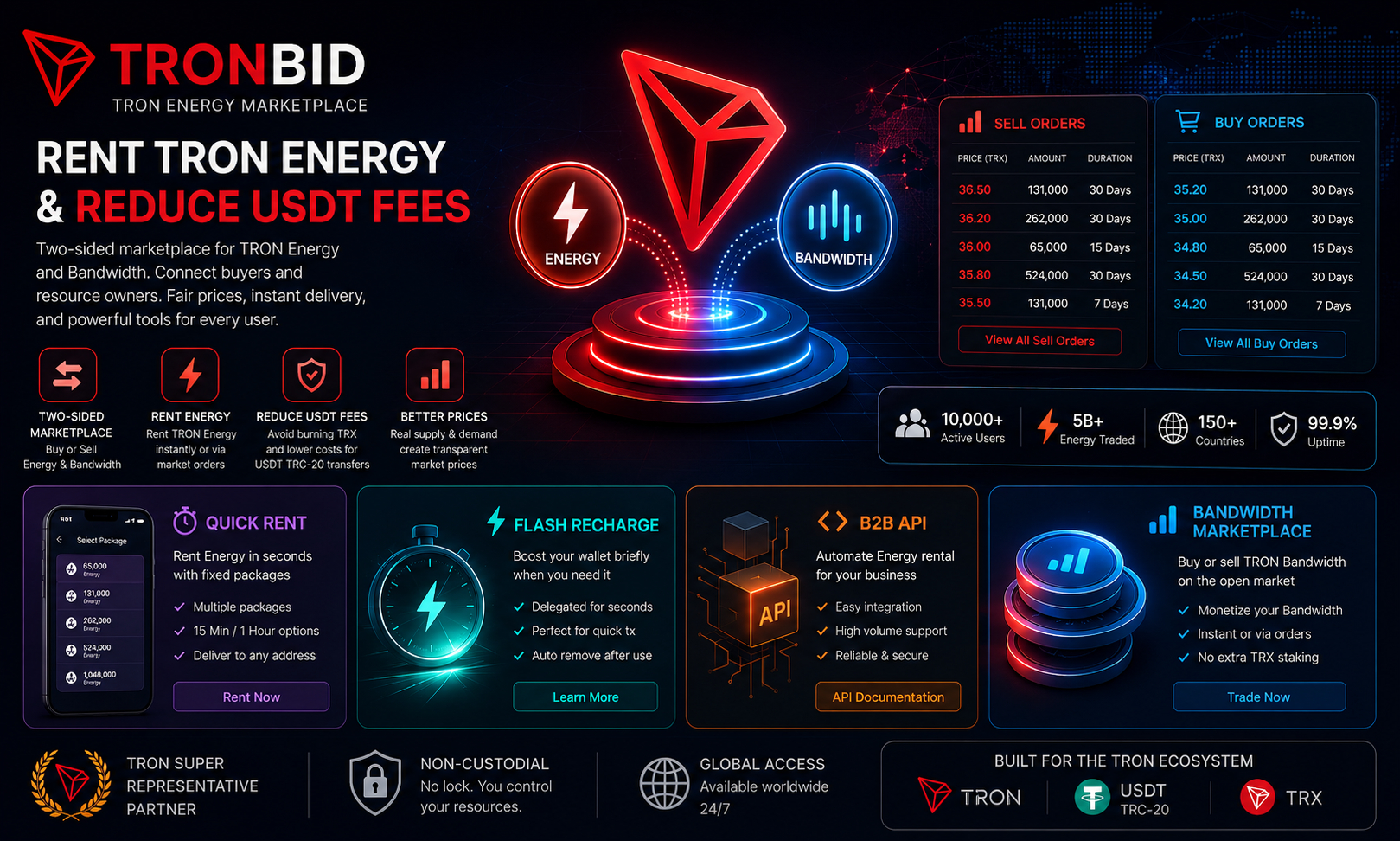
Berlin, Germany, August 26, 2026, Chainwire — TronBid has expanded its two-sided TRON resource marketplace, adding new tools that allow users to rent Energy, trade Energy and Bandwidth, and reduce USDT fees for TRC-20 transactions.
TronBid, a peer-to-peer marketplace for TRON network resources, said the updated platform is designed for users who want to manage transaction costs and access network resources without maintaining large amounts of staked TRX. The marketplace now operates as a two-sided system in which both buyers and sellers can create orders for TRON Energy and Bandwidth.
Understanding TRON Energy usage
TRON uses Energy and Bandwidth as its primary network resources. Energy is required for smart-contract computation, including USDT TRC-20 transfers.
When a wallet does not have sufficient Energy, TRX may be consumed to cover the resources needed for the transaction. That has created demand for users and businesses to rent Energy instead.
By receiving temporary Energy delegated from another account, users can complete eligible TRON transactions without maintaining enough staked TRX for their maximum resource requirements. For businesses processing frequent TRC-20 transactions, renting TRON Energy can provide another way to manage network costs and reduce USDT fees.
A two-sided marketplace for Energy
Unlike platforms where rental conditions are set entirely by the provider, TronBid allows both sides of the market to create orders.
Buyers can create BUY orders that specify the amount of Energy required, the rental duration and the price they are willing to pay. Sellers can create SELL offers with their own amount, price and rental period, and buyers can purchase all or part of those offers directly.
For example, if a seller offers 600,000 Energy, one buyer can rent 350,000 Energy, leaving the remainder available for other buyers.
Creating a SELL offer does not reserve the seller’s Energy. If resources become unavailable because they are being used elsewhere, recurring offers can automatically pause and become active again when sufficient Energy returns. TronBid said this allows sellers to participate in the marketplace while continuing to manage their resources elsewhere.
Quick Rent and Flash Recharge
For users who need resources immediately, TronBid also offers Quick Rent with predefined Energy packages and short rental periods.
Energy can be delivered directly to any specified TRON address, even when payment is made from another wallet.
The company has also introduced Flash Recharge, an option designed for wallets that already maintain their own Energy capacity but need to manage consumed resources.
Energy and Bandwidth trading
TronBid’s marketplace supports both Energy and Bandwidth, allowing holders of staked TRX to monetize the network resources their stake generates.
The platform says this creates two sides of the ecosystem: users who need to rent TRON Energy or Bandwidth and resource owners looking to make unused capacity available to the market.
By allowing both buyers and sellers to set their own terms, TronBid said it aims to create more transparent price discovery based on actual supply and demand.
B2B API for businesses
TronBid also provides a B2B Quick Rent API for exchanges, payment processors, wallets, OTC services and other businesses that process frequent TRON transactions.
Businesses can maintain a prepaid balance and automatically request Energy for specified TRON addresses before executing transactions. Instead of manually renting resources for every transfer, companies can integrate Energy rental directly into their transaction infrastructure.
For businesses handling large numbers of USDT TRC-20 transfers, TronBid said this can make it easier to rent Energy automatically and manage the network-resource component of transaction costs.
TronBid becomes a TRON SR Partner
Alongside the marketplace expansion, TronBid said it has become a TRON Super Representative Partner, adding the project to TRON’s delegated proof-of-stake governance ecosystem.
The company said the development strengthens its connection with the broader TRON ecosystem while it continues building infrastructure around Energy and Bandwidth.
About TronBid
TronBid is a peer-to-peer marketplace for TRON Energy and Bandwidth. Buyers can rent TRON Energy, create BUY orders or purchase existing seller offers, while resource owners can create SELL offers with their own prices and rental periods.
The platform also provides Quick Rent, Flash Recharge and a B2B API for businesses looking to automate Energy rental and reduce USDT fees for TRC-20 transactions.
More information:
Disclaimer: Any information written in this press release does not constitute investment advice. Crypto Front News does not, and will not, endorse any information about any company or individual on this page. Readers are encouraged to do their own research and base any actions on their own findings, not on any content written in this press release. Crypto Front News is and will not be responsible for any damage or loss caused directly or indirectly by the use of any content, product or service mentioned in this press release. For more details, visit our disclaimer page.
