TRON (TRX) Trades Near $0.335 as Stablecoin Balance Reaches $95.8 Billion
Key Takeaways
- •TRX traded near $0.335 on October 5, extending the tight $0.325–$0.345 range that held through most of September.
- •Stablecoins issued on the TRON network total roughly $95.8 billion, nearly three times the token's $31.8 billion circulating market value.
- •TRON averaged 4.41 million daily active accounts over the past 30 days and moved $2.1 trillion in USDT during the second quarter.
- •Shares outstanding in the Canary Staked TRX ETF (TRXS) have remained flat at 2.03 million since September 15, signaling no new fund demand since launch.
- •TRX supply grew at an annualized rate of 0.31% between August 30, 2025, and October 3, 2026, with fee-related token burns contributing to the modest pace.
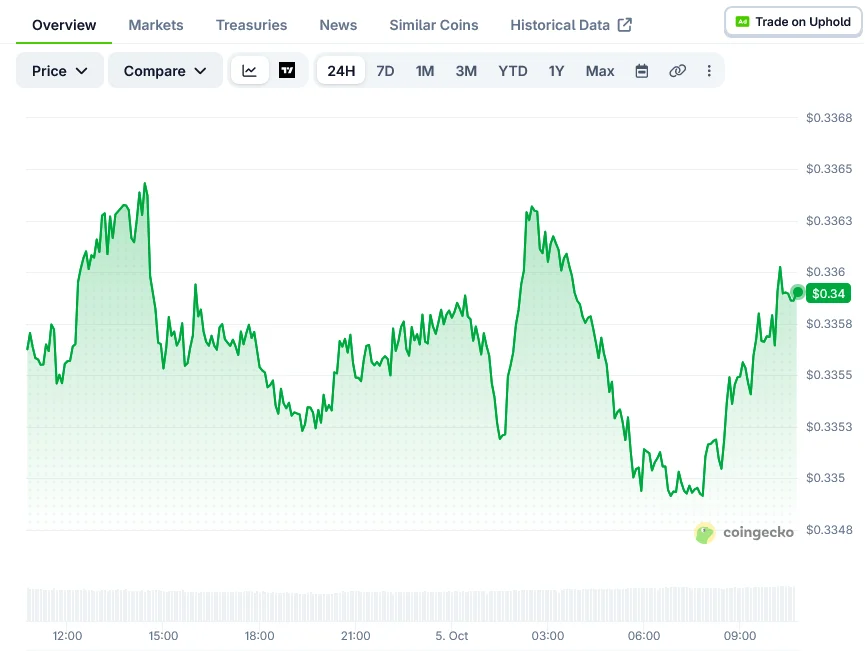
TRON's native token, TRX, traded near $0.335 on October 5, holding within the narrow range that defined most of September, when daily closes moved between roughly $0.325 and $0.345 and kept price action tightly contained.
Data from CoinGecko valued circulating TRX at approximately $31.8 billion, while DeFiLlama reported about $95.8 billion in stablecoins issued on the TRON network. Those two numbers measure different things: one reflects the market value of the token itself, and the other counts dollar-pegged tokens issued on the chain rather than money spent buying TRX. The stablecoin figure is roughly three times the size of TRX's market value — a measure of how much dollar-pegged value sits on the chain relative to its native token, and one reason stablecoin balances are among the most closely watched on-chain metrics.
USDT Activity Remains Central to the Network
TRON is a major network for USDT transfers. A second-quarter report put the value of USDT moved on the chain at $2.1 trillion for the quarter. Transfer totals count each time a dollar changes hands rather than new money entering the network, and moving a dollar of USDT does not require a dollar of TRX to be bought.
Under the network's fee model, users can stake TRX to obtain resources known as Energy and Bandwidth, or burn tokens to cover transaction costs. Either approach pays for the resources needed to transact on the chain. Both mechanisms tie activity back to the token itself: staking commits TRX toward resources, while burned tokens leave circulation and flow into the burn totals tracked by TRONSCAN. Some wallets now also allow users to settle fees in USDT.
Network usage remains elevated. A post from crypto.news highlighted that the network has averaged 4.41 million daily active accounts over the past 30 days:
JUST IN: TRON averages 4.41M daily active accounts
The $TRX network has maintained an average of 4.41 million daily active accounts over the past 30 days. pic.twitter.com/uuwJxB3XtS
— crypto.news (@cryptodotnews) October 4, 2026
Usage at that scale keeps the fee mechanics above in continuous use, since every transfer draws on Energy or Bandwidth, whether obtained by staking or burning.
ETF Shares Have Barely Moved
The Canary Staked TRX ETF began trading under the ticker TRXS on September 9. The fund is designed to track TRX while earning staking rewards.
Shares outstanding stood at 2.01 million at launch and reached 2.03 million on September 15. From that point, the count held at 2.03 million on every reported day through October 2, essentially flat since mid-September. Net assets totaled about $50.23 million on October 2, down slightly from $50.26 million on September 16 — an amount equal to roughly 0.158% of TRX's market value.
TRON DAO marked the fund's debut with a Cboe closing bell event on September 29. An increase in shares outstanding would signal new demand for the fund, though no such rise has appeared in the reported figures to date. Because the share count is disclosed on every reporting day, any movement away from the 2.03 million level would be visible directly in the data itself.
Supply Growth Remains Modest
TRONSCAN data shows TRX supply grew at an average yearly rate of 0.31% from August 30, 2025, to October 3, 2026. Daily changes depend on how many tokens are created and how many are burned. On September 9, about 3.91 million TRX were generated and 2.58 million were burned, leaving a net increase of approximately 1.33 million tokens for the day. Fees paid by burning are one contributor to those daily burn figures, linking routine network activity to the supply trend.
Price Levels in Focus
Several defined levels frame the token's recent range, measured from the current price of $0.335. A move to $0.38 would require a 13.4% gain. Reaching $0.40 would call for a 19.4% rise and would value circulating TRX near $38 billion. A sustained break above $0.35 on higher trading volume would mark an exit from the recent range, while a close back below $0.32 after a breakout attempt would undo that path.
On the downside, $0.31 sits 7.5% below the current price and $0.29 is 13.4% lower. That scenario would require a lasting drop beneath the $0.32 to $0.325 area. An October close between $0.32 and $0.36 would leave the token trading within a narrow band.
Separately, seven TRON addresses were recently sanctioned in a U.S. action. The designation applies to those specific addresses, not to the TRON network as a whole or to TRX trading. Sanctions of this kind are aimed at the listed wallet identifiers, which U.S. persons are generally barred from transacting with, rather than at the underlying blockchain.
Macroeconomic data is also on the calendar this month. September CPI is due on October 14, the Federal Reserve meets on October 27 and 28, and PCE inflation figures follow on October 29. Inflation prints and Fed meetings shape expectations for U.S. interest rates and dollar liquidity, the backdrop against which crypto and other risk assets trade.
This article originally appeared on Blockonomi.

