TRON Activity Grows While TRX Price Stays Range-Bound Near $0.33
Key Takeaways
- •GasFree gasless USDT transfers on TRON reached a record weekly volume of approximately $3 billion in early May 2026, with around 196,000 weekly transactions and nearly 30,000 unique senders by late June.
- •Rhino.fi cross-chain transfers from TRON rose from roughly $1 million to a record $48 million in weekly USDT volume by mid-June, with average transaction values increasing to as much as $24,000.
- •BAI's x402-based AI-agent payment testing on TRON remains early-stage, with daily deposit counts peaking near 30 and daily volume reaching only about $6,000.
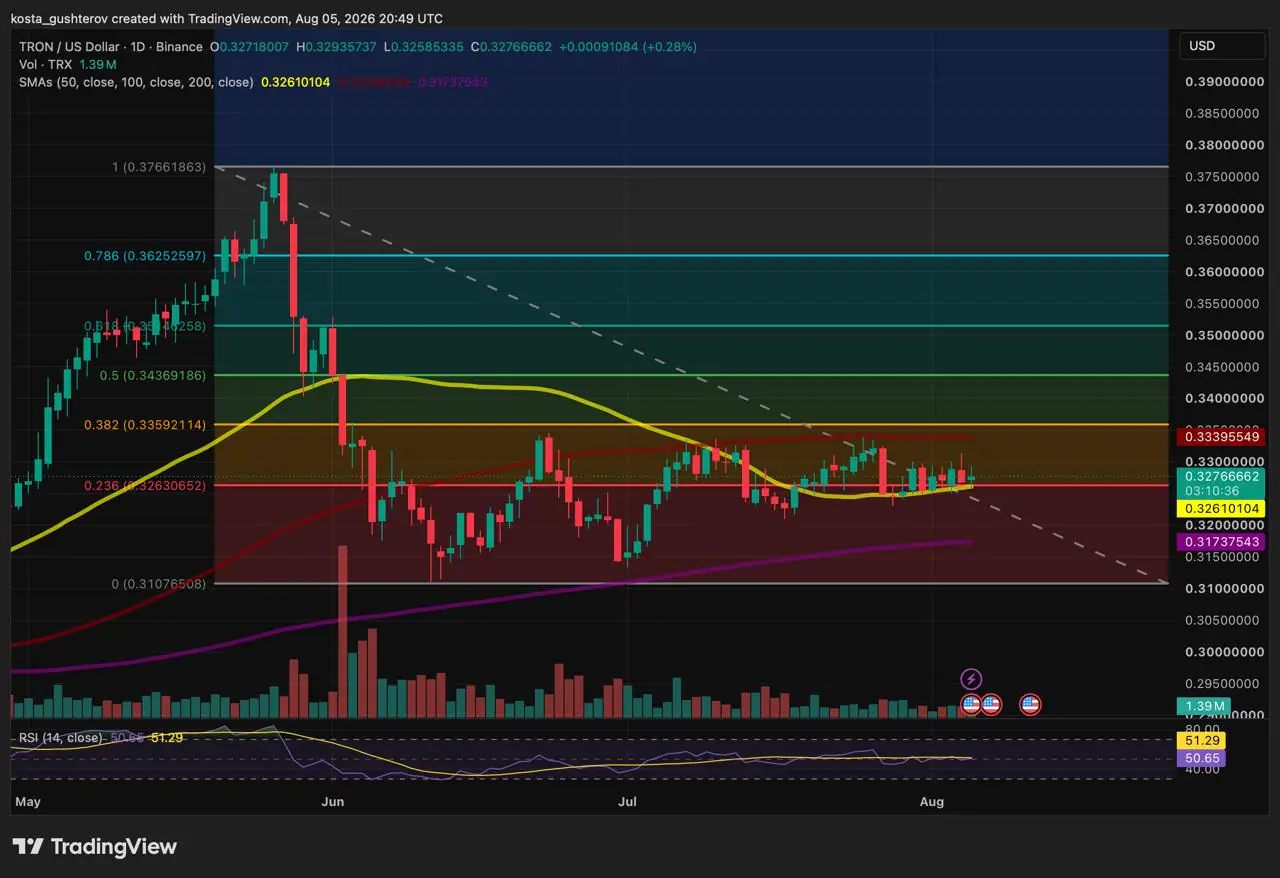
- •TRX traded near $0.32 as of August 5, 2026, confined within a narrow range between support at $0.326 and resistance at $0.334-$0.335, with an RSI of approximately 50.7 indicating neutral momentum.
- •GasFree and cross-chain integrations improve TRON's stablecoin accessibility but weaken the direct link between network usage and incremental demand for the TRX token itself.
Gasless USDT transfers and cross-chain liquidity infrastructure are expanding across the TRON network, while machine-to-machine payments remain at an early experimental stage. TRON ranks among the largest blockchain networks by USDT transfer volume, alongside Ethereum, which gives these infrastructure developments broader relevance for the stablecoin payments landscape. Despite stronger on-chain activity, TRX has not produced a comparable price move. As of August 5, 2026, the token was trading near $0.32 after moving sideways since late July.
The contrast between network growth and price stability raises a central question for TRX: will growing usage of TRON's infrastructure eventually translate into sustained demand for the token, or can adoption continue without materially affecting its valuation?
TRX Maintains Support but Faces Tight Resistance
TRX is trading within a narrow technical range. The lower boundary is reinforced by the 50-day simple moving average (SMA) near $0.326 and the 0.236 Fibonacci retracement at approximately the same level. Buyers have repeatedly defended the $0.326 area since late July.
Above the current price, the 100-day SMA near $0.334 and the 0.382 Fibonacci retracement at $0.335 form the first major resistance zone. The separation between support and resistance amounts to less than one cent, or approximately 3%.
The moving-average structure remains mixed. The 50-day SMA continues to trade below the 100-day average, indicating that medium-term momentum has not fully recovered. However, both TRX and its 50-day SMA remain above the rising 200-day SMA near $0.317, preserving the broader structure.
TRX has also moved marginally above the descending trendline extending from the May peak. The move carries limited technical weight because it occurred without a meaningful increase in trading volume and has not cleared the 100-day SMA.
Trading activity remained well below the levels recorded during the larger price swings in May and June. The Relative Strength Index (RSI) stood at approximately 50.7, a neutral reading indicating that neither buyers nor sellers currently hold strong directional momentum.
Network Activity Outpaces Token Price Movement
While TRX remains confined near $0.33, CryptoQuant's analysis of the TRON ecosystem shows expanding activity across three areas: gasless USDT transfers, cross-chain liquidity, and payments initiated by autonomous software agents.
Each development addresses a distinct limitation in stablecoin payments. GasFree enables users to send USDT without first holding TRX for gas fees. Rhino.fi makes TRON-based liquidity accessible across other blockchain networks. Projects using the x402 payment standard are beginning to test transactions between software agents.
The most substantial evidence of current usage comes from GasFree and Rhino.fi. AI-agent settlement remains experimental at this stage.
GasFree Reaches Meaningful Transaction Volume
A standard USDT transfer on TRON requires access to TRX or previously allocated network resources to cover transaction fees. GasFree modifies this process by sponsoring the network fee and deducting a fixed charge from the USDT being transferred. Users can therefore move stablecoins without first acquiring a separate token for fees. Gasless or fee-abstracted transfers have become a competitive feature across stablecoin networks, where reducing the number of tokens a user must hold to complete a transaction has emerged as a focus for improving accessibility and expanding adoption.
According to data presented by CryptoQuant, GasFree activity was close to zero at the beginning of 2025. Weekly USDT volume reached a record of approximately $3 billion in the first week of May 2026 and remained near $2.9 billion by late June.
Weekly transactions reached approximately 196,000, while the number of unique senders approached 30,000. Rising transaction and sender counts suggest that usage has expanded beyond a small number of isolated transfers, although the figures do not reveal how evenly the volume was distributed across participants.
Weekly GasFree fees reached a record of approximately $273,000. The average charge was $1.50 per transaction on an average transfer of $16,300, equivalent to roughly 0.009% of the transferred amount. While this visible charge is small relative to the average transaction size, the data does not account for any additional conversion, liquidity, or service-provider costs that users may incur.
The combination of substantial transfer volume and broader user participation indicates that GasFree has moved beyond a small-scale technical test into operational use.
Cross-Chain Flows Indicate Larger Transfer Sizes
Rhino.fi addresses a separate infrastructure limitation. Although TRON contains deep USDT liquidity, those balances are less useful when a user or business requires funds on another blockchain. Rhino.fi's infrastructure pools TRON-based liquidity and makes it accessible across more than 30 networks, with transfers completable in under ten seconds, according to CryptoQuant's analysis. Cross-chain interoperability has become a central infrastructure category across the crypto industry, as liquidity fragmentation across dozens of networks creates friction for both users and businesses seeking to move value between chains.
The Wirex integration specifically targeted users who held USDT on TRON but could not easily deploy those balances on other chains. Following the integration, weekly USDT volume transferred from TRON through Rhino.fi rose from approximately $1 million to a record of roughly $48 million by mid-June.
Average transaction value increased from roughly $3,000 to as much as $24,000 during the observed period. Transfers of that magnitude are consistent with treasury management, payment-provider liquidity operations, or business settlement activity, although transaction size alone cannot establish who initiated the transfers or for what purpose.
Larger business flows may prove more durable than fee-sensitive retail transfers, as companies typically integrate wallets, liquidity routes, and compliance systems into their ongoing operations. However, the available data does not yet confirm whether the observed increase represents recurring institutional usage or one-time activity.
AI-Agent Payments Remain in Early Testing
BAI is testing x402-based payments on TRON, but activity remains modest compared with GasFree and Rhino.fi. BAI combines on-chain agent identity with USDT settlement to enable autonomous software agents to transact directly. The x402 standard references the HTTP 402 "Payment Required" status code, repurposing it for automated machine payments, and places TRON's experimentation within a wider industry push to enable AI agents and other autonomous software to settle transactions on-chain.
BAI's deposit activity was close to zero during the first quarter of 2026 before beginning to rise in May. Deposit counts later approached 30 per day, while daily volume peaked near $6,000. Although deposits and volume increased together, the absolute figures remain small. At this scale, agent-based payments are too limited to provide a material explanation for TRX's current market valuation.
Network Growth Has Not Yet Translated Into Direct TRX Demand
TRON's network data demonstrates that its stablecoin infrastructure is becoming more widely used. However, that growth does not automatically translate into demand for the TRX token itself.
GasFree illustrates this distinction clearly. By removing the requirement for users to acquire TRX before sending USDT, the product improves accessibility but weakens the direct connection between each new user and incremental demand for the native token.
Any durable effect on TRX would need to emerge indirectly. Payment providers, fee sponsors, and infrastructure operators may require additional bandwidth and energy as overall usage grows, potentially increasing demand for staked TRX or delegated network resources. The available data does not quantify how much token-related demand these activities are currently generating.
Cross-chain integrations present a similar trade-off. Making TRON-based liquidity easier to use on other networks increases the utility of USDT held on TRON, but some of that liquidity may leave the TRON network as part of the transfer process.
For network growth to provide sustained support for TRX, evidence would need to show that rising transaction volume is accompanied by greater demand for bandwidth and energy, increased TRX staking or resource delegation, and other recurring activity directly linked to the token.
Technical Levels to Watch
A daily close above the $0.334–$0.335 resistance zone, supported by rising volume, would be needed to establish a more credible breakout for TRX. Such a move would bring the 0.5 Fibonacci retracement near $0.34 into focus. Continued momentum could then shift attention toward the 0.618 Fibonacci level around $0.35.
A move toward those levels without a sustained increase in trading volume would remain vulnerable to rejection and a potential return to the current trading range.
On the downside, a daily close below the combined 50-day SMA and 0.236 Fibonacci support level would weaken the technical structure. The next major reference point would be the 200-day SMA near $0.32, followed by the range floor around $0.31.
TRON's expanding payment activity improves the network's fundamental backdrop, but the token's price has not yet confirmed that the market is assigning greater value to that growth.
Methodology: Network figures are drawn from CryptoQuant's TRON ecosystem analysis and the project-level data cited within it. Technical levels are based on a Binance TRX/USD daily chart captured on August 5, 2026.
Disclaimer: This article is provided for informational and educational purposes only and does not constitute financial or investment advice. Cryptocurrency prices are volatile, and technical levels can fail without warning. Readers should conduct independent research before making financial decisions.

