Long-Term Treasury Yields Surge as Bond Market Grows Edgy Over Inflation and Massive New Debt Issuance
Key Takeaways
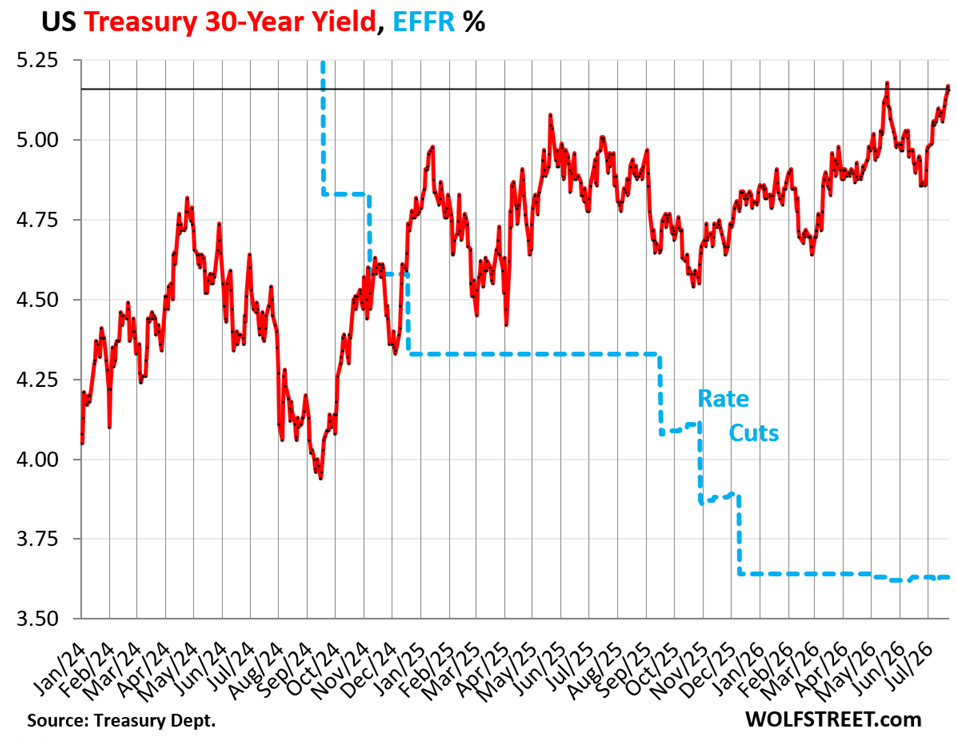
- •The 30-year Treasury yield rose to 5.16% this week, its highest level since July 2007, as bond investors demanded higher compensation for inflation risks and heavy new debt supply.
- •Despite the Federal Reserve cutting policy rates by 175 basis points since September 2024, long-term Treasury yields have moved in the opposite direction, with the 30-year yield climbing 120 basis points over that same period.
- •The national debt has grown by an additional $6 trillion since the October 2023 debt scare, when the 10-year yield briefly pierced 5% and triggered a massive wave of buying demand within hours.
- •This week's Treasury auctions showed elevated yields, with 20-year bonds clearing at 5.163% and 10-year TIPS at 2.438%, placing real yields near their highest levels since the 2008 financial crisis.
- •The Congressional Budget Office projects that net interest payments will rank among the largest categories of federal spending, which compounds the very deficit pressures driving the debt issuance that bond investors must absorb.
During the last debt scare, the 10-year yield hit 5%, and the floodgates of demand opened. Now the debt is $6 trillion bigger; no guarantee 5% will open the floodgates again.
Long-term Treasury yields surged this week as the bond market grew increasingly nervous about longer-term inflation prospects and edgy about the massive onslaught of new debt needed to fund the ballooning federal deficit. Enormous volumes of new debt will need to be issued over the coming years, and those securities will have to find buyers. The concern gripping the bond market is that growing numbers of buyers will need to be lured in with higher yields — and higher yields mean lower prices for existing bondholders, who have already endured a bloodbath since mid-2020, when the 40-year bond bull market flipped into a bond bear market and longer-term yields began their sharp ascent. Because Treasury yields serve as the benchmark for borrowing costs across the broader economy — from 30-year mortgage rates to corporate bond yields — the level at which the market absorbs new government debt carries implications far beyond the Treasury market itself.
The 30-year Treasury yield jumped 10 basis points this week to 5.16%, after briefly touching 5.19% intraday on Thursday. Together with May 19, these were the highest yields since July 2007.
The Federal Reserve has cut its policy rates by 175 basis points since September 2024, even as inflation began to accelerate again. Over that same period, the 30-year Treasury yield has risen by 120 basis points. The 30-year yield now sits 153 basis points above the Effective Federal Funds Rate (EFFR), which the Fed targets through its policy rates — a stark reversal from being 140 basis points below the EFFR before the rate-cutting cycle began in September 2024.
Those rate cuts unsettled the bond market. Bond investors fear inflation because it erodes a substantial portion of the purchasing power of long-duration bonds. They also fear a dovish Fed that permits inflation to persist, and they fear the torrent of new debt issuance.
Over a two-decade horizon, the 30-year Treasury yield took 14 years to zigzag downward from 5.2% to 1.0% in March 2020 — the final stretch of the 40-year bond bull market. It then took only six years to climb back to those same levels, marking the onset of the bond bear market.
The market value of 30-year Treasury securities purchased at the March 2020 auction has declined by more than 50%. That is the scale of the losses these bondholders have weathered, and with the expectation that more pain may lie ahead, they are demanding higher yields as compensation for the risks involved.
Beyond secondary market trading, two long-term Treasury auctions this week shed further light on the situation: the 20-year Treasury bond auction on Wednesday and the 10-year Treasury Inflation-Protected Securities (TIPS) auction on Thursday.
The 20-year Treasury bonds sold at Wednesday's auction at a yield of 5.163%. In the secondary market on Thursday, the 20-year yield rose to 5.20% — the highest since the October 2023 debt scare, which itself had produced the highest yields since 2007. The 20-year yield closed Friday at 5.18%, up 11 basis points for the week.
The 2023 debt scare was triggered when the Treasury Department disclosed just how much long-term debt it planned to issue over the following quarters. That projected flood of new supply rattled bond investors. During that episode, the 10-year yield surged relentlessly from 3.4% in May 2023 to over 5% on October 23, 2023 — a 160-basis-point move in seven months. But the 5% level opened the floodgates of demand, and within hours drove the yield back down to 4.83% — a remarkable spectacle. The 10-year yield has not touched 5% since.
There is no guarantee that demand will surge in the same way when the 10-year yield next reaches 5%, because by now the national debt has grown by an additional $6 trillion.
After witnessing the bond market's reaction, the Treasury Department walked back its long-term issuance plans, shifting its focus toward shorter-term maturities and Treasury bills. The department continues to tread carefully on long-term issuance to this day. The 10-year yield breaching 5% was an alarming moment for the Treasury.
However, the government did not actually have to sell 10-year Treasuries at 5% during that episode. The last 10-year note auction before October 23, 2023, took place on October 11, with $35 billion sold at a yield of 4.61%. The first auction after the debt scare, on November 8, saw $40 billion in 10-year notes clear at 4.519%.
The last time a 5%+ yield was required to sell 10-year notes at auction was June 2007. At that time, the Treasury Department only needed to sell $8–12 billion of 10-year notes per auction, with just 8 auctions per year. Now there are 12 auctions per year, each running in the $40–$50 billion range.
On Thursday, the 10-year Treasury yield rose to 4.71% — the highest since three days in January 2025, and before that, the highest since the October 2023 debt scare, and beyond that, the highest since 2007.
The 10-year TIPS sold at Thursday's auction at a yield of 2.438%. TIPS holders also receive inflation compensation tied to CPI, which adjusts monthly and is added to the principal. As the principal grows with CPI, coupon interest payments — calculated on the combined original principal plus accumulated inflation protection — also increase. That 2.43% real yield — the compensation investors demand above expected inflation for committing capital over a decade — stands near the highest levels since the 2008 financial crisis. For much of 2021, 10-year real yields were negative, meaning investors accepted a guaranteed loss of purchasing power in exchange for the perceived safety of government-backed securities.
In the secondary market, the 10-year TIPS yield closed Friday at 2.43%, the highest since the October 2023 debt scare (which was a few basis points higher), and before that, the highest since 2008.
Given the inflation dynamics, the enormous flood of new debt that must be absorbed, and the severe losses already endured, the bond market remains remarkably composed. It has shown signs of unease but has not yet staged a full-blown revolt. Rising yields also mean rising debt-service costs for the federal government itself; the Congressional Budget Office has projected that net interest payments will rank among the largest categories of federal spending, which in turn compounds the very deficit pressures driving the issuance that the bond market must absorb. This would be an opportune moment for Congress to take notice and act before a crisis materializes. However, Congress historically has not paid attention until a crisis is at hand — as was the case in the 1980s — at which point the situation becomes far more difficult to manage.
Related: Fed Chair Warsh scuttled forward guidance, markets are on their own.

