US Government Sold $797 Billion of Treasuries This Week; 10-Year Yield Hits 4.73%, 30-Year Hits 5.22%
Key Takeaways
- •The US government sold $797 billion of Treasury securities this week, comprising $562 billion in T-bills and $235 billion in notes across 10 auctions.
- •Fed Chair Warsh's Friday Jackson Hole speech, which lacked forward guidance, was interpreted as hawkish and pushed 1-5 year Treasury yields up 11-14 basis points.
- •The 30-year Treasury yield rose to 5.22%, the highest secondary-market level since 2007, despite three Treasury interventions including a yen intervention, doubled buybacks, and a leaked Treasury General Account story.
- •The 6-month yield sits 39 basis points above the Effective Federal Funds Rate of 3.63%, indicating markets see a very high probability of at least one rate hike.
- •Treasury Secretary Bessent has been accused, including by Druckenmiller in a Wall Street Journal editorial, of politicizing debt management to lower yields before the midterm elections.
Warsh Moved the Needle on Friday, While Bessent's Hocus-Pocus Shows 1-3 Fizzled
The US government sold $797 billion of Treasury securities this week, spread over 10 auctions — a lot of paper. Of that total, $562 billion were Treasury bills with maturities from 4 weeks to 26 weeks, spread over six auctions, with most of these sales replacing maturing T-bills. The remaining $235 billion were Treasury notes sold across four auctions. The scale of this weekly issuance is a direct consequence of the federal budget deficit, which requires the Treasury to constantly roll over maturing debt and raise new money — the dynamic that drives the $1-trillion-every-three-to-five-months pace described below.
No auctions are scheduled on Fridays, so all of this week's auctions took place Monday through Thursday. But Friday brought the wild drama — Fed Chair Warsh refusing to spoon-feed markets some soothing pap. Yields across the Treasury curve rose as a result, with the 1-year to 5-year maturities rising the most, spiking 11 to 14 basis points.
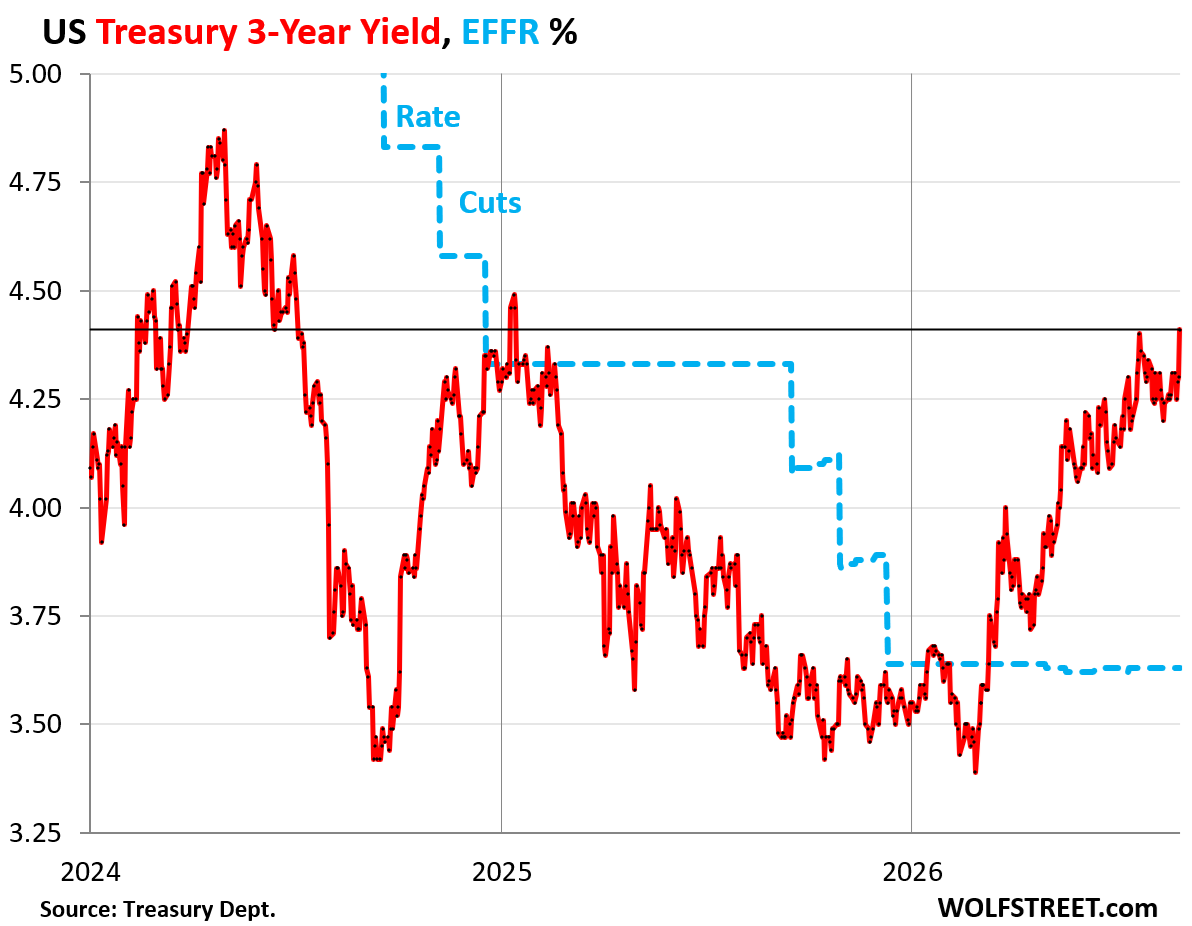
The 3-year Treasury yield spiked 11 basis points on Friday to 4.41%, the highest since a few days in January 2025, and before then, the highest since 2024. Buyers and sellers in that segment of the bond market are pricing in a scenario of multiple rate hikes. The 3-year yield now sits 78 basis points above the Effective Federal Funds Rate (EFFR), which the Fed targets with its policy rates.
The 2-year Treasury yield spiked 14 basis points to 4.34%, according to Treasury Department calculations — the highest since July 23, and before that single day, the highest since February 2025. Yet at Tuesday's auction, the government had sold $78 billion of 2-year notes at a yield of 4.20%, 14 basis points below Friday's closing yield.
This week's $235 billion of note sales included a regular 2-year note with a fixed coupon payment and a 2-year Floating Rate Note (FRN). The 2-year FRNs were sold at a "spread" of 0.055%. Holders receive an interest rate that resets weekly, based on the yield at which the most recent 13-week T-bills were sold at auction, plus the 0.055% spread (discount margin).
In the secondary market, the 5-year Treasury yield closed at 4.48% on Friday, about 9 basis points higher than the yield at which $79 billion of 5-year notes had been sold at auction on Wednesday. The 7-year Treasury yield closed Friday at 4.59%, about 8 basis points higher than the yield at which $50 billion of 7-year notes had been sold on Thursday.
Bessent's Three Hocus-Pocus Shows Fizzled
Bessent's job is to fund huge deficits by selling Treasury securities at a pace of $1 trillion every three to five months, come hell or high water — and to sell them at the lowest possible yield.
The 30-year Treasury yield was surging in July. So came Hocus-Pocus #1: the joint US-Japan yen intervention at the end of July, confirmed on August 3. That pushed yields down for a couple of days before they rose again.
Then on August 13, 30-year Treasury bonds sold at auction at a yield of 5.216%, the highest auction yield since 2001, and in the secondary market the 30-year yield continued to rise. That gave Bessent the willies. So on August 19 came Hocus-Pocus #2: an announcement of doubling the buybacks of 10-year to 30-year Treasuries. Yields dropped for just one day, then rose again.
Then came Hocus-Pocus #3: on August 24, a leaked CNBC story that he'd "tap" the Treasury General Account to fund the buybacks. That is, however, the checking account of the US — the only checking account of the US that pays for everything, including paying off maturing Treasuries, so what else would he tap? But the media ran with it, and that worked for a day.
Bessent has been accused of politicizing the bond market with these shows — trying to get yields and mortgage rates down before the midterm elections — including by his former boss, Druckenmiller, in a Wall Street Journal editorial: "Debt management that even appears to follow the political calendar spends the one asset that took two centuries to accumulate: the credibility of the Treasury market. That asset doesn't regain its value so easily."
Unimpressed with the shows, the 30-year Treasury yield rose on Friday to 5.22%, right back in the 5.20%-plus range, reflecting the highest secondary-market yields since 2007.
When yields rise, bond prices fall, and the past six years of bond bear market have been a bloodbath for holders of 30-year bonds — especially those issued in 2020, around the final paroxysm of the 40-year bond bull market that ended in August 2020. Those 30-year bonds have lost over half their value in the secondary market. The bond bear market has just passed its sixth anniversary.
A lot can go wrong over the next 30 years. Inflation can run haywire. The federal government's fiscal situation can deteriorate further, leaving behind a rapidly growing mountain of debt that could reach crisis levels. With Congress unwilling to raise taxes and cut spending, the debt will eventually remain manageable only through a combination of higher inflation — in the 3-5% range, not 2% — and higher nominal economic growth. In that scenario, the Fed would let the economy "run hot," cutting rates early and hiking late, which the author notes is what the Fed has already been doing.
Bond buyers, wanting compensation for those risks, have been demanding higher yields. Yet these buyers currently still expect the Fed to reduce average inflation over the next 30 years to about 2.25%, according to the difference between the 30-year Treasury bond yield of 5.22% and the 30-year Treasury Inflation Protected Securities (TIPS) yield of 2.97% (TIPS holders get inflation protection added to the principal, based on CPI). That difference of 2.25 percentage points reflects the average inflation over the term of the bonds that the bond market expects.
Many observers and potential bond buyers see a very low chance of inflation averaging 2.25% over the next 30 years, and they are not buying 30-year Treasury bonds until 30-year yields move significantly higher to compensate them. Some sellers share that view and are selling. Others disagree and are buying — which is what makes a market.
But increased issuance will require those fence-sitters to be pulled off the fence to buy the new securities, and pulling them off in large enough numbers would mean higher yields. That is a result of ballooning supply: new buyers who didn't want to buy must be persuaded to come in, and higher yields accomplish that.
The 10-year Treasury yield jumped 6 basis points on Friday to 4.73%, at the high end of its August range. The 10-year yield is the benchmark that US 30-year mortgage rates are typically priced off of, so its moves feed through into household borrowing costs — which is why the White House and Treasury pay close attention to it. At the August 12 auction, the government had sold 10-year Treasury notes at a yield of 4.68%, the highest auction yield since August 2007 — which had spooked Bessent and was another reason for Hocus-Pocus #2. Yields then bounced right back. Still, yields are not high compared with the pre-QE decades of bond history, which include the final years of the brutal bond bear market through late 1981, the 40-year bond bull market through August 2020, and the six years of the current bond bear market.
The government sold the $562 billion of T-bills this week Monday through Thursday, before the Warsh-inspired move on Friday. T-bill yields are less influenced by inflation and supply fears than long-term Treasury securities; instead, they react to the Fed's policy rates and expectations for those rates in the near future. Warsh jolted them on Friday: the 3-month yield jumped 6 basis points, the 6-month yield 8 basis points, and the 1-year yield 11 basis points.
But the week's auction yields predated Friday. The $83 billion of 26-week T-bills were sold at Monday's auction at a "high yield" of 3.79%, or an "investment rate" of 3.918%. Then Friday happened: in the secondary market, the yield jumped 8 basis points to 4.02%, according to Treasury Department calculations.
The bond market is now largely left to its own devices, as the Fed has stopped spoon-feeding it forward guidance about future policy rates. In early July, the bond market began pricing in a rate hike at the July FOMC meeting, and the six-month yield spiked to reflect that. But there was no majority for a hike (only three of the 12 FOMC members strongly wanted one and dissented), so that spike got worked off after the no-rate-hike meeting. On Friday there was another spike, based on Warsh's no-spoon-feeding Jackson Hole speech, which the market interpreted as "hawkish" in general terms despite the lack of specific forward guidance. With the Fed no longer offering explicit guidance, upcoming FOMC meetings and economic data releases are the remaining reference points for how short-term yields settle from here.
The 6-month yield now sits 39 basis points above the EFFR (3.63%), indicating that the market sees a very high chance of at least one rate hike within its window.
Source: Wolf Street
