Wall Street Expectations for Treasury Yields: Higher for Longer
Key Takeaways
- •Economists surveyed by The Wall Street Journal in October expect U.S. Treasury yields to stay elevated in a "higher for longer" environment.
- •Yields have risen since the start of the summer amid improving growth, new inflationary pressures, and concerns about the U.S. fiscal trajectory.
- •These combined forces have led many economists to re-evaluate their assumptions about investors' demand for Treasurys.
- •Forecast dispersion is wide, with projections for the 10-year Treasury yield in December 2027 ranging from 3.95% to 5.63%, a spread of about 1.68 percentage points.
- •As a benchmark shaping borrowing costs from mortgages to corporate debt, the 10-year yield's outlook draws attention beyond bond markets, and monthly survey updates will track revisions.
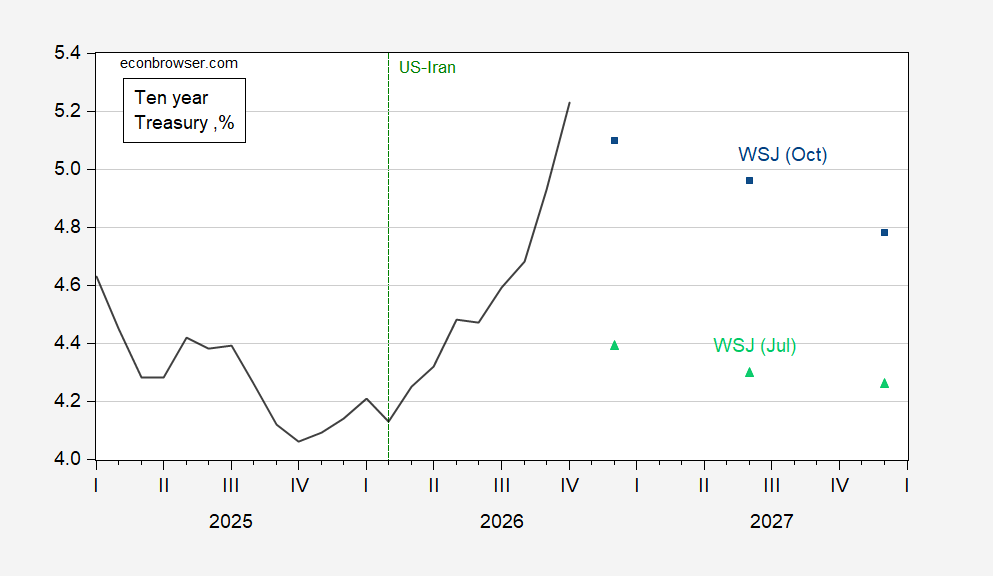
Wall Street economists expect U.S. Treasury yields to remain elevated — a "higher for longer" outlook — according to the October WSJ survey.
A mix of improving growth, new inflationary pressures, and concerns about the U.S. fiscal trajectory has pushed bond yields higher since the start of the summer. Many economists said the combination has forced them to re-evaluate their assumptions about investors' demand for Treasurys, whose yields rise when their prices fall.
The dispersion of forecasts in the survey remains wide. The low prediction for the 10-year Treasury yield in December 2027 is 3.95%, while the high is 5.63%, submitted by James Smith and Allen Sinai, respectively. That spread of roughly 1.68 percentage points illustrates the range of views among professional forecasters about where rates will stand.
The survey's accompanying figure, based on Treasury yield data via FRED and compiled by the WSJ, plots the 10-year Treasury yield in black, the October WSJ survey mean as a blue square, and the July WSJ survey mean as light green triangles, all in percent.
The 10-year Treasury yield is a widely watched benchmark for borrowing costs across the U.S. economy, influencing rates on everything from mortgages to corporate debt — one reason the survey's yield projections draw attention well beyond bond markets. The WSJ Economic Forecasting Survey gathers monthly projections from professional economists covering growth, inflation, and interest rates over multi-year horizons, making it a regular reference point for assessing shifts in expectations about the path of U.S. rates. Because the survey is updated monthly, upcoming releases will show whether and how economists revise their assumptions about Treasury demand.
Source: Econbrowser

