Treasury Bond Buyback Expansion Weighs on the Dollar as 30-Year Yield Hits Highest Level Since 2007
Key Takeaways
- •The 30-year US Treasury yield climbed to 5.32%, its highest level since 2007, while the 10-year yield reached 4.74%, and the sell-off spread to government bonds in Australia, New Zealand and Japan.
- •Brent crude rose above USD 90 per barrel as Middle East prospects deteriorated and uncertainty surrounding the Strait of Hormuz increased, intensifying inflation risks and complicating the Federal Reserve's policy outlook.
- •The Treasury Department will at least double buybacks of off-the-run securities with remaining maturities of at least 10 years, planning seven operations from 9 September that could purchase around USD 28 billion of long-term bonds through October.
- •The buyback programme is not quantitative easing, as the Treasury cannot create money and will likely fund purchases through increased short-term issuance, making it closer in design to Operation Twist from 2011-2012.
- •After the announcement, the dollar fell about 0.8% on a trade-weighted basis, the Dollar Index dropped to a three-month low, and EUR/USD rose above 1.17 for the first time since late May.
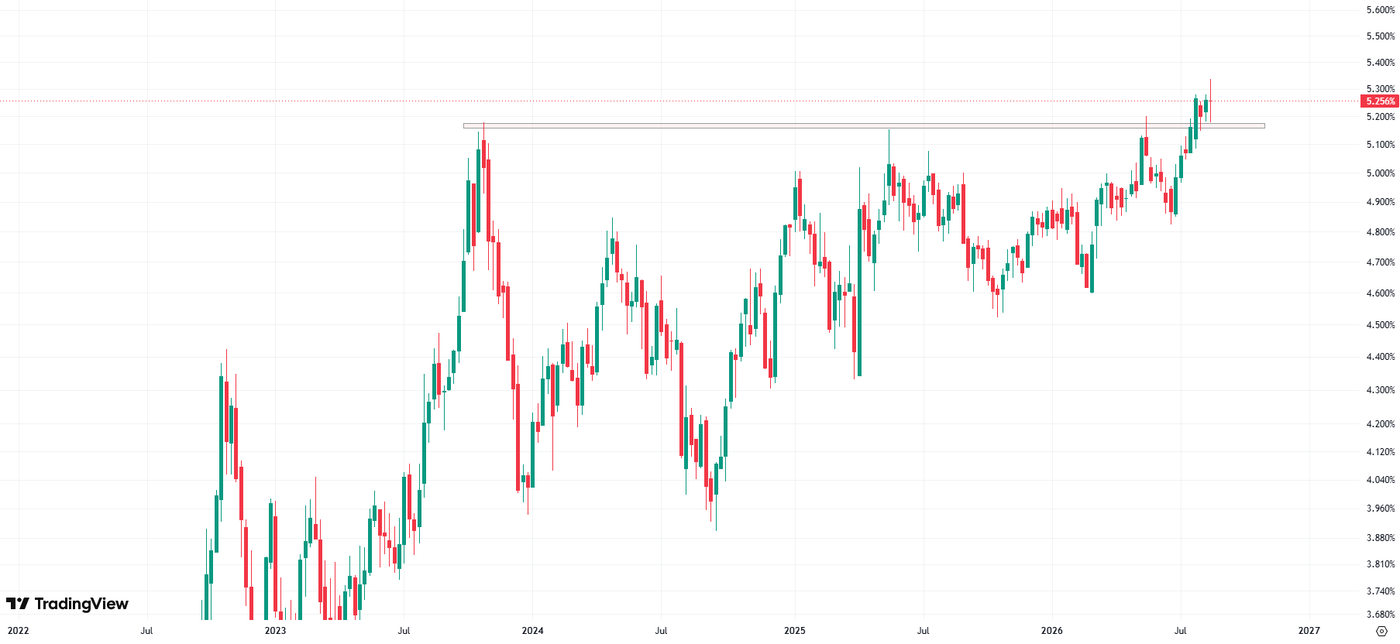
US long-term Treasury yields climbed to their highest levels since 2007 last week, while higher oil prices revived concerns about inflation and the Federal Reserve's policy outlook. In response, the Treasury Department doubled the scale of its long-term bond buyback programme. The intervention stabilised the bond market but pushed EUR/USD above 1.17, and markets may increasingly come to view a weaker dollar as the price of lower US borrowing costs.
The sharp rise in Treasury yields and Washington's subsequent response were the main market developments of the week. Rising borrowing costs, higher oil prices and persistent tensions in the Middle East initially intensified risk aversion. Later in the week, attention shifted to the attempt to stabilise the bond market, which simultaneously put significant pressure on the dollar.
Bond sell-off spreads worldwide
At the start of the week, global sovereign bond markets came under heavy selling pressure. The yield on the 30-year US Treasury climbed to 5.32%, its highest level since 2007, while the 10-year yield rose to 4.74%. The sell-off also spread to government bonds in Australia, New Zealand and Japan.
Investors were concerned about rising US government spending, record public debt and the substantial supply of long-dated Treasury securities. A further source of risk was the growing debt of major technology companies financing investment in data centres and artificial intelligence infrastructure.
Oil revives inflation concerns
Higher energy prices added to the pressure on government bonds. Brent crude rose above USD 90 per barrel as the prospects of ending the conflict in the Middle East deteriorated. Donald Trump showed no interest in extending the agreement with Iran, while fighting in Lebanon intensified once again.
The lack of progress in negotiations increased uncertainty surrounding the reopening of the Strait of Hormuz, the narrow shipping chokepoint between Iran and Oman through which roughly a fifth of the world's traded oil passes. Prolonged restrictions on shipping through this crucial route could keep oil prices elevated and intensify global inflationary pressure.
More expensive energy also complicated the Federal Reserve's policy outlook. Two relatively benign inflation readings and weaker US labour market data had previously reduced expectations of a rate increase in September. Persistently high oil prices, however, raised the risk of renewed inflation and strengthened the case for the Fed to maintain a restrictive stance.
Fed minutes provide no breakthrough
In the middle of the week, investors turned their attention to the minutes of the Federal Reserve's July meeting. Markets were looking for evidence of how close FOMC members had been to raising interest rates and whether such a move remained possible in the coming months.
The importance of the document was limited by economic data published since the meeting. Weaker labour market and inflation figures meant investors were no longer fully pricing in another rate increase by the end of the year.
The new Fed Chair, Kevin Warsh, also intends to limit communication about future monetary policy decisions and give financial markets greater freedom to interpret economic conditions. The lack of a clear signal from the Fed initially helped stabilise the dollar — until the Treasury Department unexpectedly intervened in the bond market.
Treasury steps into the market
Washington announced that it would at least double the scale of its buybacks of less liquid long-term government bonds. The operations will cover so-called off-the-run securities with remaining maturities of at least 10 years — older bonds that no longer trade as actively as freshly auctioned issues.
The programme is officially designed to improve market liquidity and reduce the risk of primary dealers being left with securities that are difficult to trade, and regular Treasury buybacks had themselves only returned in 2024 after a pause of more than two decades. Its timing, however, led investors to interpret the decision as an attempt to halt the rise in long-term yields. Only two days earlier, the 30-year yield had reached its highest level in almost two decades, and at the same time US public debt exceeded USD 40 trillion.
The expanded programme is initially scheduled to operate for two months from 9 September. With seven buyback operations planned, the Treasury could purchase around USD 28 billion of long-term securities in September and October, compared with the previously planned USD 14 billion.
The programme is not quantitative easing
The scale of the programme remains small compared with the Federal Reserve's previous asset purchases. At the peak of quantitative easing, the Fed bought USD 120 billion of securities every month.
Unlike the central bank, the Treasury cannot create new money to finance its purchases. The buybacks will therefore probably have to be funded through increased issuance of Treasury bills and other short-term securities.
The programme resembles Operation Twist from 2011–2012, when the Federal Reserve sold shorter-dated securities and bought longer-dated ones in order to push down long-term yields without expanding its balance sheet, more closely than conventional quantitative easing, and its direct effect on long-term yields is therefore likely to be limited. The more important signal is that the Treasury appears to have a level of borrowing costs beyond which it is prepared to intervene.
Bond stabilisation weakens the dollar
The reaction in the foreign exchange market was decisive. Following the announcement, the dollar lost around 0.8% on a trade-weighted basis, while the Dollar Index, which measures the currency against a basket of major trading partners, fell to its lowest level in three months. EUR/USD climbed above 1.17 for the first time since late May.
The dollar weakened despite continued expectations of further Fed tightening and the prospect of increased short-term Treasury issuance. This suggests that investors are beginning to look beyond interest-rate differentials and pay closer attention to the consistency and credibility of US economic policy.
A clear contradiction is emerging between the two institutions. Kevin Warsh argues that market interest rates should contribute to the fight against inflation, while the Treasury responds when higher long-term yields become too painful for the economy and public finances. Such intervention could weaken the tightening of financial conditions and undermine the credibility of the fight against inflation.
Washington's actions also suggest that, when faced with a choice between higher debt-servicing costs and a weaker currency, the administration may be willing to accept dollar depreciation. Bond buybacks increase demand at the long end of the yield curve and may reduce the term premium — the extra yield investors demand for holding long-dated bonds rather than rolling over short-term paper — but they also make dollar-denominated assets less attractive.
A new structural risk for the dollar
The expansion of the buyback programme does not imply an immediate dollar crisis. The currency continues to benefit from high interest rates, the depth and liquidity of US financial markets and capital inflows into the technology sector, meaning periods of dollar weakness may still be interrupted by significant rebounds.
The past week has nevertheless demonstrated that there are politically acceptable limits to the rise in US Treasury yields. If investors conclude that reducing the cost of servicing the public debt has become more important than protecting the value of the currency, downward pressure on the dollar could become more persistent.
The Japanese yen may be the main beneficiary of such a scenario, particularly if the yield gap between the United States and Japan narrows. Gold, the Swiss franc and the euro also remain potential alternatives to the dollar.
Source: OANDA MarketPulse
