Transportation capacity contraction slows in August
Key Takeaways
- •Transportation capacity posted a reading of 40 in August, indicating continued contraction, though the decline slowed compared with July.
- •Transportation prices rose to 90, marking the fourth month in the past five with extreme pricing growth.
- •Transportation utilization increased to 70.6, one of only two readings above the index’s robust-growth threshold in five years.
- •The overall Logistics Managers’ Index fell to 66.6 from July because inventory growth cooled.
- •Aggregate logistics costs climbed to 243.6, reflecting continued increases in inventory, warehousing and transportation expenses.
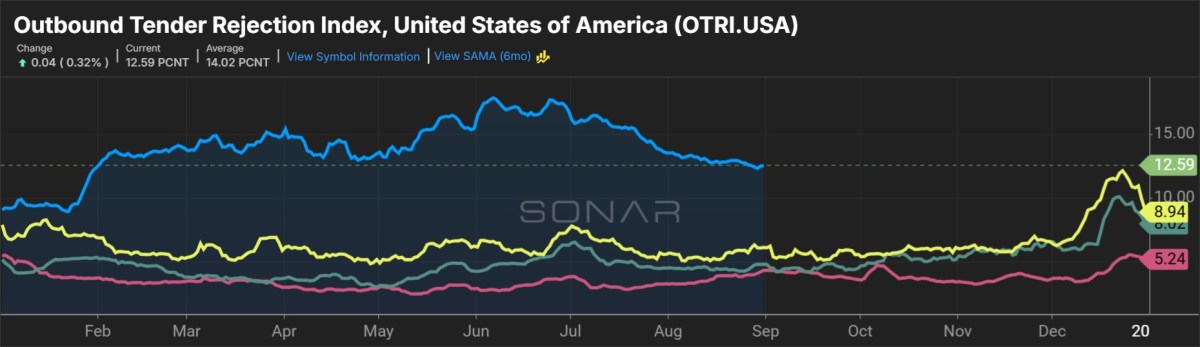
Transportation capacity continued to dwindle in August, but at the slowest rate recorded in six months, even as transportation pricing kept surging, according to a monthly sentiment survey of supply chain professionals.
The Logistics Managers’ Index signaled further tightening in transportation capacity last month, returning a reading of 40. That was 11.6 percentage points slower than July’s contraction rate, which was the second-fastest recorded in the 10-year history of the dataset. September 2020 marked the index’s fastest rate of contraction at 23.8.
The LMI is a diffusion index in which a reading above 50 indicates expansion, while one below 50 signals contraction.
Transportation prices, at 90, increased 3.1 points in the month, with the index logging extreme growth rates of 90 or higher in four of the past five months.
Transportation utilization, at 70.6, was up 5.6 points, marking only the second time in five years the index has registered “robust” growth, defined as above 70.
“Essentially, this month’s report paints a picture of logistics costs that seem to be rapidly increasing no matter what the underlying situation is,” the Tuesday report said.
Logistics managers surveyed expect the transportation market to remain very tight over the next 12 months, with future readings of 43 for capacity, 71.9 for utilization and 86.1 for pricing.
Upstream companies, including manufacturers and wholesalers, expect significant capacity tightening over the next year, returning a reading of 38.6. Downstream companies such as retailers believe a modest amount of supply will become available or enter the market, returning a one-year-forward reading of 54.5.
The overall LMI, at 66.6, was down 2.2 points from July, largely because inventory growth slowed.
“The major difference between August and readings from earlier this summer is that expansion in inventories has slowed, but logistics cost expansion remains high,” the report said.
Aggregate logistics costs, which include inventory, warehousing and transportation, totaled 243.6 in August, up 4.1 points sequentially and well above the breakeven level of 150. While tariff implementations last year were slightly inflationary for the dataset, the Iran conflict has sent all-in supply chain costs surging.
Inventory levels, at 52.8, grew at a pace that was 2.2 points slower in the month. Downstream companies, at 61.9, reported meaningful inventory growth compared with upstream firms at 49, which saw slight contraction. The latest trends were the reverse of July, when downstream firms reported declines while upstream companies added inventory.
The turnaround likely signals “that retailers are building inventories back up for Q4 after running them down during the back-to-school season.” Elevated inventory costs, stemming from higher goods costs and warehouse rents, are driving “the start-stop pattern.”
Inventory costs, at 78.6, continued to balloon in August, climbing 1.6 points during the month.
“It seems that earlier in the year, retailers were waiting until the last minute to bring inventories forward in an attempt to minimize holding costs,” the report said. “It will be interesting to see if the reigniting of tariffs will have an impact on this.”
Slower inventory growth pushed warehousing capacity, at 53.5, back into expansion, up 7.2 points from July’s reading. Even with modest loosening in the market, warehouse prices, at 75, continued to rise sharply, albeit at a pace that was 50 basis points slower sequentially.
Warehouse utilization, at 59.6, fell 6.5 points during the month.
The LMI is a collaboration among Arizona State University, Colorado State University, Florida Atlantic University, Rutgers University and the University of Nevada, Reno, conducted with the Council of Supply Chain Management Professionals.
The report adds another data point showing that transportation and warehousing conditions can move differently from broader inventory trends: even as inventory growth cooled, logistics costs remained elevated and transportation capacity stayed constrained. That makes the index useful for shippers watching operating conditions across modes and facilities, since tight capacity can affect carrier availability and warehouse pricing at the same time.
More FreightWaves articles by Todd Maiden:
- Averitt expands logistics network with Jackson, Mississippi, facility
- Broker RXO sees TL spot rate surge extend into Q3
- Descartes acquires Tai for $100M
The post Transportation capacity contraction slows in August appeared first on FreightWaves.
