TradFi Perpetual Open Interest Hits $2 Billion on Crypto Exchanges
Key Takeaways
- •CryptoQuant reported that open interest in TradFi-linked perpetual contracts on crypto exchanges has risen to $2 billion.
- •The data refers to perpetual futures tied to traditional-finance assets, not the wider crypto derivatives market.
- •Rising open interest can indicate greater leveraged demand or hedging, but it does not show whether traders are net long or short.
- •The increase suggests closer integration between conventional finance instruments and crypto exchange infrastructure.
- •Traders are watching price trends, funding rates, and liquidation activity to judge whether the growth is sustained.
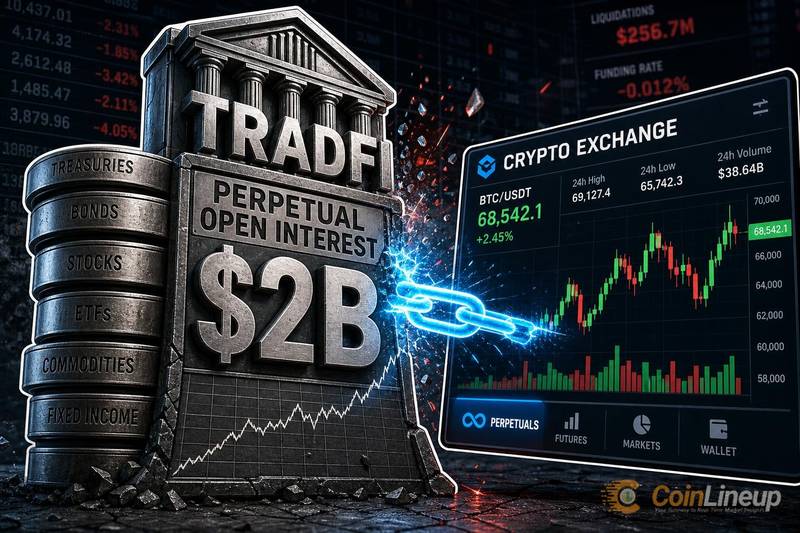
Open interest in TradFi-linked perpetual contracts on crypto exchanges has doubled to $2 billion, according to market analytics firm CryptoQuant, in what the company describes as a sign of deeper overlap between traditional finance products and crypto trading venues.
The figure refers specifically to perpetual futures tied to traditional-finance assets that now trade on crypto exchanges, rather than the broader crypto derivatives market. CryptoQuant published the $2 billion open-interest reading as the sole quantified data point in its update on the trend. For related coverage, see Top RWA Crypto Projects in 2026: 10 Real-World Asset Tokens and Protocols to Know.
Open interest measures the total value of derivatives contracts that remain open and unsettled. When open interest rises, more capital is committed to active positions; when it falls, traders are closing out exposure. For related coverage, see Binance Launches EWJUSDT US Dollar Standard Index Perpetual Contracts.
Why the increase in open interest matters for crypto market sentiment
A doubling in open interest suggests stronger demand for either leveraged exposure or hedging in these TradFi-linked products. It does not, by itself, reveal market direction, because open interest can rise alongside both long and short positioning. For related coverage, see South Korea FSC Refers Crypto Manipulation Cases to Prosecutors.
The increase also points to a growing integration of conventional finance instruments with crypto trading infrastructure, with exchanges packaging equity and index exposure into perpetual formats that are familiar to crypto traders. That matters for market structure because open interest reflects how much capital is tied up in live contracts, not just how much trading is passing through a venue at a given moment.
Competition for this flow is visible across venues. Bitget’s UEX Futures League has targeted both crypto and TradFi markets, while exchange rankings continue to show where derivatives liquidity is concentrated, including Bybit’s second-place standing in open interest among major exchanges.
Higher open interest can cut both ways from a risk perspective. More committed capital can amplify momentum when prices move in one direction, but it can also increase liquidation risk if leveraged positions are forced to unwind.
What traders should watch after CryptoQuant’s $2 billion reading
The open-interest figure becomes more meaningful when it is paired with directional conviction in price. A rising base of contracts alongside a sustained price trend would suggest genuine positioning, while open interest that climbs without follow-through in price can indicate indecision.
Funding rates and liquidation activity are the near-term indicators to watch for confirmation. Persistent one-sided funding or a cluster of liquidations would show how crowded the new positioning has become.
Sustained growth would be a stronger signal than a short-lived spike. If elevated open interest holds and expands across venues, it would strengthen the case that TradFi-linked perpetuals are becoming a durable part of crypto market structure rather than a passing rotation.
Additional source references: source document 1.
Disclaimer: This article is for informational purposes only and does not constitute financial or investment advice. Cryptocurrency and digital asset markets carry significant risk. Always do your own research before making decisions.

