Top 10 Real-World Asset (RWA) Crypto Projects in 2026: Tokens and Protocols to Know
Key Takeaways
- •The RWA tokenization market surpassed $10 billion in total value locked during 2024, with US Treasury-backed products accounting for the majority of growth.
- •Ondo Finance ranks as the most beginner-friendly RWA project by tokenizing short-term US Treasury exposure, though geo-blocks and KYC requirements limit open access.
- •Chainlink serves as critical infrastructure for the RWA ecosystem through its Proof of Reserve and cross-chain interoperability products, providing verification rather than issuing tokens directly.
- •Sky Money, formerly MakerDAO, operates one of the most proven real-world collateral models in DeFi, having backed its USDS stablecoin with off-chain assets for several years.
- •Boston Consulting Group has projected that the tokenized asset market could reach $16 trillion by 2030, contingent on platforms lowering barriers to issuance and improving accessibility.
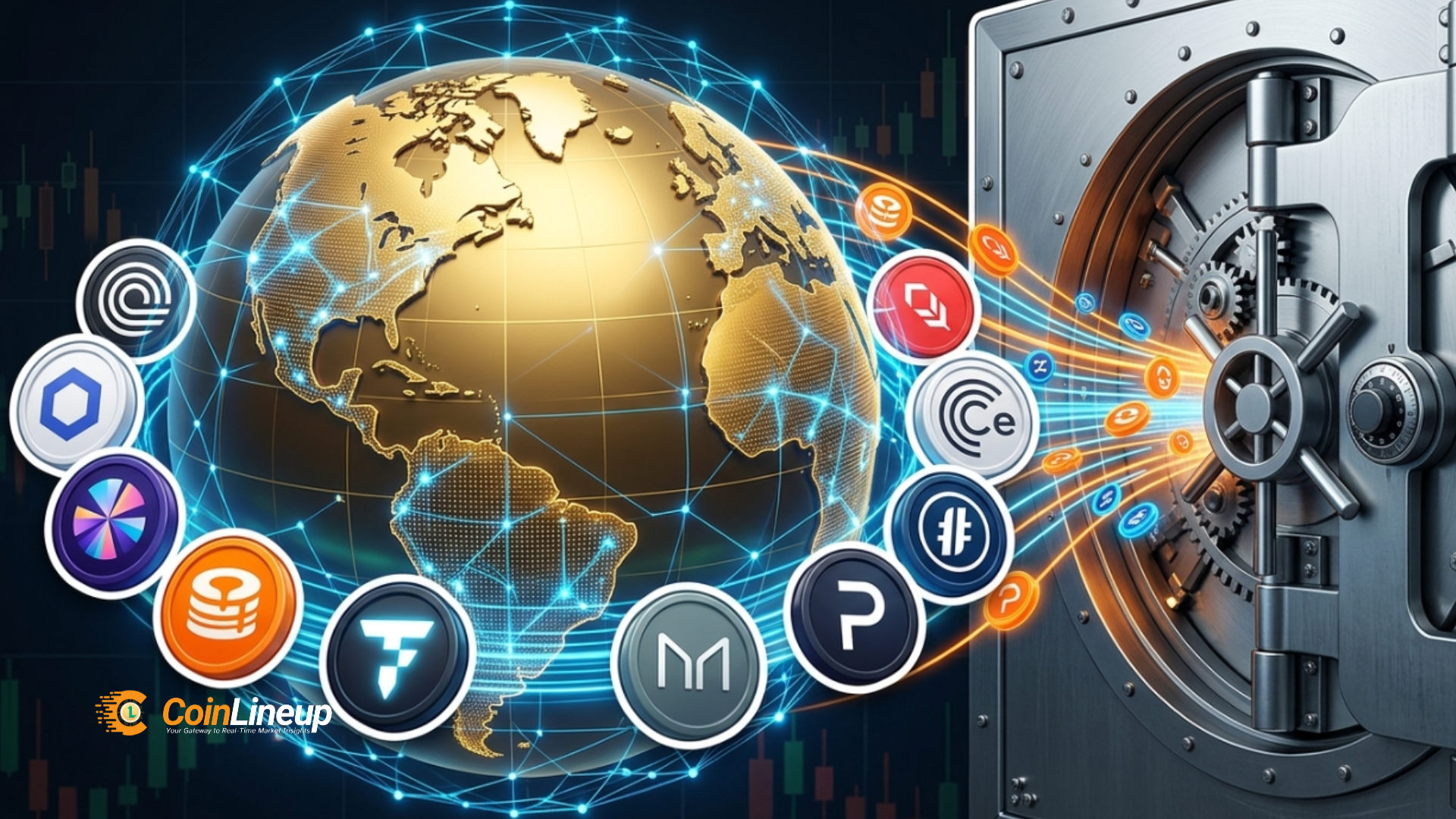
The leading real-world asset (RWA) crypto projects in 2026 are Ondo Finance, Chainlink, Sky Money (formerly Maker), Centrifuge, Maple Finance, Plume Network, TokenFi, Pendle, Polymesh, and Hashnote. Together, these ten projects span tokenized Treasury products, private credit markets, yield trading, compliance-focused infrastructure, and institutional cash management.
Ondo Finance offers the most accessible entry point for newcomers by wrapping short-term US Treasury exposure into blockchain-based tokens. Chainlink provides the infrastructure layer that most RWA projects rely on for reserve verification and cross-chain messaging. Sky Money operates one of the most battle-tested real-world collateral models in DeFi, having backed its stablecoin with off-chain assets for years. The remaining seven projects cover credit markets, yield trading, specialized infrastructure, and institutional cash management.
The sector gained significant institutional momentum in 2024 when BlackRock launched BUIDL, a tokenized fund on Ethereum, bringing the world's largest asset manager directly into on-chain tokenization. Franklin Templeton followed with its own blockchain-based money market fund. These moves gave the RWA category credibility among traditional allocators and accelerated the convergence between DeFi infrastructure and regulated finance — a convergence that shapes nearly every project on this list.
1. Ondo Finance
Ondo Finance ranks as the most beginner-friendly RWA project because its core concept is straightforward: it packages short-term US Treasury exposure into tokens that can be held in a crypto wallet.
Its flagship product is USDY, designed to pass through Treasury-style yield rather than remaining static like a conventional dollar stablecoin, such as those covered in this stablecoin guide. USDY exists alongside a broader wave of tokenized Treasury products — including BlackRock's BUIDL and Franklin Templeton's BENJI — that collectively brought institutional credibility to the category and pushed total tokenized Treasury value past $10 billion by late 2024.
While Ondo is useful for users seeking dollar stability combined with yield, its access restrictions remain a significant consideration. A recurring theme in a DeFi Reddit discussion about what DeFi users want from the market is that RWA access still feels more like regulated finance than open DeFi.
In that same thread, a user from the Caribbean noted that USDY geo-blocks and KYC requirements made it harder to access than meme coins. Another commenter in a CryptoCurrency Reddit discussion about the new generation of stablecoins echoed this point, describing USDY as appealing because Treasury yield is genuine but still subject to jurisdictional and onboarding limitations.
"USDY is appealing because the Treasury yield is real, not synthetic. But the geo-blocks and KYC requirements make it feel more like TradFi than open DeFi for anyone outside a handful of approved countries."
This tension explains Ondo's top ranking. It has one of the clearest products in the category, yet it also illustrates how quickly RWA can cease to feel universally accessible.
Best for: Users who want the simplest Treasury-backed RWA concept.
Not ideal for: Anyone expecting open access without identity checks or regional restrictions.
2. Chainlink
Chainlink earns its place on this list as infrastructure rather than as a Treasury token issuer. It is the most widely integrated oracle network in DeFi, with price feeds already securing billions of dollars across lending and trading protocols — a track record that positions it as a default verification layer for RWA projects.
For tokenized bonds, funds, or stablecoins to function at scale, reserves held off-chain must be verified, and trusted data must move between blockchains. Chainlink occupies that layer through its Proof of Reserve and CCIP (Cross-Chain Interoperability Protocol) products.
Reddit discussion around Chainlink's RWA role typically focuses on why these infrastructure rails matter rather than on direct product usage. In a DeFi Reddit thread about which RWA projects are bridging TradFi and DeFi, a commenter argued that regardless of who tokenizes the assets, they all ultimately need Chainlink for verification.
The trade-off is clear: Chainlink provides picks-and-shovels exposure to the RWA theme rather than direct exposure to any single Treasury or credit product.
Best for: Investors who want infrastructure exposure across the RWA stack.
Not ideal for: Users seeking direct Treasury or credit yield.
3. Sky Money / Maker
Sky Money, formerly known as Maker, is significant because it demonstrated that a large DeFi protocol could rely heavily on real-world collateral rather than depending solely on crypto-native yield sources. MakerDAO launched in 2017, and its DAI stablecoin — rebranded to USDS under the Sky transition — grew into one of the largest decentralized stablecoins by market capitalization, giving the protocol years of operational history with real-world collateral before RWA became a standalone narrative.
Its stablecoin system has integrated Treasury exposure through vault structures and external asset managers over several years, making it one of the most proven bridges between DeFi and off-chain debt markets.
Public discussion around Maker's RWA operations tends to be less emotionally charged than Ondo's, partly because most users interact with the stablecoin first and consider collateral strategy second. In a MakerDAO Reddit thread asking where the treasury comes from, commenters framed the RWA arm as evidence that major capital still views Maker's debt-backed stablecoin model as one of the strongest in crypto. Another comment in the same DeFi Reddit RWA bridge discussion described Maker as the largest protocol in the sector by a wide margin.
"Maker is the biggest by a wide margin. It has been using real-world assets as collateral for years and the model has held up. The Sky rebrand is confusing but the protocol underneath it is still the most proven thing in the RWA space."
The main challenge for newcomers is branding. The Maker-to-Sky transition adds complexity to an already technical system.
Best for: Users who want RWA exposure through a proven DeFi system backed by real-world assets.
Not ideal for: Beginners seeking a single-purpose product with a simple message.
4. Centrifuge
Centrifuge marks the point where the RWA narrative shifts from government debt to private credit. It was among the first protocols to bring private credit on-chain through its Tinlake product, which launched before tokenized Treasuries dominated the RWA conversation.
Rather than packaging Treasuries, Centrifuge tokenizes assets such as invoices, trade receivables, and other borrower-backed pools, enabling DeFi capital to fund real-world businesses on blockchain rails.
This makes the yield story more varied but also introduces additional risk. In a DeFi Reddit thread about high-yield staking projects, one user expressed appreciation for Centrifuge's mission and its partnerships with Maker and Aave, while noting that some pools are restricted to larger or approved investors — a signal that highlights both the project's appeal and its gatekeeping.
On the token side, Centrifuge has long used loan-related fee flows and CFG incentives to coordinate the network, giving the coin utility beyond simple speculation.
Best for: Users seeking exposure to private credit rather than only government debt.
Not ideal for: Beginners uncomfortable evaluating borrower and default risk.
5. Maple Finance
Maple Finance operates in a similar thematic space to Centrifuge but with a different profile. It functions as a lending market oriented toward larger borrowers rather than retail users.
The platform is built around managed lending pools, structured credit, and counterparties that resemble professional firms more than typical crypto participants. This professional focus makes Maple potentially useful within an RWA portfolio, offering exposure to a segment of crypto lending that aims to be disciplined and credit-aware rather than hype-driven.
The risks are well-documented in public discussion. A CryptoCurrency Reddit thread on Maple Finance's $54 million sour-debt episode served as a reminder that institutional branding does not eliminate lender risk. That default occurred in 2022 during a broader crypto credit crisis that also affected Celsius and BlockFi, illustrating how on-chain credit markets remain connected to macro conditions even when borrowers are institutionally vetted. When unsecured or lightly protected lending goes wrong, the losses are tangible.
Best for: Users seeking exposure to institutional-style credit on blockchain rails.
Not ideal for: Casual retail users expecting simple deposit-and-earn flows.
6. Plume Network
Plume Network is not the most established project on this list, but it represents a clear bet on the sector's direction.
Most blockchains are general-purpose and expect RWA teams to add compliance and custody features after the fact. Plume aims to make these features native, allowing builders to launch tokenized assets without assembling the entire compliance and custody stack independently. This positions Plume alongside compliance-focused chains like Polymesh, though with a broader asset-class scope and a modular architecture aimed at attracting third-party issuers.
This approach attracts attention from those focused on the future infrastructure of RWA rather than on purchasing a specific yield token today. The trade-off is maturity: Plume remains earlier in development than Ondo, Maker, or Chainlink, so its potential upside depends on ecosystem execution rather than already-dominant live assets.
Best for: Developers and investors seeking an early infrastructure bet.
Not ideal for: Users wanting mature, already-scaled RWA cash flows.
7. TokenFi
TokenFi targets the retail side of tokenization. While Ondo and Maple have a more corporate feel, TokenFi promotes the idea that launching or tokenizing an asset should become a straightforward product workflow rather than a bespoke legal and engineering project.
This concept is important because tokenization can only scale if the tooling becomes more accessible. Industry consultancy Boston Consulting Group has projected that the tokenized asset market could reach $16 trillion by 2030, a forecast that depends heavily on platforms lowering the barrier to issuance. However, the narrative can outpace reality. Public Reddit discussion remains focused more on potential and ecosystem growth than on concrete end-user case studies. For this reason, TokenFi ranks lower on this list — the concept and no-code angle are valuable, but broad adoption evidence is still limited.
Best for: Users interested in the tokenization-tooling narrative.
Not ideal for: Investors wanting strong evidence of live institutional traction.
8. Pendle
Pendle is not an RWA issuer, but it becomes relevant once tokenized Treasury yield behaves like an asset that traders want to split, price, and hedge.
Its core concept involves separating principal from yield, enabling users to lock rates, speculate on future yield movements, or restructure exposure from assets like tokenized Treasuries. Pendle saw substantial total-value-locked growth during 2023–2024, expanding from RWA yield trading into liquid staking derivatives and other yield-bearing assets — a sign that demand for yield-structured products extends well beyond the RWA category. Reddit discussion around Pendle typically comes from experienced DeFi users who already think in terms of yield curves — an indicator that the protocol adds complexity on top of already technical RWA products. Nonetheless, Pendle earns its place because yield-bearing RWA tokens become significantly more versatile when a protocol can transform them into tradable rate instruments.
Best for: Advanced DeFi users who understand yield trading.
Not ideal for: Beginners who simply want to hold a Treasury-backed asset and collect yield.
9. Polymesh
Polymesh is the most regulation-first blockchain on this list. It was built specifically for regulated securities, meaning identity checks, access controls, and compliance are integral design elements rather than add-ons. Built on the Substrate framework, Polymesh is purpose-built for this role rather than adapted from a general-purpose chain.
This sets Polymesh apart from nearly every DeFi-native project. In a Polymesh community Reddit thread about POLY and POLYX, users repeatedly emphasized that security tokens represent actual ownership claims, not just another utility coin. Other commenters in the broader Polymesh community on Reddit described the project as a hidden infrastructure play because it addresses back-end compliance burdens directly.
The limitation is also the selling point: this is specialized infrastructure. Users who prefer open, censorship-resistant crypto applications will find Polymesh intentionally restrictive.
Best for: Institutions and investors focused on compliant securities tokenization.
Not ideal for: Users who prioritize censorship resistance and open participation.
10. Hashnote
Hashnote represents the institutional cash-management end of the RWA category. Its role centers on placing short-term cash into blockchain-based structures that remain acceptable to funds, treasuries, and professional allocators. This places Hashnote in a segment adjacent to BlackRock's BUIDL and Franklin Templeton's tokenized products, where the target user is a treasury department rather than a retail wallet holder.
Public user commentary is thinner for Hashnote than for projects like Ondo or Pendle, as most open discussion revolves around market structure and acquisitions rather than individual investor experiences. Nevertheless, Hashnote belongs on this list because the RWA sector extends beyond retail-accessible tokens — a significant portion of the category involves where larger firms park cash as blockchain settlement becomes more mainstream.
Best for: Users tracking the institutional cash-management side of RWA.
Not ideal for: Retail users seeking open access and active community participation.
Evaluation Methodology
Each project was scored out of 10 across five categories, for a total possible score of 50. The categories were:
- Live assets: Whether real Treasury, credit, or securities activity is already operational.
- Clear role: Whether the project addresses one distinct function.
- Transparency: How verifiable the backing model is.
- Accessibility: How easily a non-expert can use the product.
- Risk clarity: How honestly the project communicates potential downsides.
Chainlink led on total score because its infrastructure role scored consistently across all criteria. Ondo led on product clarity.
The category can be understood by analogy to a shopping mall: one store sells the product, another verifies its authenticity, and another built the building. The most important evaluation question concerns risk — while RWA may sound safer than meme-coin speculation, "backed by real assets" does not eliminate smart contract risk, legal risk, or liquidity risk.
Understanding Risk Across the RWA Stack
RWA projects often appear safer than other crypto sectors because their underlying narratives involve bonds, invoices, or regulated securities. However, this can create false confidence.
- Ondo: Risk extends beyond Treasury safety to include smart contract vulnerabilities, issuer structure, access restrictions, and liquidity conditions.
- Centrifuge or Maple: Risk shifts toward borrower quality and the rigor of lender screening.
- Chainlink, Plume, or Polymesh: These represent infrastructure bets rather than direct asset-yield exposure.
The sector becomes clearer once the question shifts from "Which RWA coin wins?" to "Which part of this stack am I actually buying?"
RWA Tokens vs. Treasury ETFs
For individuals with a US brokerage account, a Treasury ETF such as SHV or BIL may be simpler, cheaper, and already regulated — requiring no crypto wallet, new-platform KYC, or gas fees.
RWA tokens become compelling in three specific situations:
- No access to a US brokerage: In regions where Treasury ETFs are difficult to purchase, tokenized Treasuries may provide the best available path to dollar-denominated yield.
- Yield within a DeFi workflow: For capital already deployed on-chain, RWA tokens allow yield generation without converting back to fiat.
- Composability: RWA tokens can integrate with lending protocols, collateral systems, and yield-trading platforms like Pendle in ways that ETFs cannot.
For users to whom none of these situations apply, a Treasury ETF is likely the simpler option — an honest reflection of where the RWA category adds value today.
Beginner Recommendations
- For the easiest product narrative: Ondo Finance.
- For infrastructure exposure rather than a single issuer: Chainlink.
- For battle-tested DeFi with substantial real-world collateral: Sky Money / Maker.
- For credit-market exposure: Compare Centrifuge and Maple Finance carefully, as both the yield profiles and risk characteristics differ.
Market Context
The RWA tokenization market crossed $10 billion in total value locked in 2024, according to DeFiLlama's RWA tracking, with US Treasury-backed products driving the majority of that growth. This milestone signals that the category is no longer theoretical — real capital has moved into these protocols, making verification and trust models increasingly important.
Research Methodology
This guide is based on live protocol documentation and public product pages reviewed in July 2026. The public interfaces of Ondo, Chainlink, Centrifuge, Maple, Polymesh, and Plume were examined directly, and Reddit discussions were cross-checked to capture how real users describe access, yield, and risk. A full sign-up, funded transaction, or restricted investor access was not completed for every product. User feedback was used to supplement what public homepages alone cannot convey.
The most striking observation was not the token list itself but how quickly the category divides into distinct functions. Some projects deliver the asset directly; others provide only the infrastructure, verification, or legal framework around it.
FAQ
What is an RWA crypto project?
A crypto project that brings real-world assets — such as Treasuries, credit, real estate, or securities — onto blockchain rails, either by issuing them, verifying them, or building infrastructure around them.
Is Ondo the best RWA project for beginners?
It is among the easiest to understand because the product is straightforward: Treasury-backed yield on blockchain rails. The main drawback is access restrictions.
Why is Chainlink on an RWA list if it does not issue Treasury tokens?
Because tokenized assets still require trusted reserve verification and cross-chain messaging. Chainlink underpins many of those workflows.
Are RWA projects safer than other crypto projects?
Not automatically. The underlying assets may be safer, but legal wrappers, issuers, liquidity conditions, and smart contracts still introduce risk.
What is the difference between Centrifuge and Maple?
Centrifuge is more associated with tokenized credit pools and asset-backed borrowing structures, while Maple operates more like a managed institutional lending marketplace.
Disclaimer: This article is for informational purposes only and does not constitute financial or investment advice. Cryptocurrency and digital asset markets carry significant risk. Always conduct independent research before making decisions.
