Nine AI Agent Crypto Tokens With Defined Roles in 2026
Key Takeaways
- •Virtuals Protocol is ranked as the leading broad AI agent economy because VIRTUAL is used in agent creation and liquidity pairing on its platform.
- •Autonolas is described as an infrastructure-focused project where OLAS supports governance, node-operator bonding and rewards for autonomous agent services.
- •Venice differentiates itself through privacy-focused AI inference, VVV token access functions and publicly announced onchain revenue-based burns.
- •Several Virtuals ecosystem tokens, including aixbt, GAME, Luna and VaderAI, derive their positions from agent personas, tooling or ecosystem distribution.
- •The article identifies category churn and ecosystem concentration as major risks for AI agent tokens, especially where token demand depends mainly on narrative attention.
AI agent crypto tokens in 2026 can be divided into projects that attach their tokens to concrete functions in agent creation, coordination or onchain execution, and projects that depend more heavily on narrative attention. In this category, the distinction matters because an AI agent can be a product, a protocol service, a persona, or a wallet-execution tool, and the token may or may not be required for that system to work.
Against that filter, the leading names identified are Virtuals Protocol, Autonolas, Venice, aixbt, GAME, Luna, VaderAI, Griffain and PAAL AI.
Virtuals Protocol is presented as the deepest ecosystem play. Autonolas is framed as the most structurally serious infrastructure project. Venice stands out for product differentiation built around privacy. The core questions for each token are what the agent does, what function the token performs, and what could weaken the project if market attention shifts away from AI-agent narratives.
Ranking scorecard
The ranking uses categories scored out of 10, with a total score out of 50.
The nine AI agent crypto coins in 2026
1. Virtuals Protocol (VIRTUAL)
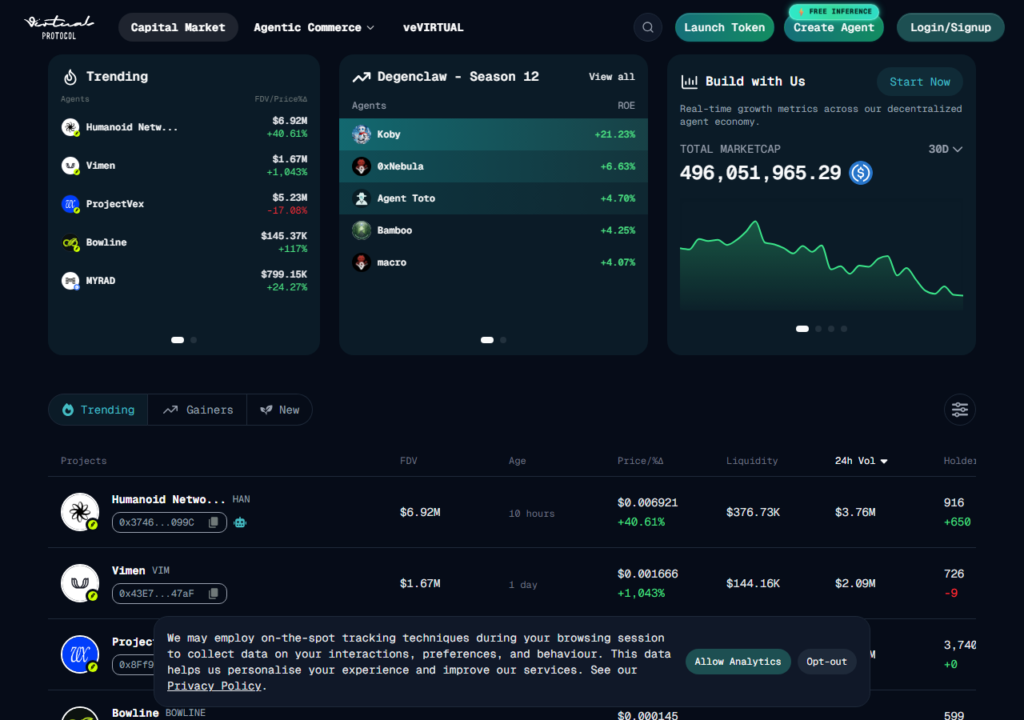
Virtuals Protocol is not a single AI agent. It is designed as an economy in which other agents can be created and traded.
The platform at app.virtuals.io allows users to launch tokenized AI agents with their own token, liquidity pool and persona. VIRTUAL acts as the base currency for agent creation and as the liquidity pair for agent tokens minted through the platform. When a new agent launches, VIRTUAL is spent and locked, making token demand structurally linked to agent creation volume rather than only to secondary-market trading.
That ecosystem concentration is both the project’s moat and its main risk. Virtuals-linked assets trade in relation to whether the Base-native agent economy continues to expand, rather than solely on the separate fundamentals of each product.
For Virtuals to lose its category-leading position, agent creation would need to become disconnected from demand for VIRTUAL. That could happen if a competing base layer attracts creators away from the ecosystem, or if agent-market saturation reduces new launches. The source argues that neither dynamic is currently the near-term direction of the ecosystem.
2. Autonolas (OLAS)
Autonolas is described as the most structurally serious agent project on the list, while also being less convenient as a narrative-driven token.
Many AI-agent projects focus on one-off interactions, such as a chatbot executing a trade or an agent responding to a prompt. Autonolas is built around persistent autonomous services that run as multi-agent processes across Ethereum, Solana and other chains. The Olas documentation includes concepts such as agent services, multi-signature-secured execution and contributor bonding, signaling an infrastructure-focused approach rather than a social-product model.
OLAS governs the protocol, bonds node operators into service commitments, and rewards contributors who build and run agent services. In that structure, the token is described as load-bearing: removing OLAS from the system would not leave the same product intact.
A CryptoCurrency thread on Reddit discusses the idea that Autonolas-style persistent agent services represent a more substantive overlap between crypto and AI than conversational wrappers.
The trade-off is attention. Autonolas receives less social-media narrative momentum than persona-driven agent tokens during market runs because the product does not have a recognizable character or face. The source frames that same infrastructure orientation as part of its defensibility.
3. Venice (VVV)
Venice made a product-design choice that many AI application projects avoid: it says no data is stored on the platform’s servers and no training is performed on user inputs.
The venice.ai product runs inference locally or through privacy-preserving infrastructure. Its pitch is a private-by-design AI platform where the provider cannot read user prompts. VVV gives token holders priority access, reduced fees, and governance over model selection and tokenomics. The project’s burn mechanism is also described as concrete, with discretionary burns of platform revenue executed onchain and announced publicly.
That privacy architecture gives Venice a product position distinct from centralized AI companies. The open question is whether a sufficiently large user segment values privacy enough to pay for it rather than using free-tier alternatives.
In the Venice AI community on Reddit, the largest discretionary VVV burn, reported at $267,000, and an emissions reduction from 5 million to 4 million tokens per year are treated as product-health signals. The emissions reduction is presented as evidence that the team is managing supply pressure rather than only issuing tokens.
Venice occupies an unusual intersection between AI products and crypto tokenomics. The token has defined functions, while the moat depends on users with a genuine privacy preference, a real but smaller segment than the overall AI-user market.
4. aixbt by Virtuals (AIXBT)
aixbt is presented as a clear example of an AI persona becoming an economic object in its own right.
The agent operates as an onchain AI system that generates market commentary, tracks crypto trends and maintains its own X/Twitter presence with verified onchain attribution. When aixbt publishes a statement, the output can be traced back to the agent’s onchain identity. That traceability is what distinguishes it from a social-media account using a chatbot. AIXBT is the tradable token for the agent persona and operates within the Virtuals ecosystem.
The project became category-defining by demonstrating that an AI persona with an economic stake and onchain presence could develop market influence. aixbt also moved early enough to gain a distribution advantage.
AIXBT’s position depends on that first-mover distribution within the AI market-commentary category. The risk is commoditization, as dozens of agent personas now produce market commentary.
5. GAME by Virtuals (GAME)
GAME is the infrastructure layer within Virtuals that agent builders use to configure and deploy their agents.
Where VIRTUAL serves as the economy token and individual agents have their own tokens, GAME is positioned as the SDK and framework token. It provides tooling on which agents run. Coinbase Institutional specifically highlighted GAME in its picks-and-shovels analysis of the AI-agent economy as an infrastructure layer within the Virtuals stack. The source treats that as a meaningful third-party signal for a token that otherwise has limited external coverage.
The case for GAME differs from the case for VIRTUAL. GAME is tied to the tooling layer and its usage as more agents are built, rather than to the economy token’s relationship with agent-creation volume.
GAME therefore holds a picks-and-shovels position relative to the Virtuals ecosystem. Its main risk is concentration: if Virtuals loses developer mindshare to a competing agent economy, GAME would lose deployment volume directly.
6. Luna by Virtuals (LUNA)
Luna is described as the most recognized conversational agent persona inside the Virtuals ecosystem, with a position based primarily on reach and distribution.
The agent has a large following across platforms, an established identity, and high recognition among crypto-native AI-agent users. As a Virtuals ecosystem asset, LUNA is tied to whether the persona maintains engagement and whether the Virtuals economy continues creating opportunities for ecosystem tokens. The token does not coordinate infrastructure or govern a protocol; it represents exposure to an agent identity with a real audience.
The source says Luna is easier to evaluate than many narrative tokens because the relevant questions are straightforward: whether the persona maintains its audience and whether the Virtuals ecosystem continues growing. It states that both have remained true for longer than expected.
7. VaderAI by Virtuals (VADER)
VaderAI occupies a similar structural position to Luna: it is a named agent persona within the Virtuals ecosystem, with its own token, identity and community following.
The main differences among Virtuals ecosystem agents are persona strength and community timing. VADER has maintained a presence inside the ecosystem through market cycles that removed thinner agent tokens. That persistence is described as a weak but real signal, because tokens that survive multiple narrative rotations inside a competitive ecosystem have shown some floor of community demand.
VADER is framed as a potential diversification within the Virtuals ecosystem if multiple agent personas can hold value simultaneously. The source says it is a weaker standalone case than VIRTUAL or GAME.
8. Griffain (GRIFFAIN)
Griffain is described as the most crypto-native agent thesis on the list because it focuses on an AI that acts on a user’s wallet, rather than only in a chat interface.
The griffain.com product positions the agent as a natural-language interface for onchain execution. A user describes what they want to do, and the agent interprets and executes the transaction. That use case is narrower than a general AI assistant, but it is also an area where the crypto layer adds distinct value. Agents that can sign and execute transactions are qualitatively different from agents that only recommend actions.
The risk is specific to that same thesis. Major wallet providers and DeFi interfaces are also building natural-language execution layers. Griffain has early-mover positioning in the standalone-agent category, but the competitive surface is broad.
Among the non-Virtuals names on the list, Griffain is described as having the strongest product thesis. The onchain execution layer is where crypto agents may have unique value, while the unanswered question is whether a standalone agent can retain that position.
9. PAAL AI (PAAL)
PAAL AI is a consumer AI assistant with crypto-token integration. The source classifies it as a product category rather than an agent economy.
The paal.ai platform provides an AI chatbot available across Telegram, Discord and the web, with the PAAL token used for premium features and staking rewards. The product targets retail crypto users who want AI tooling in the environments they already use. Its token utility is described as cleaner than many speculative AI tokens because staking and premium access have defined functions, although the infrastructure moat is thin.
PAAL faces the same risk as other AI-assistant products: the category is being commoditized by major AI labs at the same time. Its defensive position is crypto-native distribution through Telegram and Discord, along with retail community depth, rather than technical differentiation.
PAAL is the most application-oriented name on the list. Its position depends on retail crypto communities continuing to want AI tools inside their existing communication platforms and on token utility remaining active.
Decision framework
The source says no single token covers all four agent categories. It argues that a framework including one economy token such as VIRTUAL, one infrastructure token such as OLAS, and one application token such as VVV or Griffain is more defensible than focusing only on ecosystem agent personas.
That framework also separates token function from theme exposure. A token tied to launch mechanics, service coordination, privacy access or wallet execution has a different risk profile from a token tied mainly to a character’s attention cycle, even when all are marketed under the same AI-agent label.
Frequently asked questions
What is the best AI agent coin in 2026? Virtuals Protocol (VIRTUAL) is identified as the clearest answer for broad agent-economy exposure. Autonolas (OLAS) is presented as the stronger answer for an infrastructure-focused thesis rather than ecosystem speculation.
Are AI agent coins different from AI infrastructure coins? Yes. Agent coins are closer to product behavior, agent creation or agent commerce. Infrastructure coins are closer to compute, data, oracle rails or storage. The source points to an AI infrastructure crypto coins guide for that separate layer.
Why are so many top agent coins inside one ecosystem? Ecosystems with creation tools, liquidity and distribution tend to pull attention toward their own internal assets. Virtuals Protocol built that flywheel earlier than competitors. Concentration risk is the direct cost of that structural advantage.
What is the biggest risk in AI agent tokens? The source identifies category churn and ecosystem concentration as the largest combined risks. Many agent tokens have no product floor; when narratives rotate, there may be no usage base to support token demand. The source says the key question is whether the token has a real function before the narrative.
How is Venice different from other AI tokens? Venice runs a privacy-by-design inference product where VVV governs model access and the team executes discretionary token burns from platform revenue. The combination of an operating product, privacy differentiation and transparent tokenomics is described as uncommon in the AI-agent token market.
Disclaimer: This article is for informational purposes only and does not constitute financial or investment advice. Cryptocurrency and digital-asset markets carry significant risk. Readers should conduct their own research before making decisions.

