Wisconsin GOP Gubernatorial Candidate Tom Tiffany on US Trade Policy, Taxes, and Agriculture
Key Takeaways
- •Tom Tiffany, the Republican congressman for Wisconsin's 7th District, is running for governor in the November 2026 election, with incumbent Democrat Tony Evers being the target of the campaign's cost critiques.
- •The campaign pledges to freeze property taxes, repeal Governor Evers' "massive 400-year tax increase," and reduce energy costs by unleashing reliable baseload power.
- •Tiffany's agriculture platform emphasizes past support for dairy producers, ginseng growers, and mink farmers, along with a pledge that no Wisconsin farmland will fall into the hands of China.
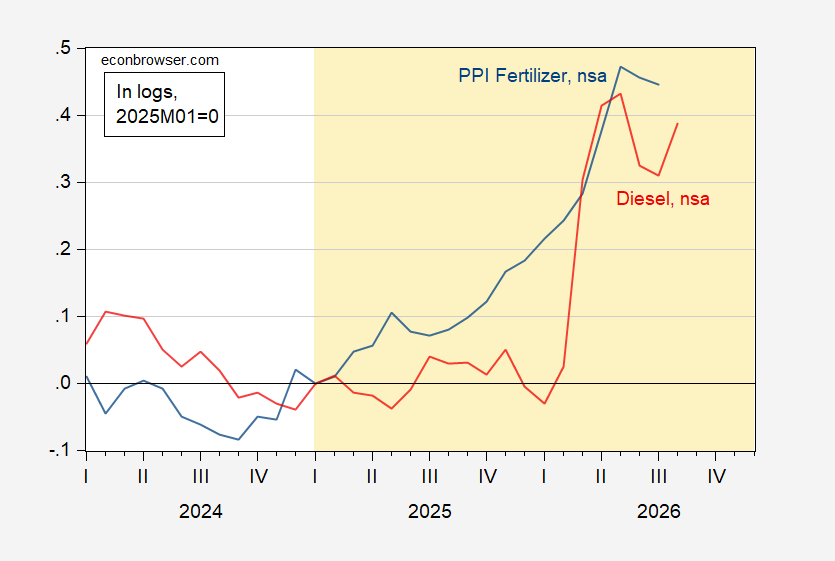
- •An Econbrowser analysis of US government data found that farm input costs such as fertilizer and diesel, along with consumer prices, have risen faster than in the pre-Trump period.
- •Midwest CPI has risen a cumulative 0.3 percentage points higher than the national figure, a trend the analysis says stands in contrast to the campaign's affordability messaging.
Republican congressman and Wisconsin gubernatorial candidate Tom Tiffany has laid out his positions on trade, taxes, energy, and agriculture on his official campaign website. Tiffany, who represents northern Wisconsin's 7th Congressional District, is running in the state's November 2026 gubernatorial election, in which incumbent Governor Tony Evers is the Democrat whose record the campaign's cost critiques target. An Econbrowser post published on August 23, 2026 reproduced the trade policy statement and related campaign material, then examined US government data on farm input costs and consumer prices.
Trade Policy Statement
Quoting from the official website, the statement on trade policy appears in the reproduced text only in truncated form: "[…]" and "[…]".
Lower Costs for Every Wisconsinite
Under the heading "Lower Costs for Every Wisconsinite," the campaign states that alongside President Trump, Tom delivered the largest tax cut in history for working families, seniors, and small businesses. It says he ended taxes on tips, overtime, and Social Security, expanded affordable childcare, opened more pathways to trade schools, and created real opportunities for workers to get ahead.
The campaign argues that under Democrat leadership in Madison, Wisconsin "is slipping down the woke and broke path of Illinois and Minnesota," asserting that families are paying more, that energy costs are now the second highest in the Midwest, and that Wisconsin is among the worst states to start a business.
Citing what it describes as Tom's proven record of standing up for Wisconsinites, the campaign pledges that as governor he will keep delivering results. He will freeze property taxes, repeal Governor Evers' "massive 400-year tax increase," and drive down energy costs by unleashing reliable baseload power. He also says he will cut burdensome regulations to make housing, childcare, and healthcare more affordable.
Protect What Makes Wisconsin Great
Under the subheading "Protect Farmers," the campaign says Tom has delivered for Wisconsin's farmers, supporting dairy producers, ginseng growers, and mink farmers through key farm support programs in Congress. It states that he fought to ban the death tax and to protect Wisconsin farmland from being destroyed by wind and solar projects. The named constituencies map directly onto Wisconsin's farm economy: the state is one of the nation's largest dairy producers, grows the bulk of the US cultivated ginseng crop, and has historically ranked among the leading mink-producing states.
As governor, the statement continues, Tom "will make sure not a single acre of our farmland falls into the hands of Communist China," and he will ensure the next generation of Wisconsin's farmers has the tools and resources they need to keep putting food on our tables.
Cost Data
Regarding costs, the US government reports the following data, as presented by Econbrowser:
Figure 1: PPI nitrogenous fertilizer, n.s.a. (blue), price diesel, n.s.a. (red), both in logs 2025M01=0. August diesel prices data through 8/17. Source: BLS, EIA via FRED, author's calculations.
Figure 2: CPI – Midwest, n.s.a. (blue), in logs 2025M01=0. Source: BLS, and author's calculations.
Those series track two of the largest purchased inputs in crop production — fertilizer and diesel — whose prices are sensitive to energy markets, which is why they are widely used as indicators of how policy shifts feed into producers' cost structure.
In other words, according to the author, farm input costs and CPI have risen faster than in the pre-Trump period, and Midwest CPI has risen a cumulative 0.3 percentage points higher than the national figure. That trajectory stands in contrast to the campaign's affordability messaging, and how the figures evolve in upcoming monthly BLS and EIA releases is one concrete measure to watch as the November election approaches.
Econbrowser also points to some local news analysis here, coverage that ties the tariffs question to political fallout in Wisconsin after the collapse of US–Canada trade talks.
