American Photographer Tom Coyner Shows 50 Years of Korea in First Solo Gallery Exhibition
Key Takeaways
- •Tom Coyner's first solo exhibition runs Sept. 15-20 at KOTE Gallery in Seoul's Insa-dong, featuring fifteen framed prints plus unframed prints and a monitor display.
- •Coyner first came to Korea in August 1975 with the Peace Corps, later worked for The Chase Manhattan Bank in Seoul, and also lived a decade each in California and Japan.
- •His five-decade photo archive documents Korea's transformation from one of the world's poorer economies through the 1987 democratic reforms and 1988 Seoul Olympics era.
- •Coyner selected people-only photographs spanning 50 years from hundreds of thousands of images for the exhibition's coherent theme.
- •After the exhibition, Coyner will launch SeoulMan Images, a photo service offering digital files and prints of Asia and other regions.
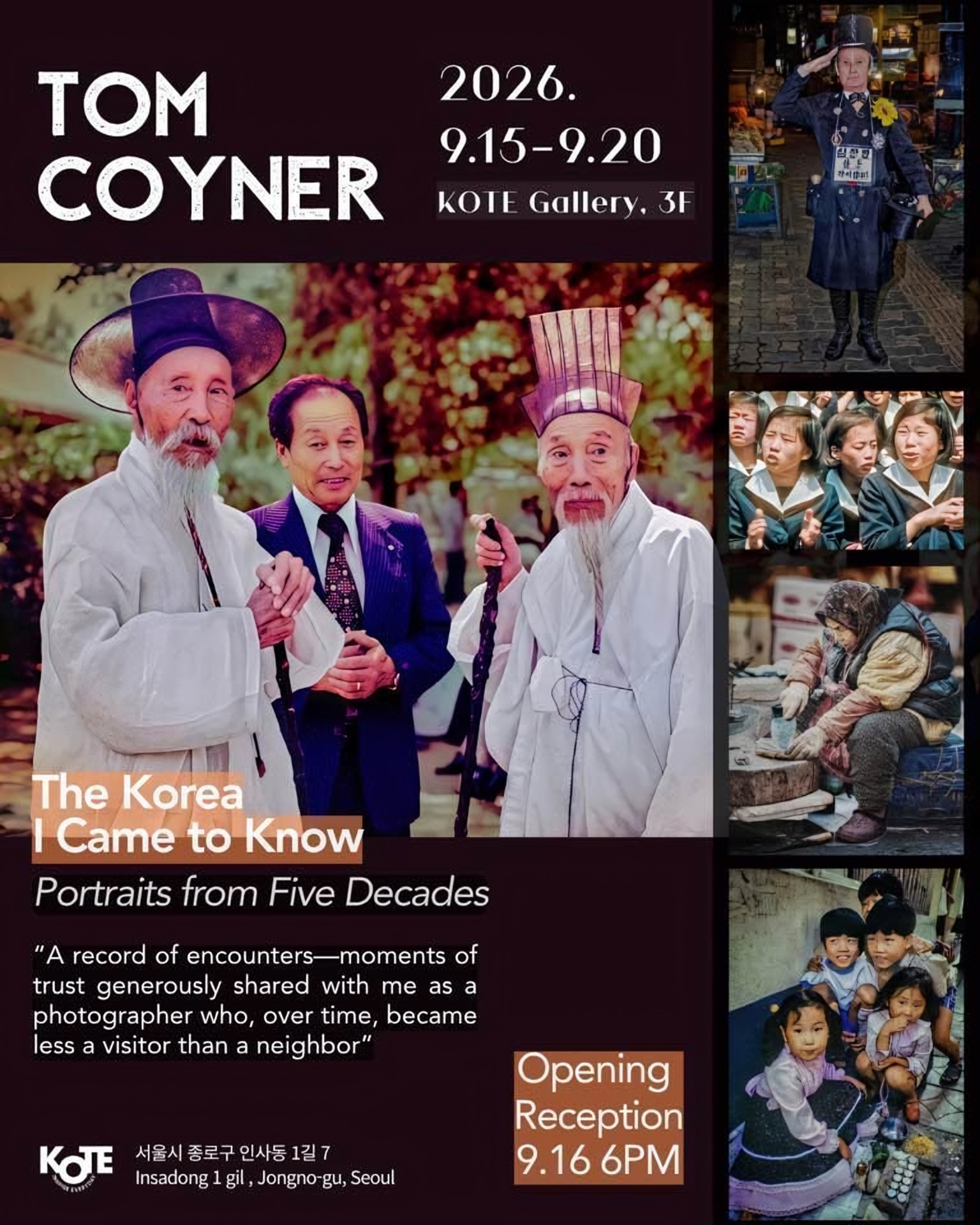
After half a century of life in Korea, U.S. photographer Tom Coyner is finally presenting his work in his first solo gallery exhibition. Fifteen framed prints, several unframed prints available for purchase, and a large number of his photographs displayed on a large monitor — all dating back to his arrival with the Peace Corps in 1975 — will go on view at KOTE Gallery in Seoul's Insa-dong neighborhood from Sept. 15 to 20.
Coyner first came to Korea in August 1975, beginning by training English teachers at a rural middle school and later developing an advanced English and American society course for the Ministry of Agriculture. Throughout his two-year assignment, he kept busy taking pictures. His arrival coincided with a period when Korea was still one of the world's poorer economies, a decade before the 1988 Seoul Olympics and the democratic reforms of 1987 marked the country's emergence on the global stage — making his five-decade archive a rare foreigner's-eye record of that transformation as lived by ordinary Koreans.
"It was an interesting challenge of temples, landscapes and people," he said of his photographic adventures in the 1970s. "Much of the time, I waited impatiently for people to get out of the way of my temple shots, only to regret years later, as they gave important time anchors to the timeless temples."
In the 1970s, when cameras were far rarer than they are today — an era before nearly everyone carried a smartphone capable of taking good-quality photos — there were fewer rules governing public photography. Coyner developed the habit of approaching people to ask permission before raising his camera.
"Many Koreans were thin-skinned about how the rest of the world viewed them and sometimes refused to be photographed," he recalled. "However, most people were pretty open and cooperative."
"One rule I have kept over the past 50 years has been if the person does not wish to be photographed, I honor his or her wishes," he added. "There are always other, sometimes better, photographs just around the corner."
Coyner began studying photography in 1967 while in high school and continued over the decades as he acquired new equipment and software and moved between countries.
"A single person's journey through the years in part defines the images' character. Photographs are very much a reflection of the photographer," he said.
"Among other things, serious photography is a philosophy that trains one to continuously 'take photographs,' even without a camera, or these days a smartphone," he explained. "Photography trains one to observe details many people overlook. Moreover, one often makes mental compositions of one's observations. As an actual introvert, the camera has given me an alibi to approach strangers. In doing so, I have forced myself to be engaged with strangers, if only for a moment — but those brief moments can be wonderful."
After completing his two years with the Peace Corps in Korea, Coyner remained in Seoul to work for The Chase Manhattan Bank. He then spent a decade each in California and Japan, while making frequent return trips to Korea.
Over the years, he has had opportunities to share his photographs through social media, newspaper columns, and once in an exhibition hosted by the Irish Embassy. People, he said, have long urged him to show his photos in a proper gallery.
"Several people have been badgering me, but I have resisted due to the expense," he said. "I have seen one-man small exhibitions self-financed by the artist, but I have largely found them to be vanity projects. I would rather spend the money on photo gear or travel expenses."
The greatest challenge in preparing for this exhibition has been sorting through decades of photographic archives to decide which images deserve the spotlight.
"I have hundreds of thousands of images, so selection has been a big challenge — particularly in delivering a coherent theme," he said. "I have settled upon people-only photos from 50 years ago to current times that show the intrinsic, robust personalities that make up the Korean people. After the exhibition, I'm launching a new photo service, SeoulMan Images, which offers digital files and prints of Asia as well as elsewhere."
For visitors, the exhibition offers a chance to see five decades of Korean daily life through the eyes of a longtime foreign resident; for those unable to attend, the SeoulMan Images launch may make his archive more widely accessible going forward.
Makgeolli will be served at an opening reception beginning at 6 p.m. on Sept. 16. More information is available on Instagram at kote.kr.

