Senator Tom Cotton's Private Plea for GOP Colleagues to Stop Talking to Reporters Leaks Within a Day
Key Takeaways
- •Senator Tom Cotton urged fellow Republicans at a closed-door lunch to stop talking to reporters, but the warning was leaked to the press almost immediately.
- •Cotton already declines to answer questions in Capitol hallways and belongs to what Axios termed the Senate's silent caucus of lawmakers who avoid press encounters.
- •The messaging directive follows a separate closed-door presentation by Cotton showing internal polling that independents are drifting from the GOP, leaving colleagues visibly shaken about midterm prospects.
- •As Senate Republican Conference chair, Cotton bears primary responsibility for shaping the party's public communications strategy.
- •Cotton previously blocked the bipartisan PRESS Act, characterizing it as enabling a floodgate of leaks that would make the Senate complicit with deep-state leakers.
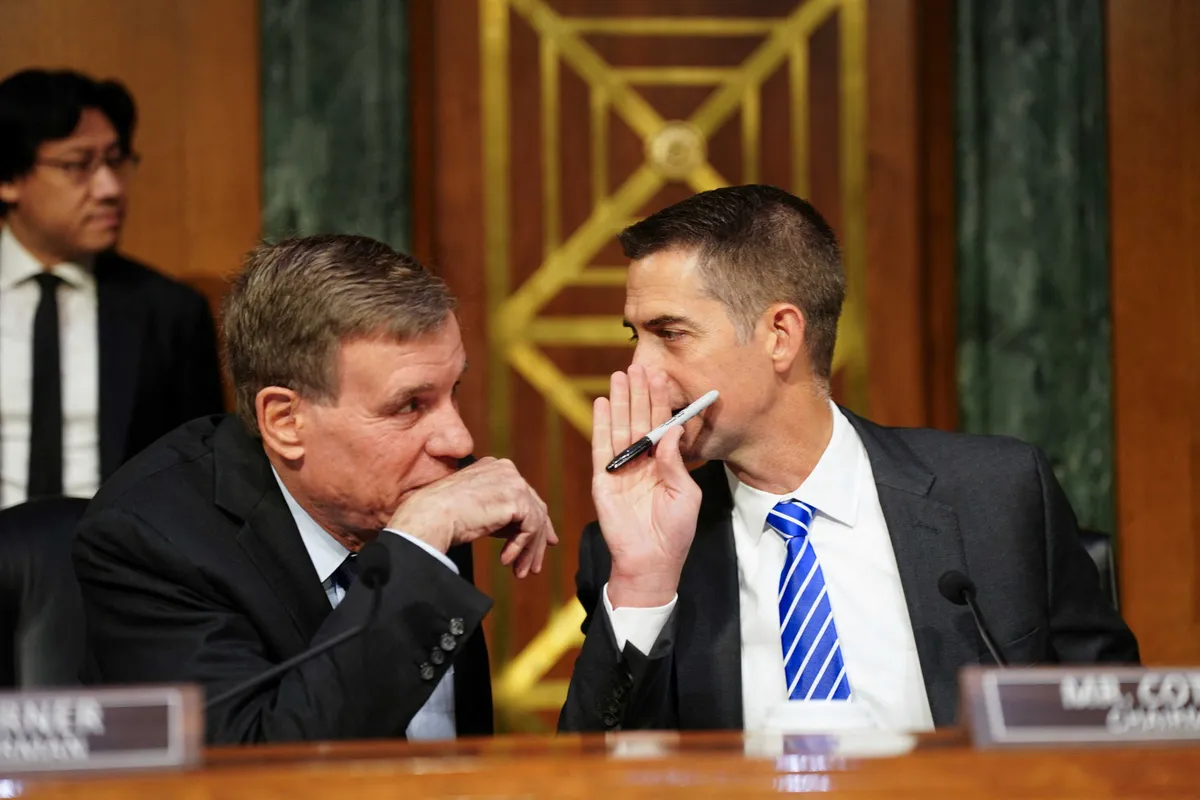
Senator Tom Cotton (R-AR) reportedly urged fellow Republicans at a private lunch this week to stop speaking with reporters — a warning that leaked to the press almost immediately.
Politico's Jordain Carney reported Wednesday that Cotton, citing "multiple attendees," delivered remarks at Tuesday's GOP lunch "warning against talking to reporters." Cotton already maintains what Carney described as "a blanket no-comment policy in the halls" — referring to the Capitol corridor stakeouts where reporters intercept senators between votes and meetings, a fixture of congressional journalism that often produces the day's most unscripted moments. Republican colleagues told Carney they "don't really know what sparked it," though it generated "a lot of questions/speculation" within the conference.
The irony of the situation was not lost on journalists covering Capitol Hill.
"The concept of telling a reporter that you were advised not to talk to reporters in a closed-door meeting is peak Congress," wrote Deseret News congressional reporter Cami Mondeaux. New York Times reporter Michael Gold echoed the sentiment, writing that "it's peak Congress that this leaked."
Others placed the episode within a familiar Capitol Hill pattern. "The leak about not leaking is one of my favorite Hill traditions," wrote Inside Elections' Nathan Gonzales. Reporter Nathaniel Reed added, "Pretty telling that this leaked out."
At least one senator turned the directive into a joke. Reporter Nancy Vu noted that Senator Lisa Murkowski (R-AK) emerged from the same lunch and deadpanned: "I'm trying out a new thing that we learned in conference today. It's called 'no comment.'" Vu observed that Murkowski then "proceeded to comment about the news of the day."
Some questioned whether the caution was warranted. Reporter Jonathan Nicholson noted that most pre-recess hallway questions typically amount to "'Is Issue X gonna get a vote before y'all leave?'" and "'What day are we getting out of here?'" — "hardly the stuff of which 'gotcha!' is made."
The push for message discipline comes amid broader unease among Senate Republicans. As conference chair, Cotton recently left colleagues "visibly shaken" at another closed-door lunch after presenting internal polling showing independents drifting away from the GOP ahead of what party leaders have privately described as a potential midterm bloodbath. That anxiety has surfaced in public friction between President Donald Trump and Senate leaders, with one senator telling CNN that instead of "talking up the wins," Republicans "are knifing each other."
Cotton belongs to what Axios termed the Senate's "silent caucus" — a small group of lawmakers who decline to answer reporters' questions in Capitol hallways, thereby avoiding the need to respond to "every utterance from President Trump." As head of the party's messaging operation, Cotton also bears primary responsibility for shaping the GOP's public communications. His push to curtail GOP senators' hallway interviews thus reflects both a personal practice and a strategic attempt to tighten control over the party's public narrative at a moment when internal polling has rankled the conference.
Cotton has long been among the Senate's most vocal critics of the press. He previously blocked the PRESS Act, a bipartisan measure designed to shield journalists from being compelled to disclose their sources. Cotton characterized the legislation as a "floodgate of leaks" that would make the Senate an "accomplice of deep-state leakers."
