Tokenized Equities Onchain Volume Hits $9 Billion, Up 800% Since January
Key Takeaways
- •The total value of tokenized stocks rose from $683.6 million at the start of the year to $2.399 billion, a gain of roughly 250%, making it the second-fastest-growing real-world asset category after venture capital.
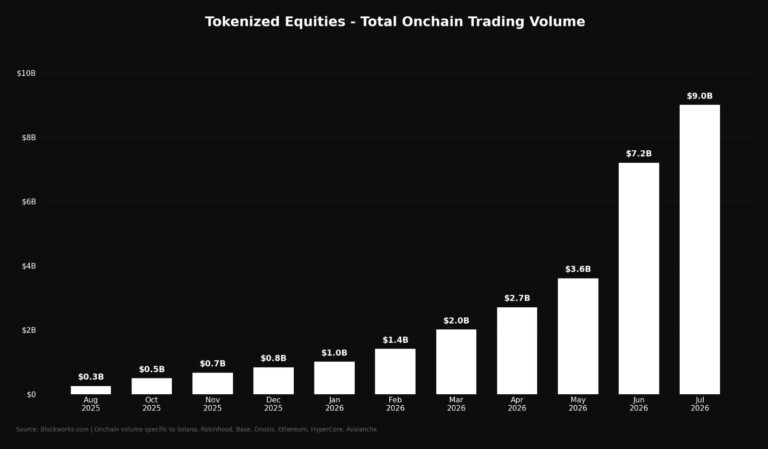
- •Onchain trading volume for tokenized equities has surpassed $9 billion, up from $1 billion in January, with the bulk of the increase occurring across June and July.
- •The June-July volume spike coincided with the launch of Robinhood Chain on Arbitrum, Binance's bStocks, and Backed Finance's xStocks listed on Solana, which distributed stock tokens to millions of existing brokerage and exchange users.
- •The GENIUS Act, signed into US law in July 2025, established the first federal regulatory framework for payment stablecoins, and a friendlier SEC posture toward tokenized securities removed a key barrier for issuers.
- •Nasdaq plans to extend trading to 23 hours a day pending SEC approval, a move that would compress the always-on advantage of tokenized equities and leave weekends, global access, and DeFi composability as the main remaining differentiators.
Tokenized stocks have become one of the fastest-growing categories within the real-world asset (RWA) space. The total value of tokenized stocks has climbed from $683.6 million at the start of the year to $2.399 billion — a gain of roughly 250% — according to data from RWA.xyz. That makes tokenized stocks the second-fastest-growing RWA category year to date, trailing only venture capital, which expanded around 270% over the same period. Even so, the category remains far smaller than RWA mainstays like private credit and tokenized US Treasuries.
The shift is even more pronounced in onchain trading activity. Tokenized equities have cleared $9 billion in trading volume, according to Blockworks data. In January, that figure stood at $1 billion, and a year ago it was $300 million. Most of that increase occurred within the span of two months. For scale, US exchanges routinely turn over more than that in a single session, which frames the category as fast-growing but still nascent.
June Is Where the Line Bends
For most of the year, the volume trend looked steady and gradual. April volumes reached $2.7 billion, and the following month came in at $3.6 billion — the kind of natural rise that reads as ordinary category growth. June is where the numbers turned exponential, doubling to $7.2 billion before growing another 25% in July. Monthly gains of that size cannot be attributed to existing users trading more; they point instead to new platforms coming to the fore.
The spike in volume across June and July lines up with the launch of Robinhood Chain and Binance's bStocks. Both products brought stock tokens to millions of existing users. The same late-June window also saw Backed Finance's xStocks list dozens of tokenized US stocks and ETFs on Solana through venues including Kraken, while Robinhood Chain itself is being built on Arbitrum. Coinbase has separately said it plans to offer tokenized equities as well.
Distribution Changed, the Product Didn't
For most of last year, tokenized equities lived on crypto-native decentralized exchanges (DEXs) and stayed under $1 billion a month. Buying Tesla exposure onchain meant finding the right liquidity pool, trusting an issuer nobody had heard of, and accepting spreads that made the trade barely worth doing. That friction is what capped the category.
What changed is where the products sit. Tokenized stocks moved into brokerage and exchange front ends with millions of existing accounts, collapsing the onboarding step entirely.
The demand underneath is an access arbitrage. Nobody is buying a tokenized Apple share because they cannot buy Apple. They are buying the wrapper: 24/7 trading, fractional size, stablecoin settlement, and availability to users outside the United States who cannot easily open a domestic brokerage account. That last group is the real volume driver, and it does not show up in US equity market data at all.
Regulation stopped being the blocker somewhere in that window. The GENIUS Act, signed into US law in July 2025, gave payment stablecoins their first federal regulatory framework, and those post-GENIUS stablecoin rails gave the settlement leg actual legal footing. A friendlier posture toward tokenized securities — marked by the SEC's new crypto task force, dropped enforcement cases, and public roundtables on tokenization — meant issuers stopped waiting for permission that was never going to arrive as a formal blessing.
Nasdaq Is Aiming at the Same Pitch
That growth story now faces its most direct competitive test. Nasdaq plans to extend trading to 23 hours a day, five days a week — a move that requires SEC approval, and one that rival venues like the NYSE are pursuing in parallel — putting the largest incumbent venue directly on top of the always-on argument that tokenized equities have been built around.
If a regulated exchange offers near round-the-clock access with full settlement finality and no counterparty questions, the crypto-native advantage gets narrower. What survives is weekends, global access without a US brokerage relationship, fractionalization at very small sizes, and composability with DeFi protocols. That is a real list — and a shorter one than it was. Nasdaq compresses the moat rather than closing it.
The open question the next few data prints will answer is whether $9 billion was the start of a curve or the top of a venue-launch bump. August data is the first month in which new-listing effects should have washed out.

