Tokenized Stocks Gain Ground as Nasdaq Prepares 23-Hour Weekday Trading
Key Takeaways
- •Nasdaq plans to begin 23-hour weekday trading on December 6, with overnight sessions from 9 p.m. to 4 a.m. Eastern time and a one-hour daily maintenance pause, subject to market data infrastructure development and regulatory changes.
- •IMF research found that 87% to 99% of overnight tokenized equity price movements passed through to conventional securities within the first five minutes of traditional market open, though no causation was established.
- •The IMF identified elevated risks in tokenized stocks, including realized volatility roughly 1.5 times higher than conventional shares, reduced liquidity, and greater pricing errors on venues with fewer transactions.
- •The tokenized stock market's capitalization reached $3.8 billion in the week of October 5, a 483% from approximately $654 million in January, according to DWF Labs.
- •Some institutions remain cautious, as TD Cowen cited limited demand due to lower liquidity and technical complexity, while Morgan Stanley pushed its tokenized equity offering to the first quarter of 2027.
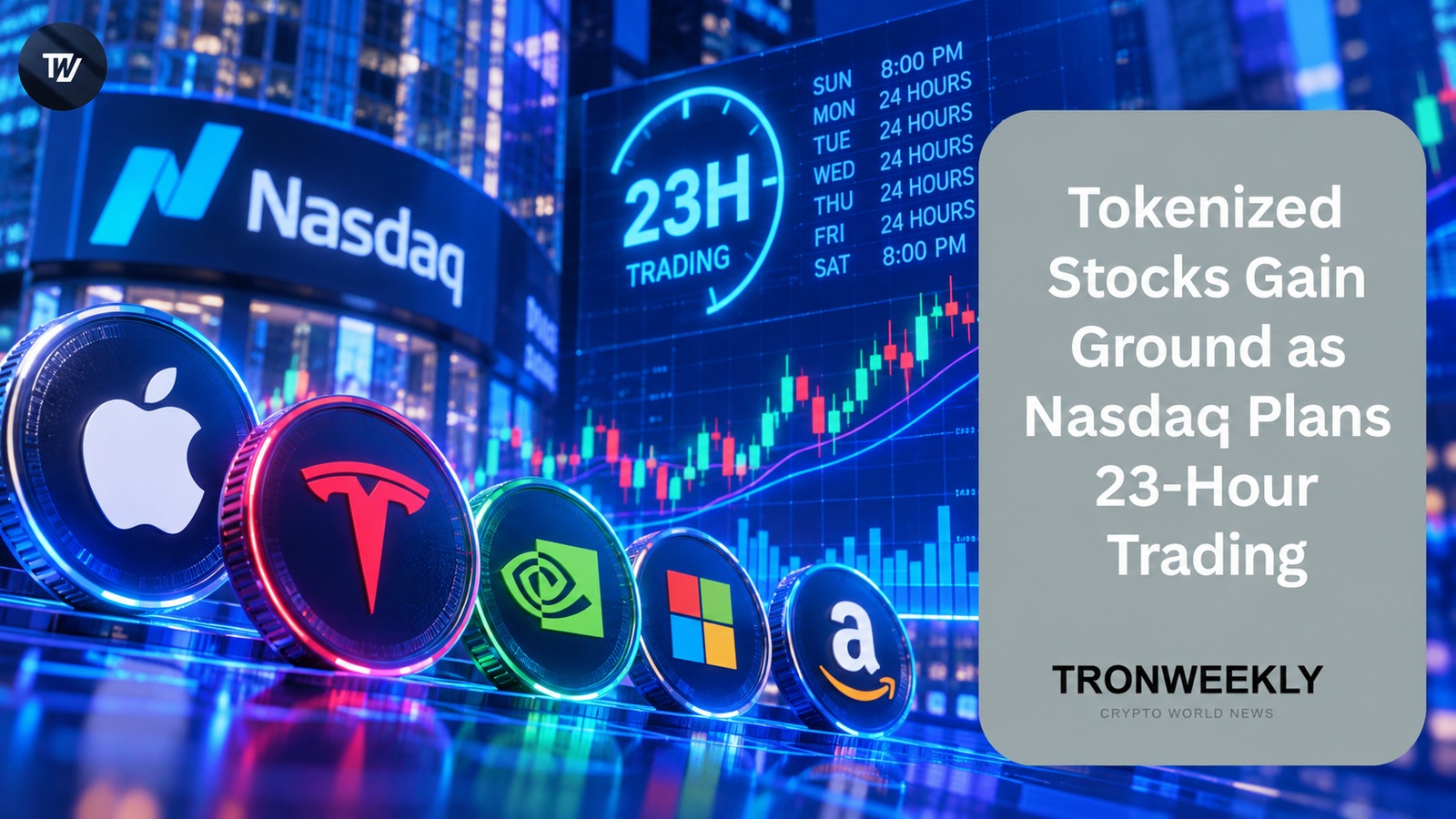
Tokenized stocks — blockchain-based representations of conventional equities that can be traded on crypto market infrastructure — are drawing increased attention as Nasdaq prepares to launch 23-hour weekday trading on December 6. In an October 23 report, Bitfinex cited research from the International Monetary Fund (IMF) showing that 87%–99% of overnight tokenized equity price movements appeared in conventional securities within five minutes of the traditional market open.
According to the report, tokenized shares give traders constant access to financial markets whenever the blockchain market is trading, even though the stock market itself is shut down. The publication noted, however, that the IMF did not establish any causation between tokenized markets and conventional stock prices. Instead, the study's results indicate a high correlation between opening prices and overnight returns.
What the IMF Found About Tokenized Stocks
The IMF's October Global Financial Stability Report analyzed the link between tokenized stocks and conventional securities. Researchers examined five highly liquid exposures: the S&P 500, the Nasdaq 100, Tesla, Alphabet, and Nvidia.
The study covered Ondo and xStocks products across 11 trading venues. Notably, the sample constituted about $345 million, or roughly 15% of the total tokenized equity market, as of July 31 — a scope that leaves most of the market, by value, outside the study's coverage.
The analysis established that more than half of tokenized stock transactions were executed outside the regular trading hours of US markets. When conventional markets opened, overnight prices were transferred to conventional prices with an 87% to 99% pass-through during the first five minutes of trading.
The researchers nevertheless identified several market risks tied to tokenized stocks. Realized volatility was about 1.5 times higher than that of conventional stocks, and liquidity was lower — a shortfall that was especially pronounced on decentralized platforms. The IMF also recorded higher pricing errors on venues with fewer transactions.
When Will Nasdaq Introduce Extended Trading?
Nasdaq is scheduled to begin overnight trading on December 6. Under the exchange's official schedule, the overnight session will run from 9 p.m. to 4 a.m. Eastern time.
The initiative is designed to facilitate 23 hours of trading every weekday: the exchange will pause for one hour, from 8 p.m. to 9 p.m., for maintenance purposes, and there will be no weekend trading.
Source: Finance.biggo
Nasdaq's traditional session will be maintained from 9:30 a.m. to 4 p.m., and the exchange intends to preserve its existing opening and closing auctions.
The rollout remains subject to certain conditions. It depends on the development of the necessary market data infrastructure as well as regulatory changes. The schedule also applies to the Nasdaq Stock Market only, not to all exchanges operated by the company. Those dependencies give market participants a concrete set of items to track ahead of the planned December 6 start.
Jesse Knutson, an executive at Bitfinex Securities, stated that the trading restrictions may increase volatility near the opening times.
How Fast Is the Tokenized Stocks Market Growing?
Tokenized stocks grew steadily throughout 2026, according to findings released in an October 16 report by DWF Labs. The report put the market's capitalization at $3.8 billion in the week of October 5 — a 483% increase from approximately $654 million in January.
Trading on decentralized exchanges reached $2.54 billion, up from $45.8 million early in the year. Weekly trading activity in October, however, did not rise above the $7.26 billion per week high achieved in late August.
DWF Labs also revealed that $313 million worth of tokenized stocks were being used in decentralized finance as of October 15. Blockchain-based transfers amounted to $17.5 billion per week, a figure that includes wallet-to-wallet transfers and loans rather than only exchange trading.
Why Do Liquidity Risks Remain?
Even as tokenized stock trading becomes more active, concerns persist over execution quality and investor appetite. In September, TD Cowen reported that US investors already have efficient access to traditional shares. The investment bank highlighted that blockchain-enabled platforms require a unique value proposition to make up for lower liquidity and technical complexity, and that availability alone is insufficient to ensure competitive pricing. Morgan Stanley, meanwhile, has rescheduled its anticipated tokenized equity offering to the first quarter of 2027.
Tokenized stocks currently offer investors an additional avenue for trading while extending the operational window of the traditional exchange. The IMF study identifies overnight price discovery in emerging tokenized markets, while liquidity, regulatory, and market protection issues continue to stand out. With Nasdaq's overnight session slated to begin December 6 pending infrastructure and regulatory conditions, and Morgan Stanley's tokenized equity offering targeted for the first quarter of 2027, the coming quarters provide concrete checkpoints for how around-the-clock equity trading takes shape across conventional and blockchain-based venues.

