Tokenized Stock DEX Volume Surges 10,163.7% to $48.7 Billion, but Liquidity Lags
Key Takeaways
- •Decentralized exchange trading volume for tokenized stocks reached $48.7 billion over the past year, up 10,163.7% year-over-year, with Uniswap accounting for $17.1 billion across its v3 and v4 pools.
- •The distributed value of tokenized stocks was $3.20 billion as of October 3, and even the broader on-chain equities measure of $4.43 billion represents only about 0.0029% of the estimated $151.9 trillion listed-equity market.
- •Trading activity is heavily concentrated, with ETF-linked products making up 44.0% of DEX volume and QQQb alone accounting for 28.9%, while equity perpetuals on Hyperliquid and Lighter traded around $67.8 billion in June versus only $4.2 million in tokenized-equity spot trades.
- •On September 17, the SEC issued a temporary Innovation Exemption allowing qualifying venues to trade tokenized NMS stocks through permissioned automated market makers without registering as exchanges, with the relief expiring five years after publication and public comment requested.
- •Citi projects a $5.5 trillion tokenized-asset market by 2030 in its base case, while an IMF analysis warns that tokenization may create risks around the legal link between a token and its underlying asset.
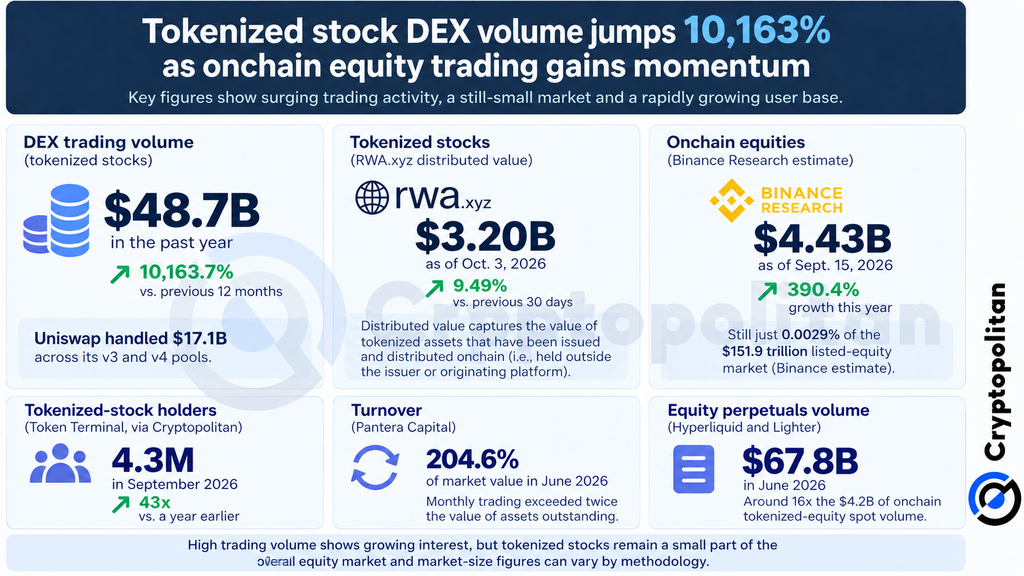
Tokenized stocks traded on decentralized exchanges generated $48.7 billion in volume over the past year, according to on-chain data — a 10,163.7% increase from the previous 12 months. Uniswap led all venues, with $17.1 billion traded across its v3 and v4 pools.
Tokenized stocks are blockchain-based representations of publicly listed shares that can be held in crypto wallets and traded at any time, including on decentralized venues such as Uniswap. The surge indicates they are starting to become more than assets that simply exist on-chain. The more pressing question is whether enough buyers and sellers are arriving to create a viable secondary market, because a high trading-volume figure alone does not mean ownership is guaranteed or liquidity is deep.
Volume, market cap, and holders measure different things
The $48.7 billion figure reflects trading activity, not the actual amount of tokenized stocks in existence. According to RWA.xyz, the distributed value of tokenized stocks — one part of the on-chain equity market — stood at $3.20 billion as of October 3. Distributed value is defined as the value of tokens that have been issued and distributed.
Token Terminal highlighted the surge in an X post on October 2, 2026:
Tokenized stock DEX trading volume is up 10,163.7% YoY, with $48.7B traded over the past year Uniswap leads with $17.1B in volume across v4 and v3 pic.twitter.com/rULbw2f4rS — Token Terminal 📊 (@tokenterminal) October 2, 2026
Binance Research, by contrast, relies on the broader concept of on-chain equities, which it sizes at $4.43 billion as of September 15 after growth of 390.4% this year. Even by that measure, on-chain equities amount to only 0.0029% of the estimated $151.9 trillion market value of listed equities — a gap that shows how small this market still is relative to traditional equities.
According to Cryptopolitan, Token Terminal reported 4.3 million tokenized stock owners last September — nearly 43 times more than the number reported the previous year. Those figures count blockchain addresses rather than verified persons, as one individual can hold many wallets.
High turnover, concentrated in a few tokens
Pantera Capital's September State of Tokenization report revealed that tokenized equity spot turnover was around 204.6% in June, meaning more than double the value of tokenized equities issued was traded during the month. Pantera warned that a high turnover rate for the whole category can be driven by just a few heavily traded tokens, while many others see very little activity.
That pattern is visible in Token Terminal data for the same one-year period behind the $48.7 billion DEX-volume figure. By reference stock, ETF-linked products — tokens referencing exchange-traded funds — account for 44.0% of trading, followed by NVDA at 10.0% and SPCX at 7.3%. Among individual assets, QQQb alone accounts for 28.9% of DEX volume, well ahead of SPYx at 5.3% and NVDA at 4.9%.
Derivatives activity is larger still. Equity perpetuals — perpetual futures with no set expiry date — traded on Hyperliquid and Lighter were worth around $67.8 billion in June, compared with only $4.2 million in tokenized-equity spot trades — a gap suggesting that many traders are more interested in betting on stock-price moves than in actually owning the tokenized shares.
Why traders are moving on-chain
The appeal of tokenized stocks is fairly simple. FalconX points to fractional ownership, near-instant settlement, potential 24/7 trading, and DeFi utility as key reasons for the growing interest.
As demand for tokenized-stock access has grown, exchanges have expanded their offerings. Kraken began offering tokenized stocks in 2025, followed by Bybit and OKX. Binance launched bStocks in June 2026. The $48.7 volume figure covers decentralized venues only, so trading executed on these centralized platforms sits outside it. Binance Research also found that the Capital Activation Rate for equities rose from 1.95% to 7.54% this year, with liquidity pools and lending accounting for most of the deployed value — the same kinds of DeFi applications FalconX cites as a draw.
The SEC opens a narrow door
On September 17, the SEC issued a temporary Innovation Exemption allowing qualifying Tokenized Securities Venues to trade tokenized NMS stocks — US-listed equities covered by the National Market System — through permissioned automated market makers, pricing systems restricted to approved participants, without registering as exchanges. The relief comes with limits on symbols and volume, requires tokens to carry the same rights as equivalent shares, and expires five years after publication. The SEC has also requested public comment on the approach, and with the relief set to expire, the long-term regulatory treatment of these venues remains open.
What the big-picture forecasts assume
Looking further ahead, Citi projects a $5.5 trillion tokenized-asset market by 2030 in its base case and estimates that moving 10% of US retail investors on-chain could create about $2.6 trillion in tokenized-equity demand.
An IMF analysis, however, warns that tokenization can create risks around the legal link between a token and the asset behind it. That distinction could matter more as trading grows and investors eventually need to enforce ownership rights or exit their positions.
Source: Cryptopolitan

