Tokenized Stock Market Activity Surges Over 415% to $29.5 Billion
Key Takeaways
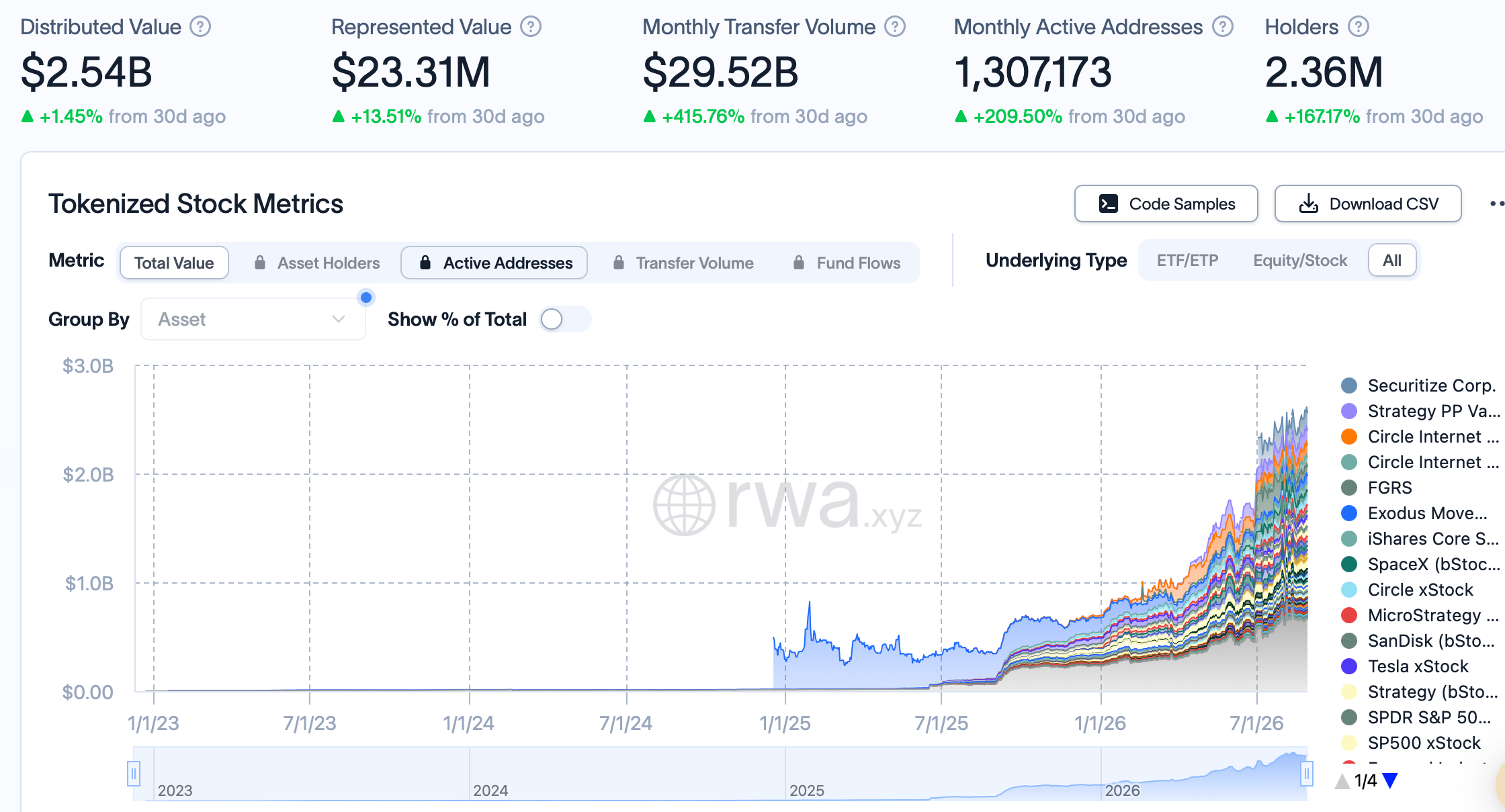
- •The tokenized stock market generated $29.5 billion in 30-day on-chain transfers, an increase of more than 415%.
- •Ondo, Kraken xStocks, and Binance bStocks held roughly 81% of the $2.54 billion in distributed value across the sector.
- •Distributed value grew 637% year over year to $2.54 billion, though it rose only 1.45% during the month, showing activity grew far faster than outstanding balances.
- •Coinbase added tokenized U.S. stocks on Base for eligible non-U.S. users on August 24, with Bitwise launching automated token portfolios the following day.
- •DeFi integration and market concentration introduce smart-contract, oracle, liquidity, and platform-dependency risks, and most offerings are limited to eligible users outside the United States.
At a Glance
The tokenized stock market generated $29.5 billion in 30-day transfers, an increase of more than 415%. Active use grew faster than outstanding value. Monthly active addresses climbed over 209% to 1.3 million, while the holder count advanced 167% to 2.36 million over the same period.
Ondo, Kraken xStocks, and Binance bStocks together held about 81% of distributed value, with a combined balance exceeding $2.05 billion. Coinbase and Bitwise expanded self-custodied equity products for eligible non-U.S. users, while DeFi integration adds custody and smart-contract risks.
Record Transfer Volume, Widening Participation
The tokenized stock market recorded $29.5 billion in on-chain transfers during the 30-day period, according to RWA.xyz data, a rise of more than 415%. The figures show participation expanding beyond transaction volume: monthly active addresses rose more than 209% to roughly 1.3 million, and holders increased 167% to 2.36 million.
The value distributed on-chain reached $2.54 billion — only 1.45% higher during the month, but 637% above its year-earlier level. That contrast matters: activity grew far faster than outstanding value, indicating heavier circulation, broader wallet use, and new product integration rather than an equivalent surge in balances.
The growth sits within a broader institutional shift toward putting traditional assets on blockchains. Asset managers including BlackRock have launched tokenized funds, and industry tracking of real-world assets on-chain has expanded across Treasuries, commodities, and now equities — a trend that has made the infrastructure for on-chain securities more familiar to both issuers and users.
Growth Concentrated Around Three Providers
The latest market composition shows both scale and concentration. Ondo led with $842.8 million in distributed value. Kraken's xStocks held $609.3 million, and Binance's bStocks reached $599.9 million. Combined, those platforms controlled roughly 81% of the $2.54 billion market, meaning issuance and infrastructure remain clustered around three providers.
Tokenized stocks show a separate ranking. Securitize Corp. represented about $163 million, followed by Strategy PP Variable xStock at $136 million. Ondo's tokenized Circle Internet Group shares held $109 million. These balances show where value sits, while transfer volume measures how often assets move between wallets and applications.
Monthly transfers equaled about 11.6 times the sector's distributed value. That ratio should not be read as $29.5 billion of new investment; it can include repeated trades, wallet transfers, redemptions, liquidity operations, and collateral movements. Even so, rising active addresses and holders provide separate evidence that participation widened alongside turnover.
The year-over-year increase from $344 million to $2.54 billion gives the market a larger base than last summer, and the sharper monthly jump in activity suggests users are finding more ways to trade and deploy tokenized stocks.
Crypto Platforms Extend On-Chain Equities Into DeFi
Coinbase added tokenized U.S. stocks to Base on August 24 for eligible users outside the United States. Initial assets covered Apple, Nvidia, Meta, and Alphabet. Base says each B20 token represents a real share held one-for-one through a regulated custody structure. Holders can keep the assets in self-custody wallets, trade through supported venues, or connect them with decentralized applications.
Bitwise followed one day later with Automated Token Portfolios built from Coinbase-issued assets. Glider executes rules-based rebalancing while users retain their tokens. Mag7X launched first, with robotics and artificial intelligence models still forthcoming. Access is limited to eligible non-U.S. persons, and Bitwise states that its SEC registration does not mean regulators approved these portfolios.
The geographic split is notable: most tokenized stock offerings target users outside the United States, reflecting a market shaped as much by jurisdictional boundaries as by demand. U.S. securities rules govern how tokenized claims on company shares can be offered and to whom, which is why eligibility screens are a recurring feature across these products.
Other platforms are moving on-chain equities beyond spot trading. Bybit added tokenized shares — including Nvidia, Apple, and Tesla — as collateral for margin borrowing in July. Robinhood-backed Arcus also introduced more than 95 stock tokens and perpetual markets. On-chain equities may generate transfers without raising distributed value by the same amount.
Several offerings support extended trading outside normal U.S. exchange hours, letting users respond to events sooner. Still, thinner off-hours liquidity can widen spreads and weaken price tracking until markets reopen.
Structural Differences and Risks
The tokenized stock market also offers differing structures. Some products provide direct claims on custodied shares, while others deliver synthetic price exposure or cash redemption. Trading hours, dividend handling, voting rights, redemption terms, and investor protections can vary by issuer and jurisdiction.
DeFi use adds smart-contract, oracle, liquidity, and liquidation risks. Market concentration creates another dependency, since three platforms hold most distributed value. Investors must assess the issuer, backing arrangements, custody, transfer restrictions, and redemption process, and should not treat tokenized stocks like brokerage holdings. Coinbase's Base offering, for example, restricts availability to eligible jurisdictions outside the United States.
