Tirana's Rapid Transformation: Why Albania's Capital Is Becoming a Must-Visit City Break
Key Takeaways
- •Albania recorded 12.5 million overnight guests in 2025, more than double the 6.1 million who visited just before the pandemic.
- •Tirana has approximately 30 skyscrapers planned, under construction, or completed, a striking shift for a city that until recently had no high-rise buildings.
- •The launch of EU accession negotiations in 2020 has accelerated foreign investment interest in Albania's infrastructure and hospitality sectors.
- •Under communist leader Enver Hoxha, Albania constructed 173,371 bunkers nationwide, roughly one for every 11 citizens, reflecting the regime's extreme isolation and paranoia.
- •Blloku, once a restricted residential enclave for communist officials, has transformed into Tirana's most fashionable district for dining and nightlife.
"Tirana is like a cross between Mumbai and Las Vegas," a teenage traveler told me a week before I arrived in Albania's capital. "I've never been to either place, but at least that's how I imagine them to be." While Tirana may not truly resemble either city, the comparison captures something essential. It has the feel of an energetic, slightly chaotic boom town where change is happening at remarkable speed.
Ranked among Europe's poorest capitals well into the 1990s, Tirana is now in the midst of a construction boom. Until recently, the city had no high-rise buildings. Today, some 30 skyscrapers have been planned, started, or completed. Tourism is surging alongside the development. In 2025, Albania recorded 12.5 million overnight guests — more than double the 6.1 million who visited just before the pandemic and a dramatic increase from the 3.3 million recorded two decades ago. For a country of fewer than three million people, those figures underscore how thoroughly tourism has become a pillar of the national economy. Albania's Adriatic and Ionian coastlines, along with its low costs relative to neighbouring Greece, Croatia, and Italy, have helped position it as one of the Mediterranean's fastest-growing destinations. The opening of EU accession negotiations in 2020 has further accelerated foreign investment interest in the country's infrastructure and hospitality sectors. The pace of transformation is such that a visitor returning in five years might find a completely different city.
Through all the change, Skanderbeg Square remains at the heart of Tirana. The pedestrianised square is so expansive that it seems possible to see the curvature of the earth — or perhaps there is simply a small hill in the middle. The city's major cultural institutions are located on the square, including the opera house and the national museum, which is closed until 2028. From the square, visitors can take in Albania's emerging skyline. Directly abutting the square is the 31-storey glass tower known as the Eyes of Tirana, its layers stacked atop one another like ill-fitted Tetris blocks. A little further away stands the 40-storey Downtown One, featuring a map of Albania cantilevered out from its surface.
Echoes of a Troubled Past
Given how rapidly the city is evolving, I spent the weekend exploring Albania's difficult history. Many of Tirana's most compelling sites are tied to the communist regime of Enver Hoxha, who presided over one of Europe's most repressive governments. Albania's isolation was extreme even by the standards of the Eastern Bloc: the country broke with the Soviet Union in 1961 and with China in the late 1970s, leaving it almost entirely cut off from the outside world for decades. A museum signpost noted that under Hoxha, the Republic of Albania was closed to "hippie tourists" as well as enemies, spies, and other "vagabonds." Border posts even employed barbers to shave the beards of foreign tourists seeking entry.
The museum of the Secret Police, known as the House of Leaves, is essential viewing. The name refers both to the covering over the building that prevented people from looking in and to the files held by the Sigurami on individuals deemed suspicious. The exhibits document the apparatus that enabled Hoxha to maintain control over the population with relatively limited resistance. "Attention! Dear guests, this room is bugged," reads a sign displayed in one of the rooms.
Bunkers and Nightlife
Another stark demonstration of the regime's paranoia is Bunk Art, a former communist bunker on the city's outskirts. Hoxha constructed 173,371 bunkers across Albania — roughly one for every 11 people. Visitors enter through a long, dark tunnel, gradually leaving sunlight behind. The bunker complex is vast, containing over 100 rooms. While many rooms look similar, the cumulative effect is almost hypnotic.
Tirana's primary district for cafes and bars is Blloku, which formerly served as the residential enclave for the communist regime's top brass. Ordinary citizens were barred from entering under Hoxha. It has since transformed into the most fashionable district for the city's new elite. Among its offerings is Radio Bar, decorated with vintage radios and retro movie posters — a stylish spot to sample raki, Albania's national spirit.
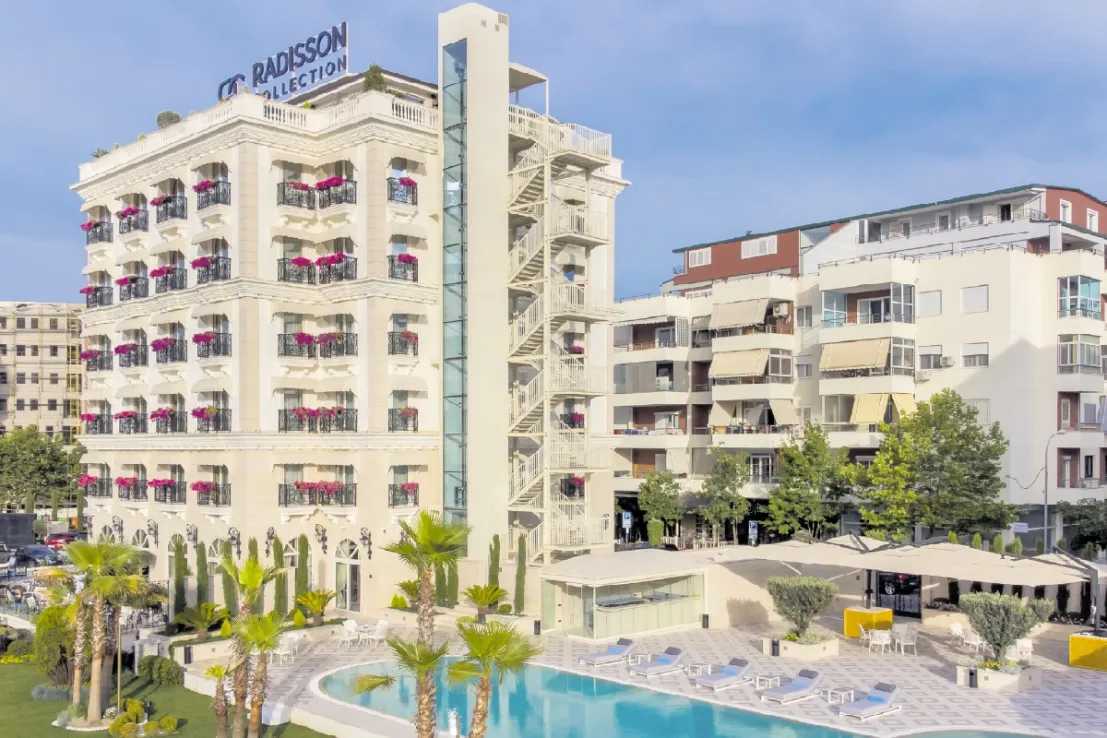
Accommodation options include the Morina Hotel, a Radisson Collection property located roughly a 30-minute walk from the city centre through Grand Central Park, or a 15-minute bus ride. The hotel features two swimming pools, a spa, and a bar overlooking the city's artificial lake.

