TIPS Yields Climb: 5-Year and 10-Year Real Rates on the Rise
Key Takeaways
- •As of July 23, 2026, both the 5-year and 10-year TIPS yields have risen, reflecting upward pressure on real interest rates.
- •TIPS yields isolate the real-rate component of returns since their principal adjusts with CPI, distinguishing them from nominal Treasury yields.
- •Increasing TIPS yields indicate that investors are seeking higher inflation-adjusted returns, which may reflect expectations of tighter monetary policy or greater government borrowing.
- •The 10-year TIPS yield is widely used by economists and policymakers as a benchmark for the long-term real cost of borrowing in the U.S. economy.
- •Market participants are monitoring CPI releases, Federal Reserve communications, Treasury issuance, and TIPS auction demand to determine whether real yield moves will persist or reverse.
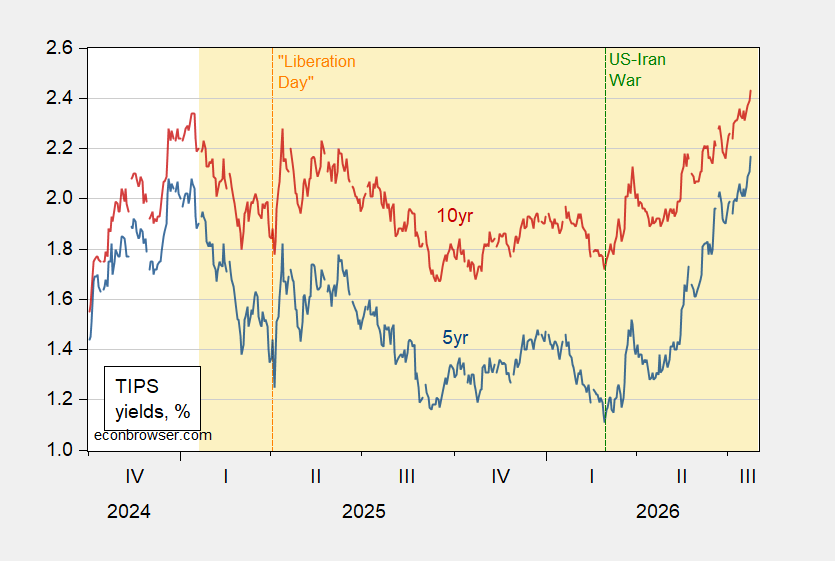
As of July 23, 2026, Treasury Inflation-Protected Securities (TIPS) yields have moved higher, with both the 5-year and 10-year maturities reflecting upward pressure in real interest rates. TIPS are U.S. government bonds whose principal is adjusted based on changes in the Consumer Price Index (CPI), meaning their yields represent real returns above expected inflation. The 5-year TIPS yield (blue) and the 10-year TIPS yield (red) are both shown in percent. Source: U.S. Treasury.
Rising TIPS yields indicate that investors are demanding higher real returns, which can reflect expectations of tighter monetary policy, increased government borrowing, or shifts in the broader macroeconomic landscape. Unlike nominal Treasury yields, which incorporate both expected inflation and real interest rate components, TIPS yields isolate the real-rate element, making them a closely watched barometer for bond market conditions. Comparing nominal Treasury yields with TIPS yields also helps derive market-based inflation breakeven rates, a commonly used gauge of inflation expectations over comparable maturities.
The 10-year TIPS yield in particular is frequently cited by economists and policymakers as a benchmark for the long-term real cost of borrowing in the U.S. economy. Higher real yields can affect financial conditions by raising inflation-adjusted returns available on low-risk government debt, a reference point used across credit markets and asset valuation models. Investors and policymakers typically monitor subsequent CPI data, Federal Reserve communications, Treasury issuance, and demand at TIPS auctions to assess whether moves in real yields are broadening or reversing.

