Thune Rallies Behind Collins in Georgia Senate Race as National Republicans Reassess Priorities
Key Takeaways
- •Senate Majority Leader John Thune traveled to Atlanta to back Mike Collins' Republican challenge against Democratic Sen. Jon Ossoff, saying the GOP can win Georgia despite national Republicans deprioritizing the race.
- •Polling shows Ossoff leading Collins 51.1% to 43.3%, and the Cook Political Report this week moved its rating of the race from "lean Democrat" to "likely Democrat."
- •The Senate Leadership Fund and its affiliated One Nation nonprofit have spent $25.9 million in the Georgia race so far, with an additional $17.3 million reserved for television advertising.
- •Ossoff enters the final stretch with a major fundraising edge of $42 million on hand compared with Collins' $2.2 million, a gap that affects advertising capacity in the costly Atlanta media market.
- •Georgia Republicans are focusing turnout efforts on hundreds of thousands of 2024 Trump voters who have never voted in a midterm, while Ossoff labels Collins a "Trump puppet" and cites an ethics investigation and other campaign controversies.
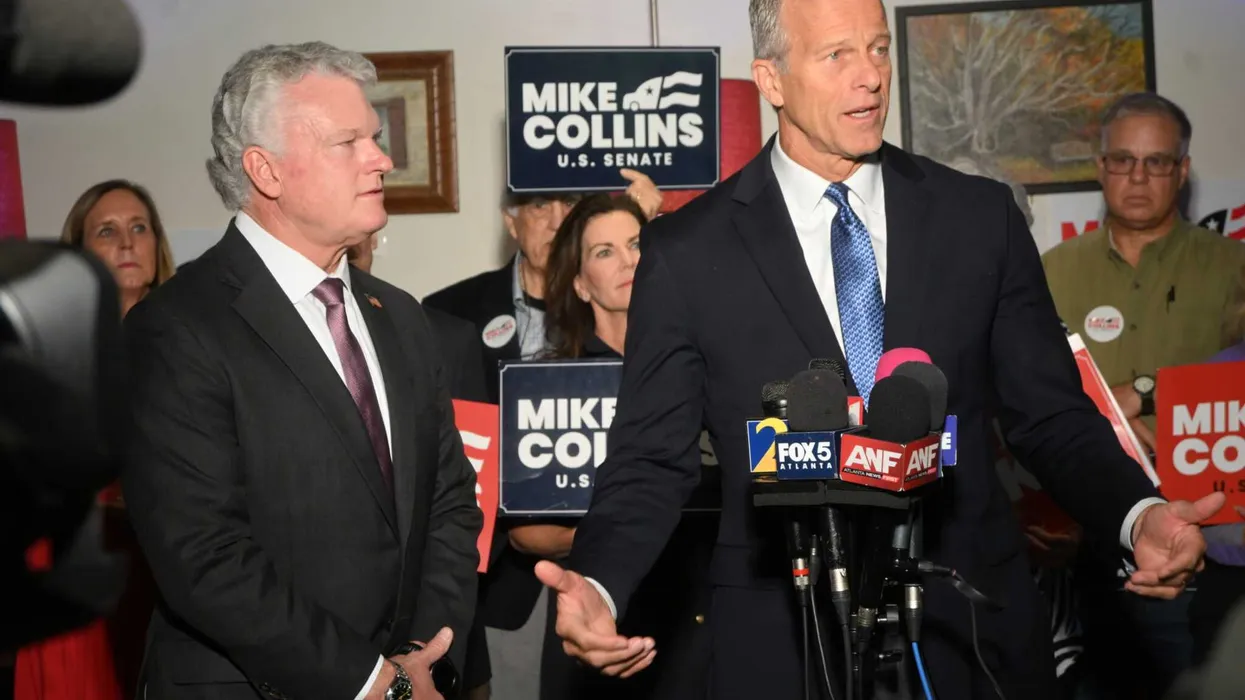
U.S. Senate Majority Leader John Thune traveled to Atlanta to bolster the campaign of Mike Collins, the Republican challenging Democratic U.S. Sen. Jon Ossoff in the Nov. 3 midterm election. The outcome will help determine the Senate's partisan balance in a chamber Republicans currently hold under Thune's leadership.
His visit came amid reports that national Republicans are deprioritizing Georgia's Senate race in favor of states they believe offer better odds of victory, including Texas, Maine, Alaska, Ohio, Michigan and New Hampshire.
Polling shows Ossoff with a sizable lead: the Real Clear Politics average places him nearly eight points ahead of Collins, 51.1% to 43.3%, and the Cook Political Report this week shifted its rating of the race from "lean Democrat" to "likely Democrat." Real Clear Politics aggregates publicly released surveys, and the nonpartisan Cook Political Report grades races on a competitiveness scale that runs from toss-up toward safe seats for each party, so the shift moves Georgia a step further from true toss-up territory.
Still, speaking with reporters at a Buckhead cafe on Friday, Thune said the Senate Republican caucus believes the Trump-endorsed Collins has a shot at becoming its next member.
"I wouldn't be here if I didn't think that we could win the state of Georgia," the South Dakota Republican said. "It's going to come down to who gets out to vote on Election Day, and there's been a significant investment made now in ensuring that we turn our voters out on Election Day."
Thune also appeared alongside Collins at a closed-door fundraiser Thursday night that featured Gov. Brian Kemp and other top Georgia Republicans. Kemp had supported Collins' opponent in the GOP primary and had cast doubt on Collins' ability to win a general election. The joint appearance marked a shift from the primary, when Kemp and Collins were on opposite sides of the race.
The Senate Leadership Fund, Thune's political action committee, reported spending $1.7 million this week on advertising opposing Ossoff, part of a nearly $4.5 million outlay across U.S. Senate races in Georgia, Michigan, Maine and Iowa.
Together with the affiliated One Nation nonprofit, the group has spent $25.9 million in the Georgia race so far, and the fund holds an additional $17.3 million in television ad reservations in the state, according to the Collins campaign.
Those dollars could provide a significant boost to Collins in a race in which Ossoff has held a strong financial advantage. During the last fundraising reporting period, Ossoff was the top political fundraiser in the country, according to the Federal Election Commission, entering the current reporting period with $42 million on hand. Collins' report showed a comparatively modest war chest of $2.2 million. Gaps of that size shape how much advertising and voter contact each campaign can sustain in the closing stretch, particularly in the Atlanta media market Thune described as especially expensive.
"It takes resources to communicate, no question about it," Thune said Friday. "It's an expensive state, especially in the Atlanta market, but we're doing everything we can to get resources in this direction, and we believe that Mike Collins is going to win here."
Collins acknowledged that flipping the seat Ossoff won in early 2021 was always going to be an uphill battle, but expressed confidence that Georgians, as they learn more about the candidates over the coming weeks, will judge Ossoff's record as too liberal.
"It's the number one race in the country," he said. "Jon Ossoff has been the most vulnerable Democrat out there, period, and it is because of the way he votes. You've got a crystal clear choice in this race."
Georgia GOP Chairman Josh McKoon said the key to a Collins victory will be mobilizing the coalition that helped President Donald Trump win the state in 2024, even though Trump is not on the ballot this year. Midterm electorates historically run smaller than presidential-year ones, a pattern that puts occasional voters at a premium for turnout-focused campaigns.
"We've got hundreds of thousands of voters that voted for Donald Trump in 2024 that have never voted in a midterm election, and at the Georgia Republican Party, we are laser focused on getting those people off the couch and in the voting booth," McKoon said Friday. "If we turn those people out, we're gonna win these elections."
Speaking to reporters during a virtual press conference Thursday, Ossoff said he believes voters will find Collins too closely tied to Trump to elect to the U.S. Senate.
"Congressman Mike Collins is a Trump puppet who has voted seven times for the disastrous Iran war that has sent gas prices through the roof," Ossoff said. "He's voted repeatedly for the Trump tariffs that sent grocery prices soaring, and he voted with Donald Trump to double health insurance premiums for more than a million Georgians. He possesses not a shred of independence. He is Donald Trump's puppet, and we will be sure to remind voters of that over the next 40 days."
Ossoff also cited a series of controversies that have rocked Collins' campaign. They include a House ethics investigation into allegations that his office used government funds to pay a top aide's girlfriend for work she did not do; antisemitic videos posted by his son-in-law; apparent efforts by another top aide to intervene on behalf of an associate who had minimized the extent of the Holocaust and had been jailed for contempt of court; and bizarre posts from a former staffer, including an image of the staffer wearing Ku Klux Klan robes and of a swastika made out of the word "twink." With Ossoff pledging to press his case over the next 40 days and Republicans counting on first-time midterm voters to show up, both closing arguments now head toward the Nov. 3 ballot.

