Thom Tillis's 'Forgiveness' Plea Exposes 'the Entire Problem' With MAGA, MS NOW Analysis Argues
Key Takeaways
- •Tillis is retiring from Congress in January rather than running for reelection, after President Trump deemed him insufficiently loyal and too critical.
- •The North Carolina senator voted to confirm several of Trump's second-term Cabinet nominees, including Health and Human Services Secretary Robert F. Kennedy Jr., and now expresses regret over those votes while promoting his new book.
- •Under Kennedy, all members of the Vaccine Advisory Board were dismissed and replaced with vaccine skeptics, and the board subsequently overhauled the vaccine schedule, including for measles.
- •Measles, which the United States declared eliminated in 2000, is reappearing in communities in states such as Pennsylvania and South Carolina, with heightened stakes for infants too young to be vaccinated.
- •Russert argued that Tillis's remark telling him not to worry because he had the means and access to vaccinate his infant early reflected an individualistic, zero-sum outlook that exemplifies the problem with the MAGA philosophy.
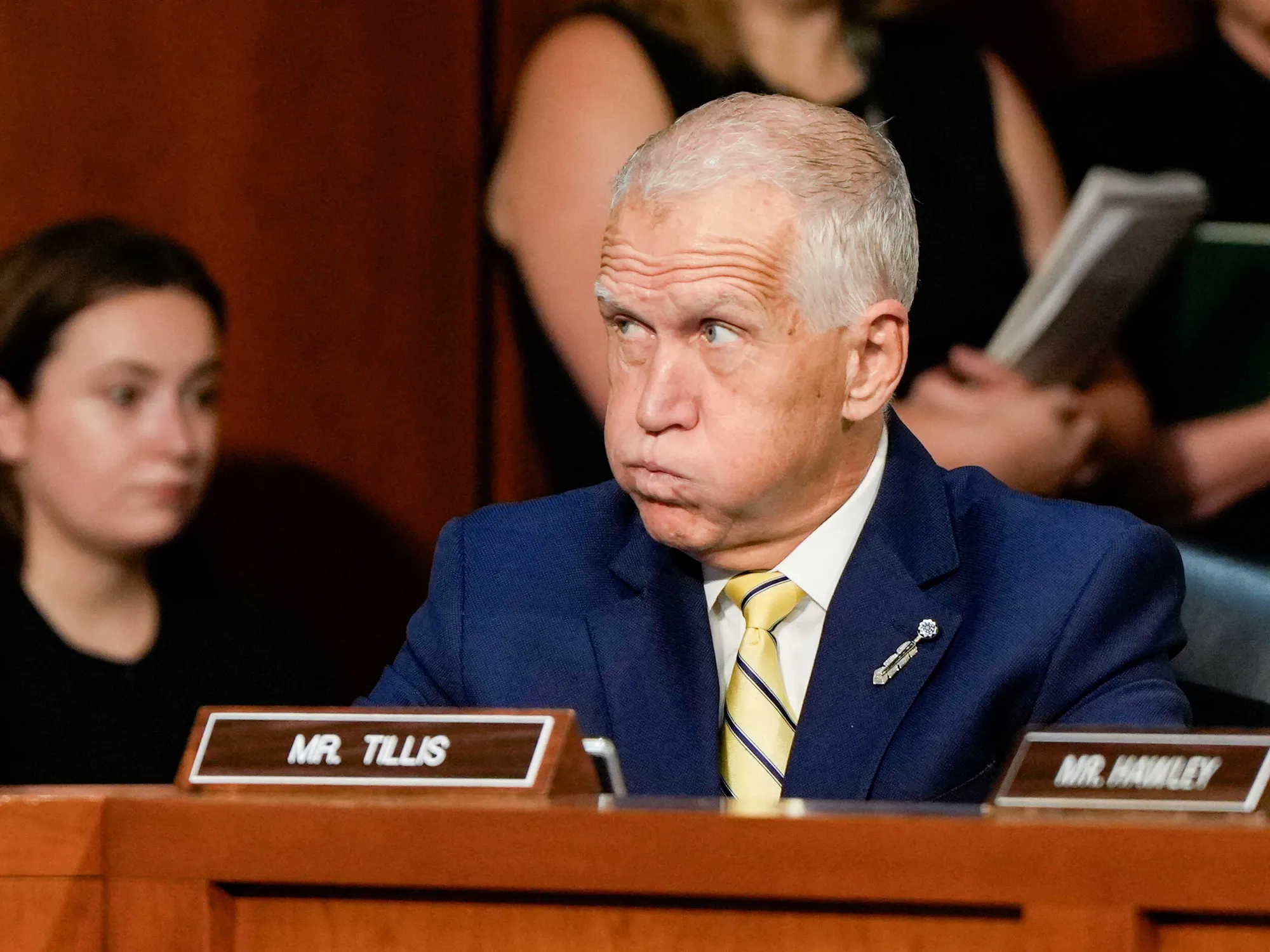
Sen. Thom Tillis of North Carolina says he is "seeking forgiveness" for his role in enabling President Donald Trump's second administration — but in making the plea, the outgoing Republican has exposed what commentator Luke Russert calls "the entire problem" underlying the MAGA movement, according to a new analysis published by MS NOW.
Tillis is retiring from Congress at the end of his term in January rather than seeking reelection, after drawing fire from Trump, who deemed the senator insufficiently loyal and too critical. Despite that rupture with the president, Tillis voted to confirm several of Trump's second-term Cabinet nominees — votes he now says he regrets, and for which he is seeking forgiveness while promoting his new book, How to Lose Friends and Antagonize Presidents.
MS NOW's Luke Russert examined Tillis's contrition in a piece published Saturday. "Tillis' new book is, in part, supposed to be him taking accountability for his role in advancing the rogues' gallery of the Trump Cabinet, including Robert F. Kennedy — an anti-vaccine conspiracy theorist whose brain worms outnumber his medical degrees," Russert wrote. "Even a worm could have predicted what happened next. He fired all members of the Vaccine Advisory Board, handpicking multiple fellow vaccine skeptics as their replacements. That board overhauled the vaccine schedule — including for measles, which is seeing a comeback in states like Pennsylvania and South Carolina." Measles, which the United States declared eliminated in 2000, has been resurfacing in American communities — a shift with particular stakes for infants too young to be vaccinated.
Before voting to confirm Kennedy as secretary of Health and Human Services, Tillis had publicly said he hoped the nominee would "go wild" in the role "as an outsider with new ideas." Russert pressed the senator on that remark during a guest appearance on his show, The Weeknight, asking whether Kennedy had, in fact, gone far enough.
"As the father of a 10-week-old daughter — far too young for the routine measles vaccine, which begins at 12 to 15 months — I asked: 'Did he go wild enough for you?'" Russert wrote. "Tillis responded: 'I'm not worried about your daughter because you're going to make an informed decision and you have the means and the access.' When I explained that — under the longtime guidance of actual experts — infants can't receive the measles vaccine until after 12 months, Tillis responded: 'Is it illegal to get it sooner?' He went on to say that I 'don't have to worry' about the new vaccine schedule because 'you've got an educated choice in the resources.'"
With that exchange in mind, Russert argued that Tillis had "summarized the entire problem with the MAGA philosophy and the Republicans like Tillis who helped it along, regardless of whatever they say about it now."
"T seemed to think that the problem facing me was an individual one and that any consequences would be individual," Russert wrote. "Under this view, the United States is not a united country, but just a collection of hundreds of millions of rugged individualists whose actions have no effects on their neighbors. According to Tillis, I could somehow get my child vaccinated early, so I shouldn't have to worry. But at 10 weeks old, that was not a choice available to me."
"This kind of zero-sum thinking is making us a weaker nation," he added. "If you have enough money for retirement, you shouldn't worry about whether Social Security will help your neighbors. If your kids are in a good school, you shouldn't worry about whether the educational system is falling apart. If you live on a hill, you shouldn't worry about the homes being flooded in the valley. Setting aside the moral implications of ignoring the needs of your neighbors — and the rather old-fashioned question of whether we are our brother's keeper — this isn't how things work. If my neighbors are sick or poor or uneducated, that will affect me, too, eventually."
With his term ending in January and the overhauled vaccine schedule already in effect, Tillis's plea for forgiveness lands while the policies that flowed from those confirmation votes remain in force. Russert concluded that while Tillis may now regret his role in elevating the most contentious figures in Trump's Cabinet, he may not genuinely "understand why it was wrong in the first place."

