Outgoing Republican Sen. Thom Tillis Condemns Trump's DOJ Weaponization at Jack Smith Senate Hearing
Key Takeaways
- •Sen. Thom Tillis skipped questioning Jack Smith at a Senate Judiciary Committee hearing to instead deliver remarks about the weaponization of the Justice Department.
- •Smith was appointed special counsel in November 2022 and brought two federal cases against Trump, both of which were dropped after Trump won the 2024 election under Justice Department policy against prosecuting a sitting president.
- •Tillis criticized the '8647' social media post that prompted the Secret Service to interview former FBI Director James Comey, calling it an unsuitable basis for a prosecution.
- •Tillis said he remains interested in determining who was responsible for the January 6, 2021, Capitol attack, which injured more than 100 police officers.
- •Smith said he made only two brief public announcements as special counsel and believes future prosecutors should be permitted greater communication with the public to foster trust in high-profile cases.
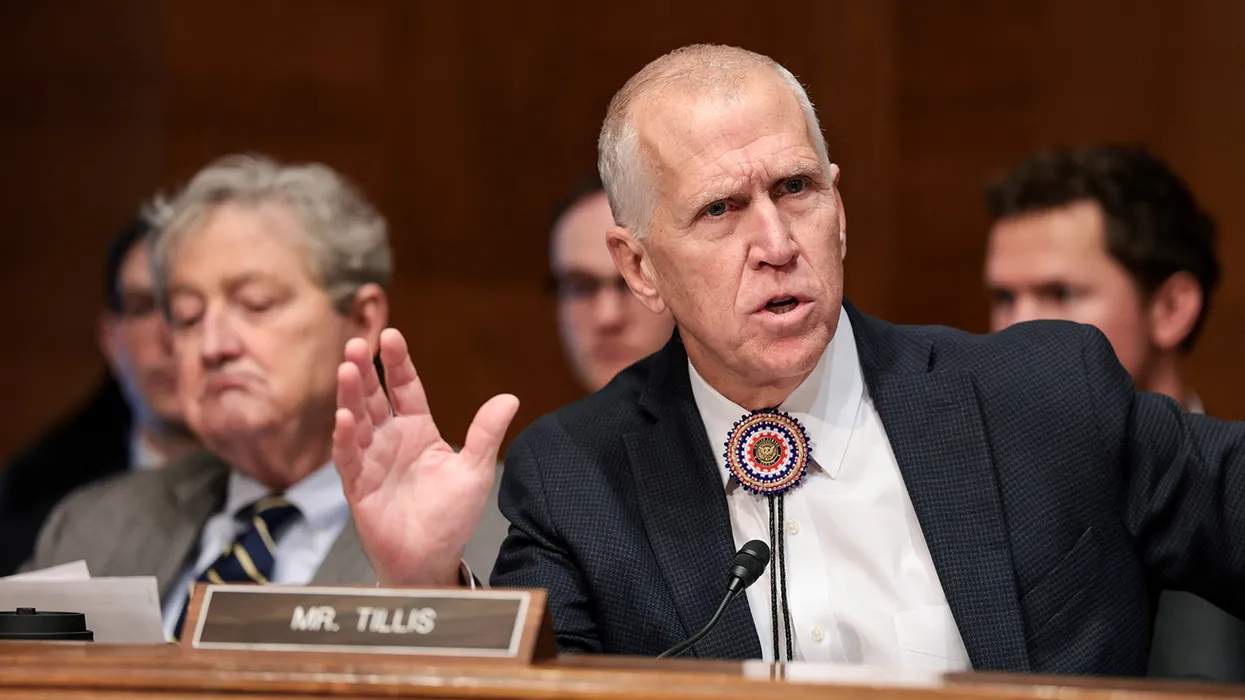
Sen. Thom Tillis (R-N.C.) used his time at a Senate Judiciary Committee hearing on Tuesday to deliver pointed remarks about President Donald Trump's weaponization of the Justice Department, rather than spending his allotted ten minutes questioning former special counsel Jack Smith.
Smith was appointed special counsel in November 2022 and brought two federal cases against Trump — one over the retention of classified documents after he left office, and another over efforts to overturn the 2020 election. Neither went to trial; both were dropped after Trump won the 2024 election, with Smith citing Justice Department policy against prosecuting a sitting president.
Tillis, who is not running for reelection, told the committee that he had asked artificial intelligence to identify specifics about so-called "vindictive prosecution" and found examples involving Trump himself.
"The one thing I want to, where on may be a bit of an odd duck, is I have few skills, but good memory is one of them. I think it's fascinating how people want to pick up the mantle of a vindictive prosecution when their guy is not in office, but I was going through AI after you finished your opening statement," Tillis said.
"I find it interesting people think they are the only party that is right and righteous on this. That is a general statement. I don't expect you to speak to it. Recently, I thought 8647 was not a solid basis for making a former FBI director, who disappointed me profoundly on this committee, probably not the right way to spend our time or the perp walk," he added, referring to Trump's targeting of former FBI Director James Comey.
The "8647" line referenced the social media post that led the Secret Service to interview Comey: a photo of seashells spelling out the numbers, pairing slang for "get rid of" with Trump's status as the nation's 47th president.
"I had to get that out there," Tillis said, before issuing a caution to his colleagues. "I think we all need to be mindful of how we behave and how we are perceived."
While many of his colleagues have sought to accuse Smith of political motivation, Tillis said he remains interested in determining "if at some point in the future we can get down to who, precisely, was responsible for forcing every member of the U.S. Senate to be in this room while thugs destroyed this building and injured over 100 police officers. I hope we can find who is responsible for that and hopefully we can cool the political temperatures to get to that fact-based assessment."
Tillis was referring to the January 6, 2021, attack on the U.S. Capitol, when a mob of Trump's supporters breached the building as Congress met to certify the 2020 election results.
Tillis then invited Smith to describe what he might have done differently across his two cases.
Smith responded: "One of the things I was taught as a prosecutor through my career is you only do your talking in the courtroom; you don't talk on the courthouse steps. One of the things I learned from this experience is if you stick to that and that alone people can unfairly malign your team, you, and your case in a way, and you really can't respond because you don't want to interfere with someone's right to a fair trial. And you don't want to get down in the gutter and start calling people names. At the same time, there are things being put out daily that are patently untrue."
Smith said he was not advocating that prosecutors go online and respond in comment sections, but he agreed that, in the future, prosecutors should be able to communicate with the outside world.
"I believe strongly we did our investigation the right way. But I limited myself and who I talked to about that," he continued. "I think I did two announcements under four minutes in the time I was special counsel. I think going forward to engender public trust in these cases, I think that's a real thing we need to think about, going forward, in the future."
Smith's point speaks to a long-running tension at the Justice Department between the tradition of prosecutorial silence and public demands for transparency in politically charged cases — one any future special counsel will have to navigate. For Tillis, whose current term will be his last, the hearing served as a parting caution to colleagues about how the department's power is used.
This article was originally published by Alternet.

