Tether’s XAUt Secures Shariah Certification From Amanah Advisors
Key Takeaways
- •Amanah Advisors certified Tether’s XAUt as Shariah-compliant based on its physical gold backing, reserve transparency, and absence of interest or leverage.
- •Tether says each XAUt token represents one troy ounce of physical gold stored in Swiss vaults.
- •Tether reported that XAUt was backed by more than 707,000 troy ounces of gold worth over $3.3 billion as of March 31.
- •Onchain data cited by RWA.xyz showed XAUt’s asset value rising from about $700 million in July 2025 to roughly $2.5 billion.
- •The certification could help Tether pursue distribution to Islamic banks, financial institutions, and investors in regions such as the Gulf Cooperation Council, South Asia, and parts of Africa.
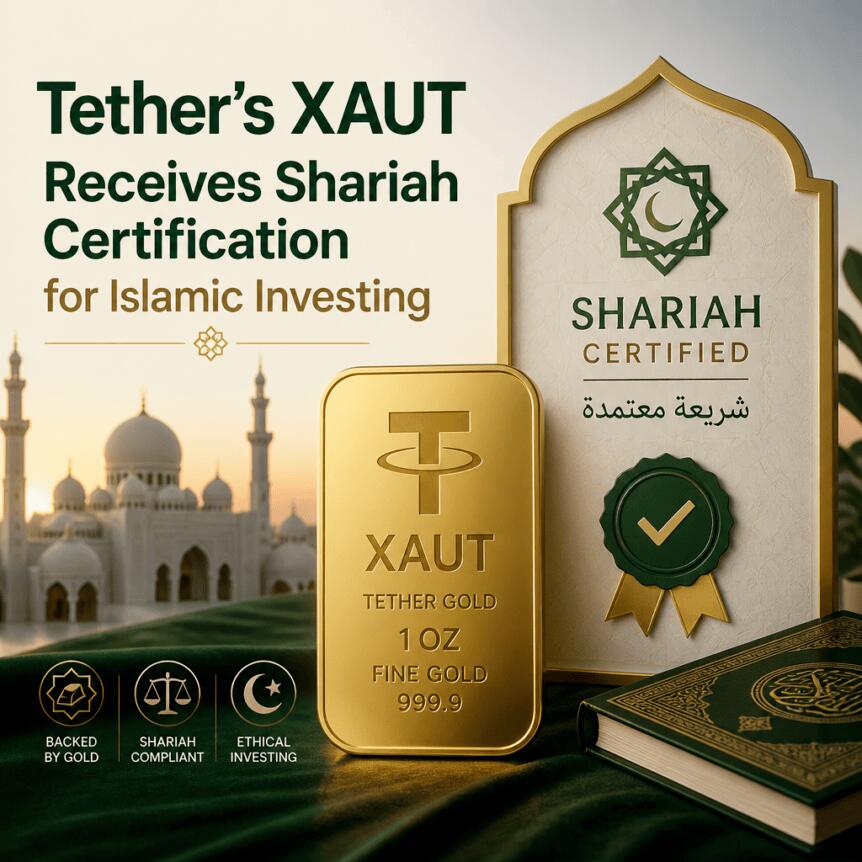
Tether’s gold-backed token XAUt has received Shariah certification from Amanah Advisors, a development that could support broader use of the product by Islamic financial institutions and investors seeking Shariah-compliant exposure to physical bullion.
The certification addresses whether the token’s structure is consistent with Islamic finance principles, including how the asset holds value and whether its design includes income-generation mechanisms that could raise concerns related to interest. According to Tether, Amanah Advisors concluded that XAUt complies with key Shariah requirements because it is fully backed by physical gold, does not use interest or leverage, and is supported by transparent reserves.
Tether says each XAUt token represents one troy ounce of physical gold held in Swiss vaults. The company has described XAUt as one of the largest tokenized gold products in the crypto market.
Certification and Islamic finance requirements
For investors and institutions operating under Islamic finance rules, the assessment of a tokenized commodity is not limited to whether it tracks a real-world asset. The structure of the product, its custody arrangements, and any embedded financial features can determine whether it is considered suitable under Shariah guidelines.
Islamic finance frameworks generally restrict practices viewed as involving interest, excessive uncertainty, or speculative dynamics. Those restrictions have been a recurring issue for the wider adoption of mainstream crypto products and tokenized offerings among compliance-focused Islamic finance participants.
By obtaining certification from Amanah Advisors, Tether has addressed one of the main due-diligence barriers for institutions and investors that require Shariah review. Tether said the certification provides a clearer route to distribute XAUt to Islamic banks, financial institutions, and individual investors in regions where Islamic finance is widely used, including the Gulf Cooperation Council, South Asia, and parts of Africa.
Tether also emphasized reserve transparency and physical custody as important elements of the compliance case. The company’s position is that every XAUt token corresponds to one troy ounce of gold stored in Swiss vaults and that the token is not structured with leverage or interest-bearing features.
Reserve reporting and onchain asset value
Tether’s latest reserve reporting, available through its gold reserve reports page, showed that XAUt was backed by more than 707,000 troy ounces of physical gold as of March 31. The company said those reserves represented a value of more than $3.3 billion.
Alongside reserve coverage, onchain data cited by RWA.xyz indicates that XAUt’s asset value has expanded over the past year. The source article said XAUt’s onchain asset value rose from about $700 million in July 2025 to roughly $2.5 billion, reflecting increased use of token infrastructure for gold exposure.
Tokenized commodities are often discussed in relation to liquidity and accessibility. In the case of XAUt, the Shariah certification adds another dimension by connecting physical backing with religious and contractual suitability standards. If institutions in Shariah-compliant finance systems are able to review the product with fewer structural objections, the certification may support additional distribution channels in jurisdictions where regulators and compliance departments assess whether income, risk, and custody features conform to established principles.
Wider development of Shariah-compliant crypto products
The question of whether cryptocurrencies and digital assets are compatible with Islamic finance has been debated for years. Scholars have differed on whether digital assets satisfy Shariah expectations, in part because of concerns about speculation and uncertainty. At the same time, projects designed to meet Islamic finance requirements have increasingly moved from theoretical discussion toward product development.
One example cited in the source dates to 2025, when Bahrain-based AlAbraaj Restaurants Group said it had adopted a Bitcoin treasury strategy and planned to develop Shariah-compliant financial instruments intended to broaden access to Bitcoin in the Islamic world.
The source also noted more recent developments involving stablecoin infrastructure. In April, Palm Azgar Finance expanded its Shariah-compliant PUSD stablecoin to ADI Chain, positioning the product in relation to the scale of the global Islamic finance market. According to the source, PUSD became the second stablecoin available on that network, allowing institutions to settle transactions using either a dollar-linked asset or a dirham-denominated token on the same infrastructure.
These developments point to attempts to structure digital asset exposure in ways that can satisfy institutional review processes. Tether’s XAUt certification fits within that broader pattern by addressing a specific requirement: an assessment from a recognized advisor on whether a tokenized gold product is consistent with Shariah guidelines.
Regional regulation and market access
Distribution of tokenized assets also depends on the regulatory environment for digital asset services. The source described Dubai as an increasingly prominent crypto hub and noted that the emirate’s Virtual Assets Regulatory Authority, or VARA, issued its 50th virtual asset service provider license earlier this month. The article said that figure places Dubai ahead of Hong Kong and Singapore in the number of licensed crypto firms, highlighting the pace of regulated market development in the region.
For tokenized assets such as XAUt, regulatory clarity can affect whether institutions are willing to adopt or distribute a product, particularly when token custody, settlement, and access must be aligned with local compliance requirements. Shariah certification addresses religious and contractual suitability, while licensing regimes and regulatory frameworks address operational and legal requirements.
Tether’s certification of XAUt by Amanah Advisors therefore comes at the intersection of tokenized real-world assets, Islamic finance compliance, and regional digital asset regulation. The next measurable developments would include whether Shariah-compliant financial institutions add XAUt to their offerings, whether Tether announces new distribution arrangements, and whether reserve reporting and onchain activity continue to show growth in the tokenized gold product.

