Tether and Shiga Plan Self-Custodial Wallets for Africa and GCC Markets
Key Takeaways
- •Tether and Shiga plan to launch self-custodial wallets aimed at users across Africa and the six-member Gulf Cooperation Council.
- •The wallets would give users direct control over their crypto assets instead of relying on a third-party platform to safeguard funds.
- •The project represents a move by Tether beyond stablecoin issuance into consumer-facing products for emerging markets.
- •No launch date, supported-asset list, fee structure, or country-level availability has been confirmed, leaving the announcement as a statement of intent rather than a product launch.
- •With self-custody, losing the recovery phrase results in permanent loss of access, as there is no password reset or customer support capable of recovering it.
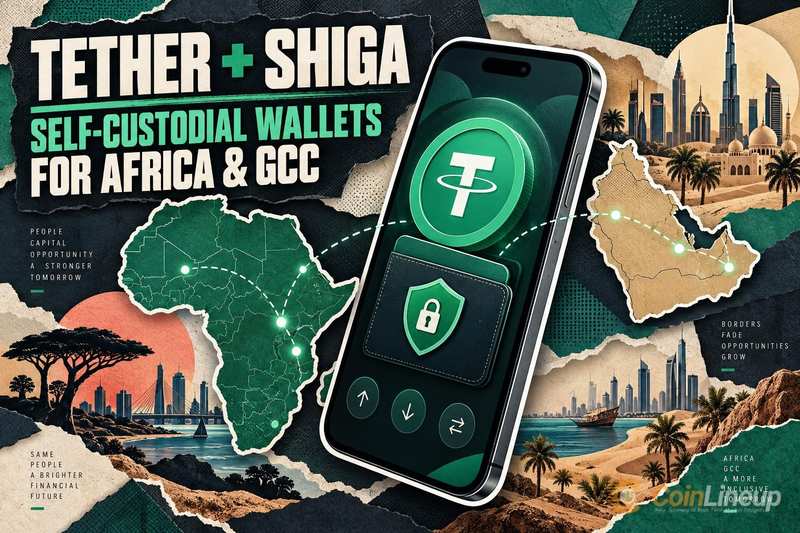
Tether, the issuer of the USDT stablecoin — a token designed to track the value of the US dollar — and Shiga are preparing to launch self-custodial wallets aimed at users across Africa and the Gulf Cooperation Council (GCC), a six-member bloc comprising Bahrain, Kuwait, Oman, Qatar, Saudi Arabia, and the United Arab Emirates. Under the plan, users in these markets would hold direct control over their crypto assets rather than relying on a third-party platform to safeguard funds on their behalf.
Scope of the Announcement
The initiative names two parties: Tether, the company behind USDT, and Shiga. Africa and the GCC are identified as the stated target markets. As of now, no launch date, list of supported assets, fee structure, or country-level availability has been confirmed.
The project would represent a new direction for Tether, which has historically expanded beyond stablecoin issuance. Stablecoin issuance and consumer wallets occupy different layers of crypto infrastructure: the former creates the asset, while the latter gives a way to store and transact it — a segment that puts a company directly in front of individual users rather than institutions and trading platforms. The company has previously collaborated with law enforcement on asset recovery, including working with the US Department of Justice to restrain more than $52 million in cryptocurrency. A consumer-facing wallet product targeting emerging markets would mark a departure from those earlier activities.
What Self-Custody Means for Users
In a self-custodial wallet, the user — not a company — controls access to the funds. The arrangement is often compared to holding cash in one's own pocket rather than depositing it at a bank: no third party can freeze, move, or lose the assets.
That control carries responsibility. Users of self-custodial wallets must securely back up their recovery phrase, the string of words that acts as the master key to the wallet. Losing that phrase means permanent loss of access; there is no password reset and no customer support line capable of recovering it.
Self-custody does not guarantee safety or suitability for every user. It shifts the burden of security from a platform to the individual. For people new to crypto, that trade-off deserves careful thought before committing funds.
Why Africa and the GCC Are Named
The announcement explicitly names Africa and the GCC as the intended rollout regions. Both areas span a large number of countries with varying regulations, currencies, and levels of digital infrastructure, meaning availability and usability could differ significantly by jurisdiction. More broadly, stablecoins such as USDT are commonly used for cross-border payments and for holding dollar-denominated value — functions often discussed in connection with markets where direct access to US dollar banking can be limited. Prospective users are advised to confirm country-level availability before relying on the product.
Open Questions
Several important details remain unresolved. It is not yet clear which cryptocurrencies or stablecoins the wallets will support, what fees will apply, how the product will handle local regulatory requirements in each country, or when the wallets will actually be available to download and use.
Any follow-up communication from Tether or Shiga — such as technical documentation, a supported-asset list, or country-by-country availability details — would be the clearest indication of whether and how the plan progresses toward launch.
Until those details are published, the announcement should be treated as a statement of intent rather than a product launch. Anyone considering using the wallets once released is encouraged to review supported assets, fee disclosures, and applicable local laws before moving funds.
Self-custodial products form one part of a broader conversation about how people in different regions access and control digital assets. The recent security incident at Bitget offers a practical reminder of why custody arrangements matter when it comes to securing crypto holdings.
Source: CoinLineup
Disclaimer: This article is for informational purposes only and does not constitute financial or investment advice. Cryptocurrency and digital asset markets carry significant risk. Readers should conduct their own research before making decisions.

