Tether Reports $1.5 Billion Q3 Operating Profit as Reserves Climb to $191 Billion
Key Takeaways
- •Tether's excess reserves grew roughly 94% over three months, reaching $7.95 billion at the end of September versus $4.11 billion in June, and rising to 4.34% of liabilities from 2.24%.
- •U.S. government debt remained the largest reserve component, with total Treasury bill exposure of $132.4 billion including indirect positions and direct holdings of $122.84 billion maturing in under 90 days on average.
- •Combined gold and Bitcoin holdings increased to $27.45 billion from $24.64 billion at the end of June, representing about 14.3% of total reserves, even as cash-equivalent holdings declined during the quarter.
- •Operating earnings relied on returns from reserve investments as USDT circulation held near $184 billion during the first nine months, with issued tokens accounting for nearly all of the company's $183.47 billion in token-related liabilities.
- •CEO Paolo Ardoino said the reserve strategy aims to sustain liquidity for redemptions during periods of market stress and outlined plans to fund infrastructure over time.
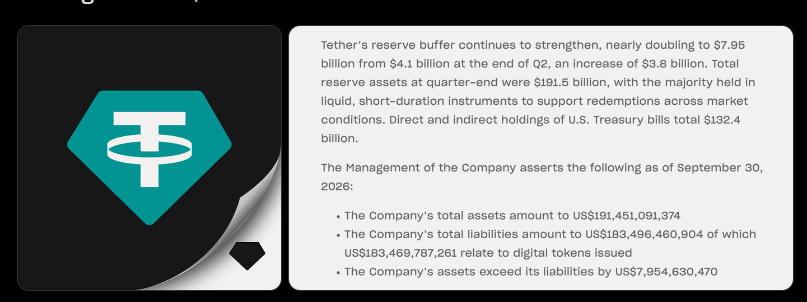
Tether, the issuer of the USDT stablecoin, posted $1.5 billion in net operating profit for the third quarter of 2026, lifting operating earnings for the first nine months of the year to $4.5 billion. The figures were disclosed in an announcement published on X on Oct. 30, which showed the company holding $191.45 billion in assets against $183.50 billion in liabilities as of Sept. 30.
Excess reserves — the cushion by which assets exceed obligations — reached $7.95 billion at the end of September, nearly double the level recorded three months earlier. Rising investment valuations contributed to the improvement, even as cash-equivalent holdings declined during the quarter. For stablecoin issuers, the measure is a core indicator of backing, since it captures the margin of additional assets held beyond the tokens in circulation.
Nine-Month Operating Profit Reaches $4.5 Billion
Income from U.S. Treasury bills and reverse repurchase agreements accounted for most of Tether's earnings. Collecting returns on reserves held against redeemable tokens is the core revenue structure of fiat-backed stablecoin issuance, one that ties earnings to the size of the reserve portfolio and the returns on the short-term instruments within it. The company continued to collect returns from its reserve investments while the amount of USDT in circulation changed little, with issuance holding around $184 billion during the first nine months of the year.
By Sept. 30, Tether had recorded $183.47 billion in liabilities linked to issued digital tokens. Those tokens made up nearly all of the company's liabilities and are classified as obligations that holders can redeem on demand under the relevant terms.
Excess Reserves Grow by Nearly $3.8 Billion in Three Months
Tether ended June with $187.75 billion in assets and $183.64 billion in liabilities, leaving a reserve cushion of $4.11 billion. Over the following three months, assets grew by roughly $3.7 billion while liabilities fell slightly, widening the gap to $7.95 billion — an increase of about 94%.
The larger buffer gave Tether approximately $104.34 in assets for every $100 in reported liabilities. Excess reserves stood at 4.34% of liabilities, up from 2.24% in June. These figures measure how far the company's assets exceed the value of its obligations at the reporting date. Because the cushion reflects both asset valuations and the volume of tokens outstanding, it can shift with market prices as well as with issuance or redemption activity.
CEO Paolo Ardoino said the reserve strategy is designed to maintain liquidity for redemptions during periods of market stress. He also discussed plans to fund infrastructure over time.
U.S. Treasury Bills Remain the Largest Reserve Holding
At the end of September, Tether directly held $122.84 billion in U.S. Treasury bills with a weighted average maturity of less than 90 days. Including indirect positions, total Treasury bill exposure reached $132.4 billion, making U.S. government debt the largest component of the reserves.
The portfolio also contained $9.52 billion in overnight reverse repurchase agreements and $7.18 billion in term reverse repos. Together with bank deposits and other short-term holdings, Tether's cash, cash equivalents and short-term deposits totaled $139.58 billion, representing about 72.9% of total assets held in reserve.
The company uses these shorter-term investments to generate income while keeping a large share of its reserves in instruments that mature relatively quickly. Because such instruments come due within weeks or months, they convert to cash on a near-term schedule — a property relevant to the redemption-liquidity objective Ardoino described. Treasury bills and reverse repos produced most of Tether's operating earnings during the first three quarters of 2026.
Gold and Bitcoin Holdings Reach $27.45 Billion
Tether's reserves included $19.08 billion in physical gold and $8.37 billion in Bitcoin, bringing the combined position to $27.45 billion, up from $24.64 billion at the end of June. The two assets accounted for roughly 14.3% of total reserves in September.
Both holdings were valued at market prices on Sept. 30, using $83,621.23 per Bitcoin. The gold holdings consist of physical bars that meet London Bullion Market Association standards — the benchmark specifications for bars traded in wholesale gold markets — meaning price swings in gold and Bitcoin can change the reported value of those reserves from one disclosure to the next. The quarter saw cash-equivalent holdings decline while the gold and Bitcoin positions rose, a compositional shift that subsequent disclosures will either continue or reverse.
Elsewhere on the balance sheet, Tether reported $14.18 billion in secured loans, $6 billion in other investments, $4.18 billion in public equities and $63.9 million in corporate bonds. The company said its secured loans carry collateral above the amount borrowed and include procedures to maintain that coverage.
Separately, Tether's equity reconciliation recorded a $1.66 billion financial result for the first nine months of 2026, a measure distinct from the $4.5 billion in net operating profit.

