Blumenthal urges Treasury and DOJ to investigate Tether over Iran-linked USDT
Key Takeaways
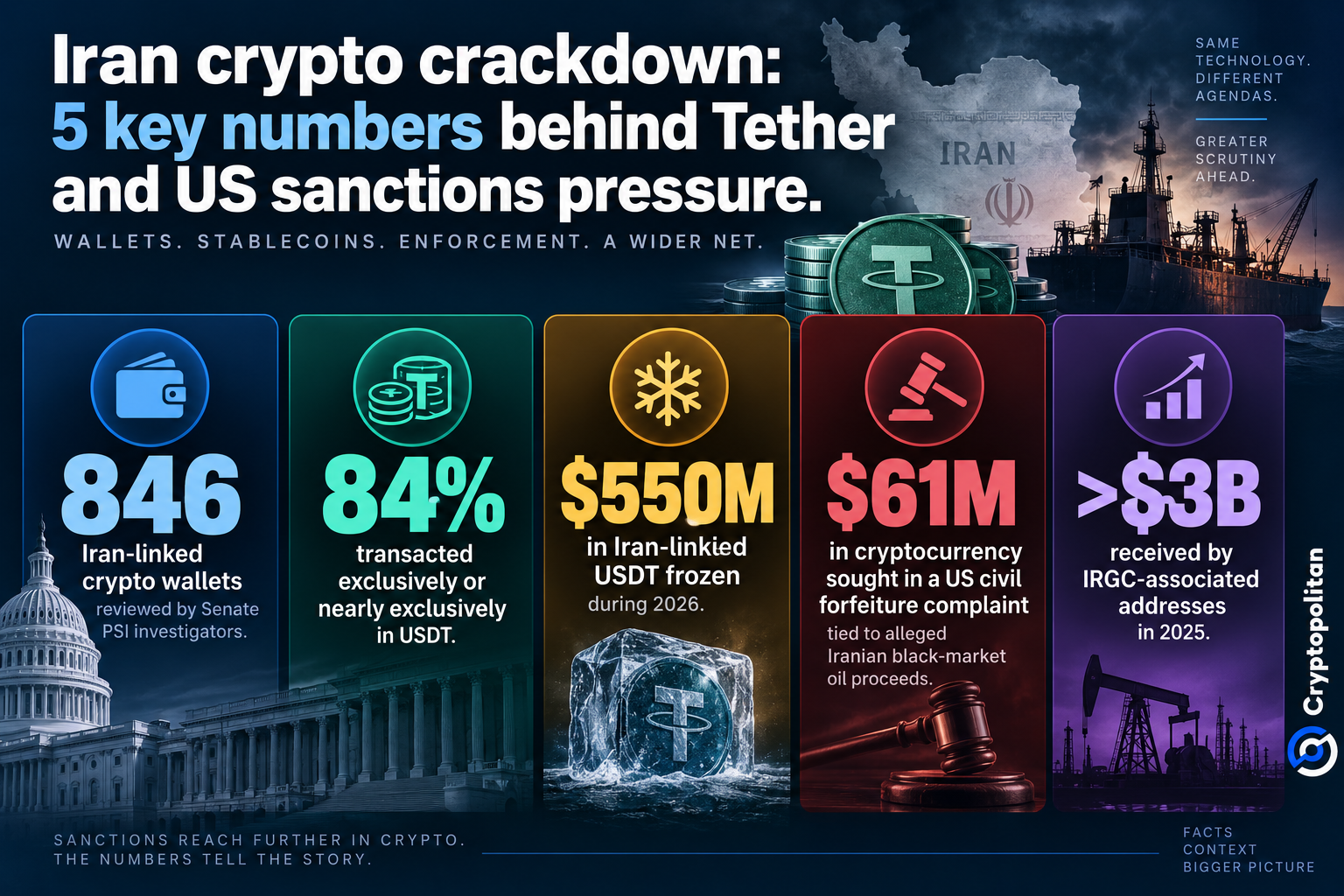
- •A September 28 Senate PSI report found that 84% of 846 Iran-linked wallet flagged or targeted for confiscation transacted exclusively or almost exclusively in USDT.
- •Blumenthal referred the findings to Treasury Secretary Scott Bessent and Attorney General Todd Blanche over possible sanctions and Bank Secrecy Act violations, also flagging Cantor Fitzgerald's roughly 5% stake in Tether and its connection to Commerce Secretary Howard Lutnick's family.
- •Tether said it froze approximately $550 million in USDT tied to Iran's central bank and other sanctioned entities in 2026 and reported cooperation with over 340 law enforcement agencies across 67 countries.
- •Treasury's Operation Economic Outcast, launched on August 24, targets nearly 60 Iran-linked entities and names digital assets as one of five sanctionable sectors, which TRM Labs says raises secondary sanctions risks for exchanges, OTC brokers, and payment service providers.
- •Federal prosecutors filed a September 14 civil forfeiture seeking roughly $61 million in cryptocurrency linked to Iranian black-market oil sales, with related wallets processing about $1.5 billion in allegedly illegal funds, while US authorities reportedly investigate whether Binance knowingly processed Iran-related trades.
US authorities are broadening their scrutiny of the crypto infrastructure Iran reportedly uses to move money, and Tether — the issuer of USDT, a dollar-pegged stablecoin — now sits at the center of the matter. On September 28, Senator Richard Blumenthal of the Senate Permanent Subcommittee on Investigations (PSI) called on the Treasury Department and the Department of Justice to examine Tether further. The company responded by stating that it has assisted in freezing almost $550 million in USDT associated with Iran in 2026.
For global crypto firms, the more pertinent fear is not a short-term market crash but a gathering rise in sanctions and compliance exposure surrounding the services they offer and the way funds flow through their platforms.
Two sides of the same wallet data
Blumenthal made the PSI results public in Washington, D.C., on September 28. Investigators examined 846 wallet accounts that had been flagged or targeted for confiscation because of their connections to Iran. According to the report, 84% of those wallets transacted exclusively or almost exclusively in USDT.
“Tether and its flagship token have become central to Iran’s shadow banking system” – Sen. Richard Blumenthal, September 28 PSI release
The findings, set out in Blumenthal’s PSI release, were referred to Treasury Secretary Scott Bessent and Attorney General Todd Blanche over possible violations of sanctions and the Bank Secrecy Act, the US anti-money-laundering law built around recordkeeping and reporting requirements. Blumenthal also noted Cantor Fitzgerald’s roughly 5% stake in Tether, as well as the firm’s connection to the family of Commerce Secretary Howard Lutnick.
In a September 28 statement, Tether said it was responsible for freezing approximately $550 million in USDT tied to Iran’s central bank and other sanctioned entities in 2026. Such freezes demonstrate the direct control a stablecoin issuer can exert over tokens in circulation.
“USD₮ is not a haven for sanctioned actors…” – CEO Paolo Ardoino, Tether’s September 28 statement
According to Tether, the company cooperates with more than 340 law enforcement agencies across 67 countries — a record it presents as evidence of its compliance efforts.
Enforcement is climbing the whole stack
The Tether dispute is only one part of a wider US campaign against Iran. On August 24, the Treasury Department launched Operation Economic Outcast, an action that targets nearly 60 Iran-linked entities and makes digital assets one of the five designated sectors subject to sanctions.\nAccording to TRM Labs, the move raises the likelihood of secondary sanctions being imposed on exchanges, OTC brokers, payment service providers, and other entities supporting Iran’s cryptocurrency industry — restrictions that can extend to firms outside the US if they continue serving designated actors.
On September 14, federal prosecutors filed a civil forfeiture case seeking roughly $61 million in cryptocurrencies believed to be linked to black-market oil sales from Iran. Prosecutors said a related group of wallets has processed about $1.5 billion in funds regarded as illegal. Chainalysis has also reported that IRGC-related wallets received more than $3 billion up to 2025.
Why exchanges are watching more than Tether
US authorities increasingly treat stablecoins, exchanges, wallets, and crypto-for-oil networks as parts of the same sanctions environment. Cryptopolitan recently reported that US authorities are investigating whether Binance knowingly processed Iran-related trades. Taken together, the PSI referral, the forfeiture filing, and the reported Binance probe show scrutiny now running across stablecoin issuance, trading platforms, and the wallet networks moving oil-linked funds.
For global crypto firms, the pressure is likely to surface in stricter checks on who they do business with and greater exposure to secondary sanctions. What happens next depends on whether Treasury or the Justice Department follows up on Blumenthal’s referral, and whether that leads crypto companies to tighten how they screen for Iran-linked activity.

